
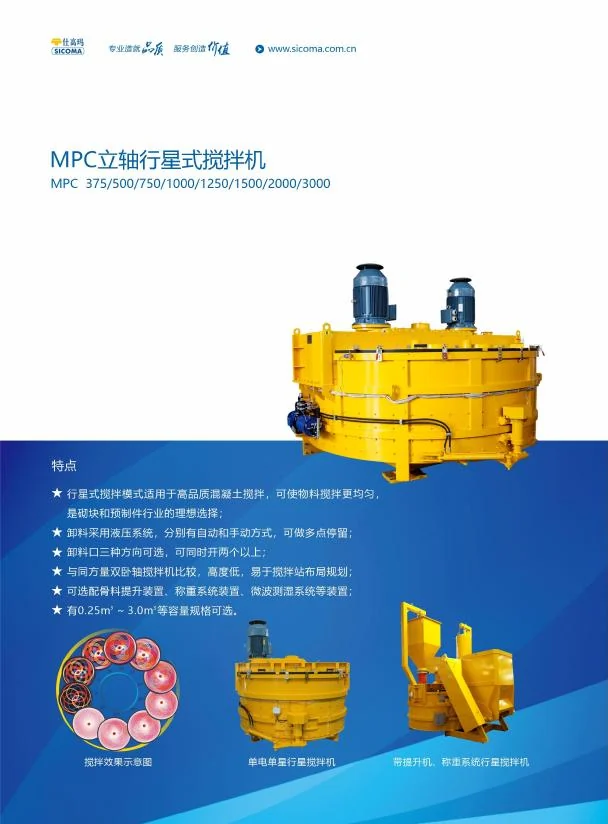
A planetary concrete mixer selection starts with the concrete that must leave the mixer, not the largest number in a model table. Define compacted output per batch, recipe volume before mixing, aggregate size, required uniformity, discharge method and the time available for a complete cycle. Then test the candidate mixer with the plant’s actual materials.
The MPC planetary concrete mixer range provides published models for this comparison. The product page is a selection starting point. Final suitability still depends on the recipe, duty and interfaces stated by the buyer.
Start with compacted output, not a volume label
Three values are often confused during quotations: total vessel volume, charging volume and compacted concrete output. They do not describe the same condition. Dry aggregate and powders occupy a different bulk volume from the finished concrete, and the mixer needs working space for material movement.
Write the requirement as a material balance. For each recipe, list the mass and bulk density of cementitious materials, aggregate, water, admixtures, pigments and fibers. State the compacted concrete required at discharge. Ask the supplier which published value each model-table column represents.
Do not select a mixer by dividing a nominal plant target by an assumed batch volume. The real hourly output also includes dosing, charging, dry mixing where required, liquid addition, wet mixing, quality holds, discharge and the time needed for the receiving equipment to clear.
Check the full production cycle
A simple planning equation is:
hourly output = compacted output per accepted batch × accepted batches per hour
The phrase “accepted batch” matters. A theoretical 40 cycles per hour has little value if material sequencing, a slow discharge gate or quality sampling limits production to 30. Record each stage separately during trials.
| Cycle stage | Evidence to request | Common constraint |
|---|---|---|
| Dosing | Actual scale records and moisture correction | Aggregate moisture variation |
| Charging | Time and order for every constituent | Restricted inlet or overlapping feeds |
| Mixing | Defined start point and recipe-specific time | Fibers, pigments or low water content |
| Discharge | Gate-open time and residual material | Small outlet or sticky mix |
| Reset | Gate proof, receiving clearance and next-batch permissive | Downstream congestion |
The FHWA field-control brief notes that material introduction order should remain consistent with the sequence used in trial batching. It also states that mixing time depends on the specification, equipment, constituents and temperature. This is why a single universal cycle time should not be copied into a purchase specification.
Define uniformity before comparing mixer types
Uniformity is an acceptance result, not a mixer-name claim. The American Concrete Institute’s guidance on mixing adequacy describes sampling different portions of the discharge and comparing properties such as air content and slump. It points to ASTM C94 criteria and notes that large differences can indicate poor loading sequence or insufficient mixing.
ASTM C94/C94M covers production and testing requirements for ready-mixed concrete, including mixer performance and uniformity. A project should use the edition and acceptance criteria named in its contract. Do not claim compliance merely because a mixer can produce concrete.
For precast work, prepare a trial plan around the difficult recipes, not only the easiest mix. A useful matrix can include the smallest and largest intended batch, the lowest water content, the highest pigment or fine-powder content, fiber-reinforced material where applicable, and the largest permitted aggregate.
Verify loading sequence and moisture control
Mixer selection cannot compensate for unstable batching. The FHWA’s sustainable pavement systems guidance identifies batch size, loading sequence and mixing time as major production factors. It also warns against loading mixers above rated mixing capacity.
During a trial, record the actual sequence rather than a shorthand such as “all dry materials first.” Note when each scale finishes, whether feeds overlap, when admixtures enter and when mixing time starts. If aggregate moisture changes, apply the plant’s approved correction before interpreting a change in mixer performance.
A planetary mixer may be attractive where a plant needs intensive material circulation in a compact vessel, but the purchase decision still rests on measured results. If the application is better served by a horizontal-shaft machine or requires a different discharge arrangement, compare the standard twin-shaft mixer range using the same recipe and acceptance plan.
Inspect discharge, residue and changeover
Precast production often changes colors, recipes or component types during a shift. Ask where material can remain after discharge and how operators can inspect those locations under safe isolation. Record residue after a defined number of batches. A fast gate opening does not prove that the vessel empties cleanly.
The receiving hopper, skip, belt or mold-filling system must accept the peak discharge rate. Confirm the open height, connection position, flexible transition and load path. If discharge is throttled to protect downstream equipment, include that time in the cycle calculation.
Cleaning access should be reviewed as a task. Identify the isolation boundary, access openings, wash-water route, tools, lighting and how the gate is secured. Avoid a specification that simply requests “easy cleaning” without defining the recipe-change requirement or inspection method.
Match the mixer to the plant interfaces
Prepare one interface sheet before requesting a final quotation:
- required compacted output and recipe envelope;
- maximum aggregate size and bulk densities;
- constituent sequence and dosing equipment;
- target cycles per hour with stage times;
- discharge elevation, opening and receiving capacity;
- electrical supply, control voltage and communication signals;
- dust extraction and wash-water arrangements;
- access, maintenance space and lifting provisions;
- required trial recipes and acceptance measurements.
The wider VOGO product range can help identify related conveying, valve, dust-control and drive interfaces. Each component should still be selected from its own duty data rather than assumed from the mixer model.
Run a recipe-based acceptance trial
Use a written test sheet for each recipe. Record material tickets, moisture corrections, batch masses, loading sequence, start and stop times, motor current or power trend where available, discharge time, visible residue and all fresh-concrete results. Sample at predefined discharge portions rather than where the result looks most favorable.
Repeat the trial. One acceptable batch cannot show repeatability. Compare the samples against the project specification and the agreed test method. The FHWA guidance also states that worn, damaged or coated blades affect production, so record the condition and clearances that existed during acceptance.
Do not infer long-term wear life from a short factory trial. Use the trial to confirm process behavior, controls and measurable uniformity. Put wear materials, inspection intervals and replacement criteria in the operating and spare-parts documentation.
Conclusion
A planetary concrete mixer selection should connect compacted batch output to the complete plant cycle and then prove uniformity with representative recipes. Compare models only after defining material sequence, moisture correction, discharge, cleaning and interfaces. The most useful quotation is the one that turns those inputs into a testable selection rather than relying on nominal volume alone.