
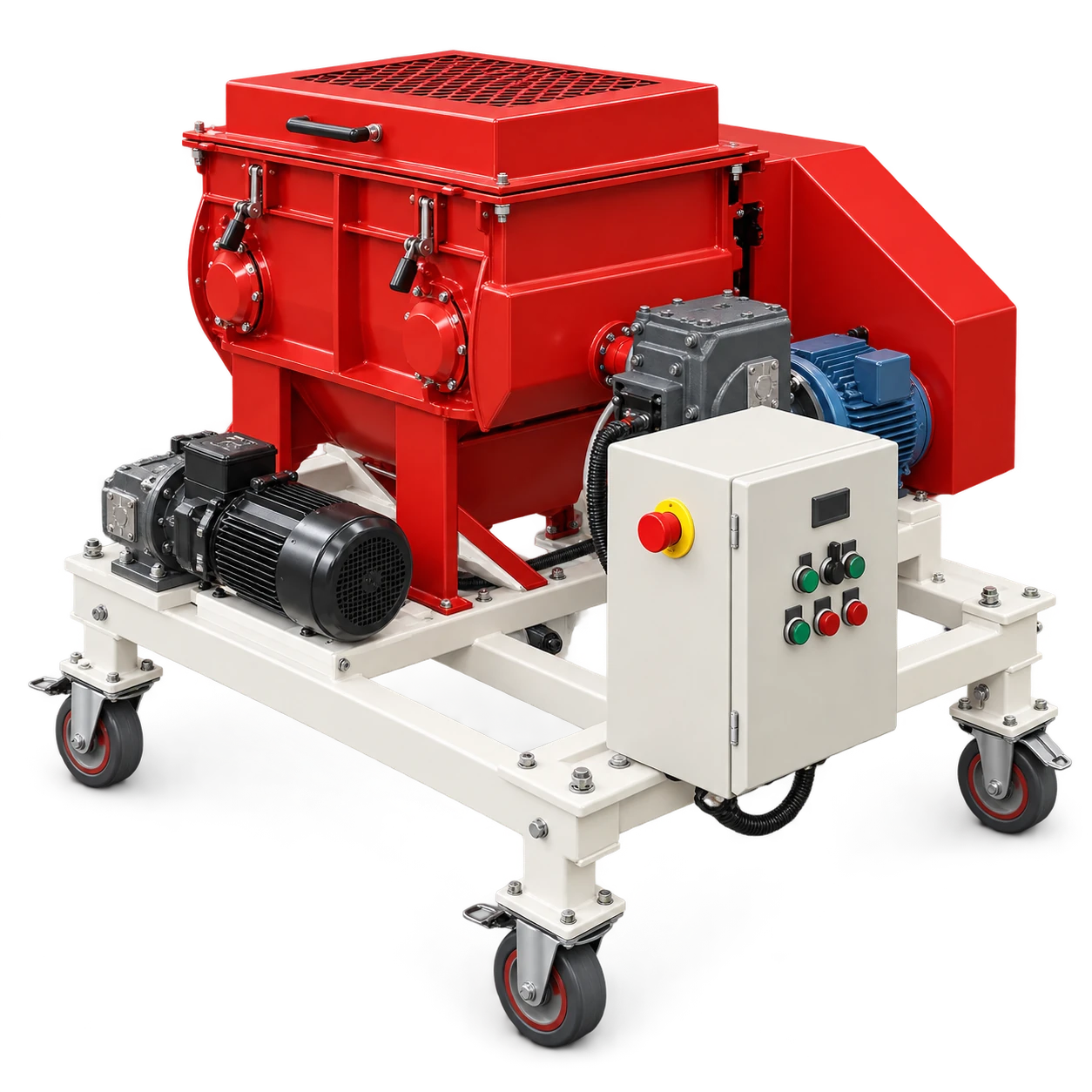
Laboratory concrete mixer repeatability is demonstrated by repeated batches made with the same controlled materials, quantities, sequence, timing, discharge and test method. A different result does not automatically indicate a mixer problem: aggregate moisture, delayed testing, inconsistent scraping or a changed batch volume can create the same symptom.
The MTO twin-shaft laboratory mixer is one equipment option for concrete testing and teaching. Select it from the required compacted batch volume, batch frequency, laboratory space and discharge arrangement, then write the trial method around the actual machine. Its product identity does not replace a project-specific test protocol.
Define what repeatability means before testing
Separate three questions that are often combined:
| Question | Comparison | Typical evidence |
|---|---|---|
| Within-batch uniformity | Samples from different portions of one discharge | Slump, air, density, temperature or constituent distribution |
| Between-batch repeatability | Successive batches made to the same procedure | Range, standard deviation or control chart for selected results |
| Scale-up relevance | Laboratory result versus production process | Representative plant trial and agreed production acceptance tests |
The American Concrete Institute explains that mixing adequacy can be investigated by testing samples from different points in the discharge. Its technical answer on mixer uniformity notes that large differences in slump or air content can indicate an unsuitable loading sequence or insufficient mixing. That is a within-batch check; repeatability also asks whether the same controlled process produces comparable batches over time.
Choose the response variables before starting. Fresh density is useful because it can reveal changes in the physical makeup of the mixture. Slump, air content and temperature may also be appropriate. Strength results add curing, specimen preparation and test-machine variation, so do not use strength alone to diagnose the mixer.
Fix the batch-size window
A laboratory mixer should be tested at the intended working volume, not merely at the maximum amount that fits in the vessel. Too small a batch may not engage the mixing tools in the same way as the normal test batch. Too large a batch can restrict material circulation, increase spillage and invalidate the comparison.
Record the following for every run:
- total batched mass and calculated fresh volume;
- compacted or fresh-concrete volume definition used by the laboratory;
- vessel and blade condition before charging;
- minimum and maximum intended trial-batch size;
- amount retained for tests, specimens and expected handling loss.
Do not infer a permissible fill level from the bowl’s geometric volume. Use the equipment manufacturer’s rated working basis and verify the recipe during commissioning. The VOGO catalog identifies the MTO range by compacted capacity; final selection still needs confirmation against the actual recipe, test quantity and handling method.
Control moisture before blaming the mixer
Aggregate moisture changes both the effective water content and the mass of aggregate introduced. The FHWA’s field-control guidance identifies moisture testing as a core control and describes unit weight as a useful indicator of mixture consistency. The same discipline is needed in a laboratory comparison.
For each aggregate fraction, document:
- sample time and test method;
- measured moisture and absorption basis;
- corrected wet aggregate mass;
- water carried by the aggregate;
- added batch water after correction.
Keep the correction worksheet with the batch record. If the first batch uses dry laboratory aggregate and the next uses material that has been exposed to humid air, the nominal recipe may be unchanged while the effective water content is not.
Condition cementitious materials and admixtures consistently as well. Record material temperature, admixture concentration and the elapsed time between weighing and charging where these can affect the trial.
Standardize charging and the start of mixing time
“Mix for three minutes” is incomplete unless the start point is defined. It could mean motor start, completion of aggregate charging, addition of water or completion of all constituents. Pick one definition that matches the governing procedure and use it for every batch.
ASTM C192/C192M provides standardized requirements for preparing materials, mixing concrete, and making and curing laboratory specimens. Use the edition named by the contract or laboratory quality system. Do not claim ASTM compliance from the presence of a mixer alone; the whole practice and referenced tests must be followed.
A usable sequence sheet includes:
| Stage | Record |
|---|---|
| Precheck | Cleanliness, blade condition, gate position and material temperatures |
| Dry charge | Constituent order and time each addition ends |
| Liquid charge | Water and admixture order, duration and any hold point |
| Mixing | Exact start point, powered mixing time and any prescribed rest |
| Scrape-down | Whether permitted, isolation method and duration |
| Final mixing | Restart time and duration |
| Discharge | Gate or vessel method, start and completion times |
| Testing | Sample location and elapsed time to each test |
If a manual scrape-down is part of the method, it must be performed only under the laboratory’s safe isolation procedure. A stop button is not proof of hazardous-energy control. OSHA’s lockout/tagout overview distinguishes energy control for servicing and maintenance from ordinary operating controls.
Keep discharge and sampling consistent
The first and last portions of a discharge may not have identical composition. Define whether the sample is a composite, a middle portion, or multiple portions used specifically to assess uniformity. Use the same receiving container, discharge opening and handling time.
Do not leave the choice to whoever is operating the test. Mark sample containers in advance and record the discharge portion, sample mass, any remixing applied to the sample, time from water contact to test, and ambient conditions where required.
For a laboratory comparison, perform tests in a fixed order. Changing the order can change elapsed time and therefore the result. If there is not enough concrete for all tests and specimens, increase the planned batch within the rated working range rather than taking undersized or unrepresentative samples.
Use a repeatability calculation without inventing a limit
Consider a worked example using fresh density. Three controlled trial batches return 2,390, 2,405 and 2,398 kg/m³.
mean = (2390 + 2405 + 2398) ÷ 3 = 2397.7 kg/m³
range = maximum − minimum = 2405 − 2390 = 15 kg/m³
relative range = 15 ÷ 2397.7 × 100 = 0.63%
These figures are an example, not an acceptance limit. The project must define the test method, instrument resolution, sample plan and allowable variation. Investigate an outlier against the batch record before changing the mixer: moisture correction, weighing, charging time, sample location and test delay are all plausible causes.
For longer studies, plot each result in time order. A trend can be more informative than a pass/fail line. It may reveal blade wear, residue accumulation, scale drift or a gradual change in material conditioning.
Verify the mixer without claiming production equivalence
Laboratory equipment is valuable because it makes controlled, economical trials possible. It cannot reproduce every production condition. Production mixers may have different tool speed, energy input, feed overlap, aggregate drop height, discharge geometry and temperature rise.
When a laboratory formulation moves toward production:
- freeze the laboratory recipe and test method;
- translate masses to the production moisture and batching system;
- document the production charging sequence and actual overlap;
- run a representative plant trial;
- sample defined discharge portions;
- compare results with the project specification;
- record cycle time, discharge residue and operating observations.
The planetary mixer selection guide explains how recipe trials, discharge and the complete plant cycle belong in a production mixer decision. A laboratory result should be one input to that process, not a guarantee of scale-up.
Commission with a controlled acceptance matrix
Use at least one normal recipe and one demanding recipe that the laboratory expects to handle. Depending on the work, the demanding case may be the smallest batch, lowest water content, highest fine-powder content or largest permitted aggregate. Do not choose a condition outside the mixer’s published duty simply to create a stress test.
For each case, verify material and moisture records, scale and instrument status, charging and timing, motor and gate functions, abnormal movement or residue, predefined sampling points, repeated-result acceptance, and safe cleaning access.
If results vary, change one factor at a time. Simultaneously changing mixing time, batch volume and charging order may improve a result but will not identify the cause.
Conclusion
Laboratory concrete mixer repeatability comes from a controlled system, not the mixer name. Fix moisture correction, batch volume, loading sequence, time definitions, discharge, sampling and test timing; then compare repeated results against a predefined rule. Use a production-representative trial before treating laboratory evidence as proof of full-scale mixer performance.
For a quotation, send the test material, target compacted batch volume, expected batches per day, power supply, discharge preference and required test protocol.