
Introduction
When handling cement, fly ash, silica fume, and other fine mineral powders, selecting the right screw conveyor ensures system reliability and environmental compliance. Engineers and plant managers must balance dust containment and efficiency with maintenance access in bulk material transfer systems. While pneumatic conveying is often used for long distances, mechanical screw conveyors remain the standard for short-distance, precise volumetric feeding and horizontal or inclined transfers. The two main configurations for these applications are the tubular screw conveyor and the U-trough screw conveyor. Both use a rotating helical screw to move dry bulk materials, but their structural differences make them suited to different process conditions. This guide compares tubular and U-trough designs. It evaluates sealing capabilities and maximum inclination angles, along with maintenance access and wear management, to help specify the correct conveyor for cement and powder handling systems.
Structural differences and sealing capabilities
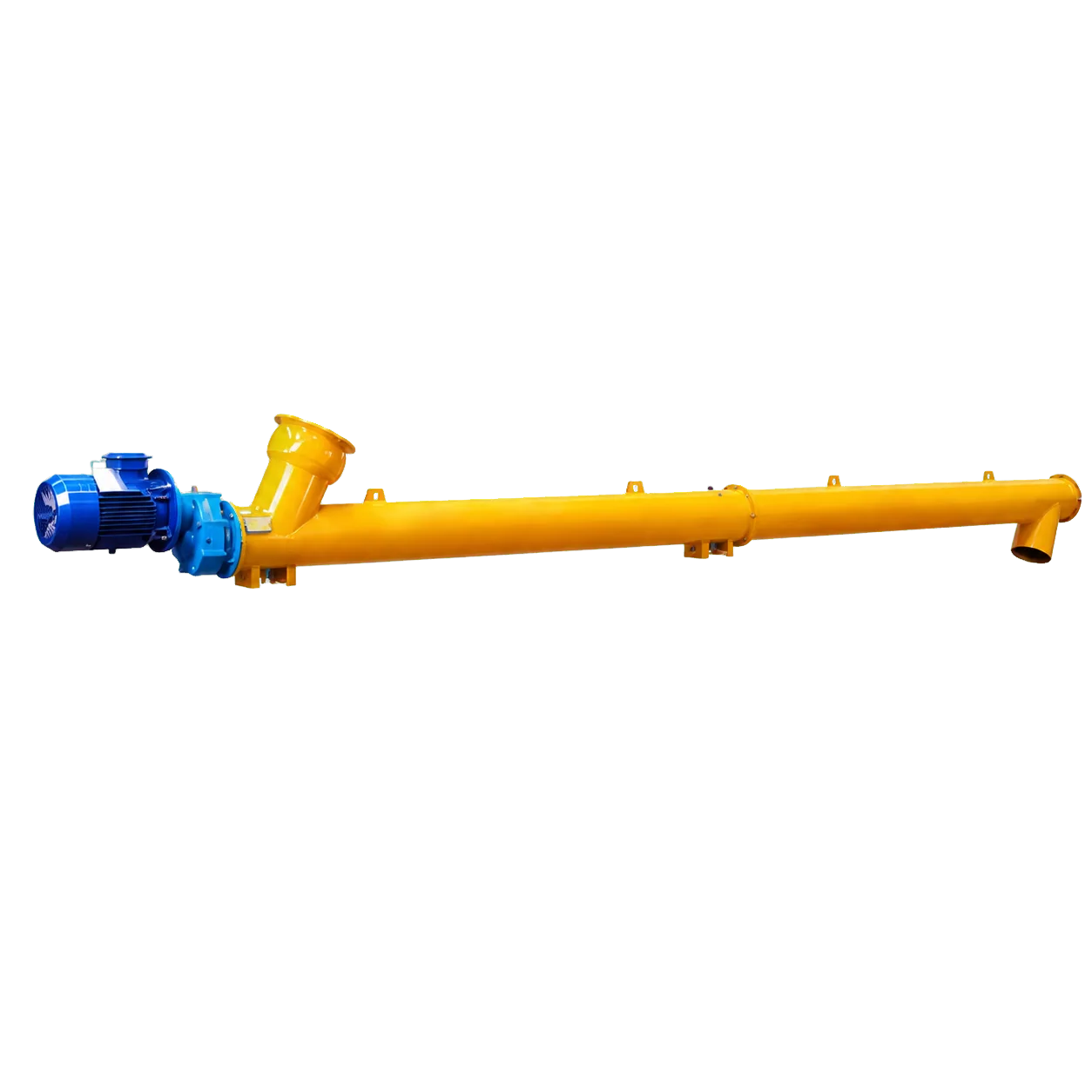
The main engineering difference between tubular and U-trough screw conveyors is the casing design, which controls dust containment. A tubular screw conveyor has a fully enclosed, seamless cylindrical tube. The screw rotates inside this rigid pipe, and the only openings are the flanged, gasketed inlet and outlet connections. This continuous enclosure creates a dust-tight conveying path that limits external dust exposure and prevents material contamination. Tubular conveyors are therefore specified for highly aerated or ultra-fine powders like silica fume, where dust emission is a major health and safety risk. To maintain this integrity, tubular designs often incorporate purgeable shaft end seals or PTFE packing glands, which introduce a slight positive air pressure to prevent fine dust from migrating into the bearing assemblies.
A U-trough screw conveyor has a U-shaped steel trough covered by a flat, removable plate. The cover provides basic containment, but the design includes longitudinal joints, inspection openings, and gaps at the cover flanges. These leak paths mean U-trough conveyors require careful gasketing and regular maintenance to prevent dust escape. For applications where dust-tight integrity is not the main constraint, or where the material is less prone to aerosolisation, the U-trough design is a practical choice. The trough itself is typically fabricated from thicker carbon steel, often between 4 mm and 6 mm, to withstand the abrasive nature of cementitious materials without premature structural degradation.
Inclination angles and material fallback
The conveyor casing design determines the maximum installation angle. U-trough conveyors are limited to near-horizontal or low-incline installations. At inclination angles above 15 to 20 degrees, the open trough allows material to slide back under gravity. This fallback reduces conveying capacity and increases drive power demand. U-trough designs are usually restricted to horizontal transfers between adjacent process units, such as moving collected dust from a baghouse hopper to a disposal bin.
Tubular screw conveyors do not have these inclination limits. The cylindrical casing contains the material bed and prevents fallback at any angle. These conveyors can operate at steep inclinations and, in some configurations, vertically. This design is the standard choice for multi-floor plant layouts that require elevating cement or fly ash between levels, or where space constraints require a steep transfer angle. For extremely steep applications approaching 45 degrees or vertical, engineers can specify reduced-pitch flights or add pipe discs to the screw shaft. These discs act as physical barriers, actively pushing the material upwards and completely negating the effects of the material’s natural angle of repose, which for dry cement typically sits between 30 and 35 degrees.
Maintenance access and operational considerations
Tubular conveyors provide better sealing and steeper operating angles, but U-trough conveyors are easier to maintain. The removable upper cover of a U-trough design allows direct visual inspection of the screw flights, trough liner, and material flow. If the material compacts easily or the process requires frequent internal cleaning to prevent cross-contamination between batches, operators can unbolt the cover to access the interior. This full-length access is particularly valuable when handling materials that may absorb ambient moisture and set like concrete inside the trough if left stagnant.
Tubular screw conveyors require different maintenance. Because the casing is a continuous tube, internal inspection requires hatches or dismantling flanged connections. In standard dry powder applications such as cement transfer, the enclosed environment reduces internal buildup, decreasing the need for internal access. Both designs use serviceable components, including selectable hanger bearings and end bearings. In tubular conveyors, hanger bearings support long shaft sections and can be serviced without dismantling the entire conveyor. Modern hanger bearings often utilise self-lubricating composite materials, such as Orkot or hardened steel with grease nipples, ensuring that the critical shaft support points remain operational even in high-dust environments where traditional lubrication might attract abrasive particles.
Wear management and abrasion considerations
Cement, fly ash, and silica fume are highly abrasive, particularly if trace moisture is introduced into the system. Managing this wear is critical for extending the operational lifecycle of the conveyor. In U-trough conveyors, the most effective wear management strategy is maintaining an autogenous wear layer. By ensuring the trough is never completely emptied during standard operations, a protective layer of material rests against the steel base, absorbing the abrasive friction from the moving flights. When complete emptying is required, U-troughs are often fitted with interchangeable abrasion-resistant (AR) steel liners or polyurethane wear strips that can be replaced independently of the main trough structure.
For tubular conveyors, replacing internal liners is significantly more complex due to the enclosed design. Therefore, wear management relies heavily on the screw flight itself. Engineers frequently specify hardfaced screw flights, where a wear-resistant alloy is welded onto the leading edge of the flighting. This hardfacing dramatically increases resistance to abrasive wear without making the entire flight brittle. Additionally, controlling the rotational speed of the screw is vital; running the conveyor at the minimum required RPM reduces the sliding friction between the powder and the steel components, substantially lowering the overall wear rate.
Application matching: when to specify which design
The choice between a tubular and U-trough screw conveyor depends on material characteristics and layout requirements.
Specify a tubular screw conveyor when:
- The material is a fine, highly aerated powder (such as silica fume, fly ash, or microfine cement) that requires strict dust containment.
- The layout requires horizontal, highly inclined, or vertical conveying paths.
- Space is limited, and the compact, rigid tubular body simplifies routing.
- The application is concrete batching, dry-mix mortar production, or an asphalt plant, which requires enclosed transport of cementitious powders.
- The conveyor is loading the top of a silo, where height and dust emission are primary concerns.
Specify a U-trough screw conveyor when:
- The conveying path is horizontal or at a low inclination (below 15 degrees).
- The material is sticky or cohesive, or the system requires frequent manual clearing and internal inspection.
- Maintenance access is critical, and operators can manage occasional dust weeping from cover joints with proper extraction or gasketing.
- The system discharges collected dust from bag filters and requires regular trough cleaning.
- The conveyor is situated at the bottom of a silo for extraction, where easy access is needed to clear potential ratholing or bridging of the material.
Conclusion
Choosing the correct material handling equipment improves facility efficiency and reliability. The choice between a tubular and a U-trough screw conveyor ultimately depends on balancing dust containment against maintenance access. Tubular conveyors are fully enclosed and dust-tight, handling steep inclinations and fine powders without material fallback, making them ideal for demanding environmental and spatial constraints. U-trough conveyors allow easier access for inspection and cleaning in horizontal, low-dust applications, offering lower initial capital expenditure but potentially higher maintenance operational costs. Evaluating bulk density, moisture content, abrasiveness, and system inclination optimises performance and extends equipment life.
For projects requiring enclosed powder conveying, VOGO Machine supplies cement screw conveyors. Tubular screw conveyors are available in selection diameters from Ø89 mm to Ø407 mm. Lengths range from below 1 metre to 15 metres, with catalog reference capacities from 1.3 to 170 t/h. Each unit is project-specific. Drives, bearings, and connections are configured to match material and layout requirements, typically using standard 3-phase, 380 V, 50 Hz, 4-pole motors running at 1,450 rpm. Published capacity ranges are selection references. Actual performance must be confirmed for each project based on bulk density, moisture, and inclination. VOGO Machine manufactures customisable cement screw conveyors for these industrial applications. For technical guidance, selection parameters, and the product datasheet, visit the VOGO Machine cement screw conveyor product page at https://vogomachine.com/cement-screw-conveyor/en/.