
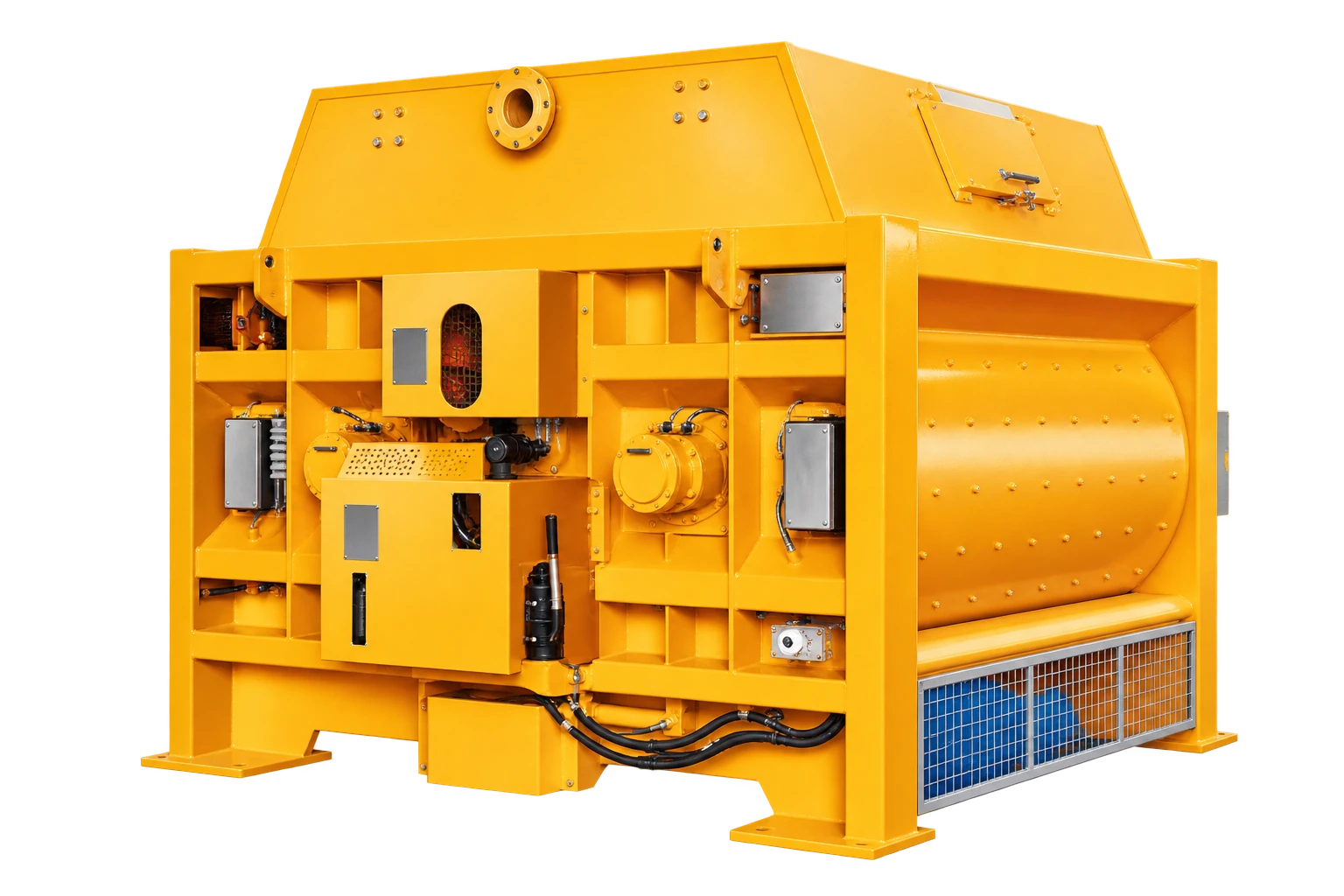
A roller-compacted concrete mixer selection should be based on the material envelope, accepted batch size, complete cycle time and evidence from representative trials. RCC is a stiff, zero-slump concrete; a large nominal mixer volume does not prove that the plant can wet, blend and discharge the project mixture uniformly at the required rate.
The MAW hydropower twin-shaft concrete mixer is a candidate for hydropower and dam-concrete production. Its catalog identifies a 1.5–10 m³ class and asks buyers to select by concrete class, batch output and aggregate size. Final power, working volume and cycle performance remain project-specific and require supplier confirmation.
Define the RCC production duty before comparing mixers
Start with the placed-concrete requirement, not the mixer model. Record the RCC class or project specification, maximum and combined aggregate grading, moisture range, cementitious system, admixtures, target consistency, placing method and temperature controls. Also state the minimum sustained production rate and the duration for which it must be maintained.
The U.S. Army Corps of Engineers’ RCC engineering manual and the U.S. Bureau of Reclamation’s RCC design standard treat mixture proportioning, trial work, production and placement as connected decisions. That system boundary matters: an adequate mixer cannot compensate for inaccurate moisture correction, interrupted transport, poor spreading or delayed compaction.
Issue each bidder the same duty sheet:
| Input | Procurement value | Why it changes selection |
|---|---|---|
| Aggregate grading and maximum size | Project-approved limits | Affects charging, mixing resistance, clearance and discharge |
| Batch volume | Accepted compacted or fresh volume basis | Sets working volume and number of cycles |
| Target consistency and density method | Named project test | Defines repeatable trial evidence |
| Mixing sequence | Dry, water/admixture and final wet stages | Changes total cycle and wetting behavior |
| Required effective output | m³/h at plant discharge | Prevents selection from nominal volume alone |
| Downstream arrangement | Conveyor, truck, hopper and placer | Determines surge, discharge and continuity requirements |
| Temperature and exposure | Actual seasonal envelope | Affects water, cooling, wear and maintenance planning |
Do not convert a catalog range directly into guaranteed output. Ask the supplier to state the assumed working volume, bulk density, aggregate envelope, sequence, cycle definition and availability behind every production claim.
Choose mixer type from material and process evidence
The Cement Association guide on roller-compacted concrete production notes that horizontal-shaft single- and dual-shaft mixers provide intense, fast mixing and are commonly preferred for large RCC projects. It also explains that drum systems may require smaller batches or longer mixing, while truck mixers can struggle with uniform mixing and discharge of stiff RCC.
That is a screening principle, not a universal verdict. Compare alternatives against the actual project:
- A twin-shaft batch mixer can support short, controlled cycles and rapid discharge, but shaft seals, liners, arms and discharge gates need planned inspection access.
- A single-shaft or pan arrangement may suit a particular plant layout or smaller duty if trials prove uniformity and output.
- Continuous mixing can serve continuous placement, but feed accuracy, residence-time distribution, startup material and process verification must be addressed explicitly.
- A drum or truck mixer should not be accepted merely because it handles conventional concrete; the stiff RCC mixture must be demonstrated at production scale.
Mixer enclosure also needs precise language. An enclosed mixer can limit spillage and exposure, but it is not automatically airtight, dust-tight, explosion protected or pressure rated.
Calculate effective output from the complete cycle
For a batch plant, use:
Theoretical output = accepted batch volume × 3,600 / complete cycle time in seconds
Then apply a demonstrated availability factor that covers routine pauses, minor adjustments and normal cleaning rather than an optimistic nameplate percentage.
Calculation example — assumed values only: a project needs 180 m³/h delivered continuously to the placement system. If transport and placement are available 80% of the scheduled time, the mixing plant must be able to recover at approximately:
180 / 0.80 = 225 m³/h
Suppose a proposed mixer produces an accepted 6 m³ batch on a measured 90-second complete cycle. Its theoretical output is:
6 × 3,600 / 90 = 240 m³/h
At an assumed 80% mixer availability, effective output is only:
240 × 0.80 = 192 m³/h
That does not meet the 225 m³/h recovery requirement. The engineering response may be a shorter proven cycle, a larger accepted batch, parallel production, more downstream buffering or a lower placement target. It is not reasonable to erase charging, discharge or routine delay time from the calculation. None of these example figures are VOGO ratings.
Build a representative full-scale RCC mixer trial
Laboratory work establishes a controlled mixture basis. The laboratory-to-production scale-up guide explains why bowl geometry, energy input, charging path and discharge cannot be scaled by volume alone. The production mixer trial must therefore use representative aggregates, moisture, cementitious materials, admixtures and batch sequence.
Plan enough consecutive batches to distinguish a stable process from a single good result. For each batch, record:
- actual masses, aggregate moisture corrections and water additions;
- time stamps for charging, dry mixing, liquid addition, final mixing and discharge;
- motor current or other available load evidence without treating it as a universal acceptance limit;
- RCC consistency and density by the project method;
- sample position and timing within discharge;
- mixture temperature and ambient conditions;
- visible dry pockets, balls, segregation, buildup, leakage or incomplete discharge;
- downstream conveyor or hopper behavior and any interruption.
ASTM’s C1170/C1170M test method covers consistency and density of stiff to extremely dry RCC using a vibrating table and surcharge. Its published scope also flags aggregate-size conditions and oversize-particle handling. Use the edition and sampling rules named by the project; a density result by itself does not prove within-batch composition uniformity.
Where uniformity is contractually important, define sampling locations and acceptance statistics before the test. Compare the beginning, middle and end of discharge for specified indicators such as density, moisture, selected constituents or gradation. The project designer should set tolerances—do not invent a generic percentage after results are known.
Check discharge, segregation and downstream continuity
RCC selection often fails at the interfaces. Observe whether the discharge gate clears the stiff mixture without excessive hold-up, whether material drops create segregation, and whether the receiving hopper accepts a full batch without backing up. The Cement Association guide cautions that handling methods can segregate coarse aggregate from mortar; mixer acceptance should therefore include the real discharge and transfer path.
Review these boundaries during the trial:
- maximum and minimum practical batch sizes;
- gate opening profile and residual material after discharge;
- surge-hopper capacity and high-level protection;
- conveyor loading and transfer-point containment;
- restart procedure after an interruption;
- rejected-batch route that does not contaminate accepted RCC;
- washout and cleaning controls that keep people away from stored mechanical energy.
If the plant stops with material inside, follow the manufacturer and site isolation procedure before inspection. Never infer that a stopped motor means shafts, gates, hydraulic accumulators or gravity-loaded material are safe.
Roller-compacted concrete mixer selection checklist
Accept the mixer configuration only when the evidence package answers each item:
- The approved material envelope and maximum aggregate size were used.
- Working batch volume was stated and did not rely on gross geometric volume.
- The complete cycle definition included charging and discharge.
- Consecutive batches met project consistency, density and uniformity criteria.
- Beginning, middle and end of discharge were checked where required.
- Effective output met the production and recovery-rate calculation.
- Temperature, moisture correction and admixture sequence were documented.
- Discharge and transfers showed no unacceptable segregation or buildup.
- Wear parts, sampling points, cleaning access and safe isolation were reviewed.
- Supplier guarantees and exclusions match the tested configuration.
If a trial misses one criterion, preserve the data and change one controlled variable at a time. Shortening final mixing merely to reach output can invalidate uniformity; increasing water merely to ease discharge can alter the approved RCC mixture.
Conclusion
Roller-compacted concrete mixer selection is a production-validation exercise, not a catalog-volume comparison. Screen the mixer from aggregate, batch and process requirements; calculate effective output from the complete cycle; then approve the machine only after representative full-scale trials demonstrate consistency, density, uniformity, discharge and downstream continuity. For the MAW mixer, submit the project concrete class, aggregate grading, accepted batch output and required effective rate for configuration review.