
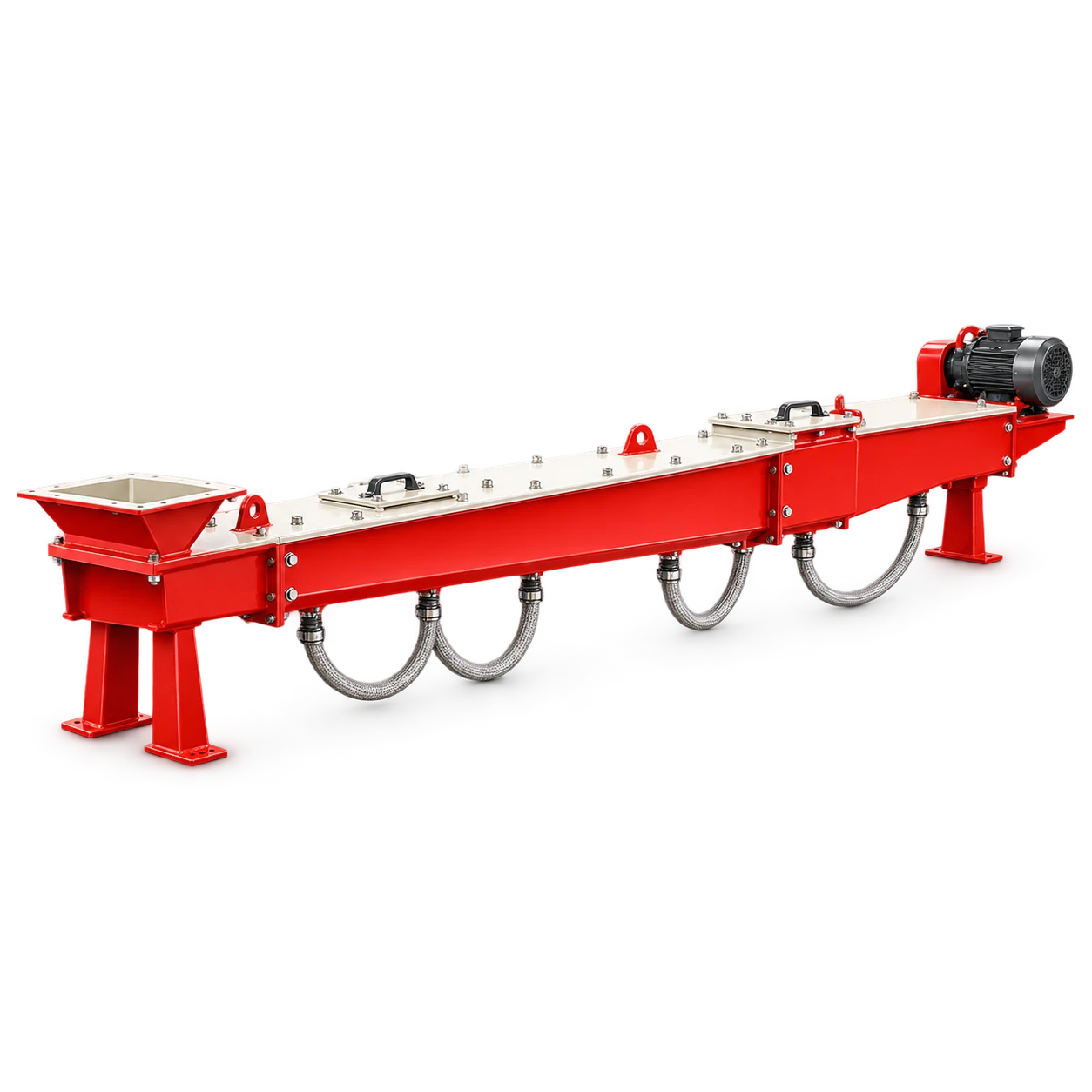
An air slide conveyor quotation should price a defined conveying system, not an unexplained length of chute. Give every bidder the same material envelope, route elevations, required rate and supply boundary. Compare technical exceptions and interface responsibilities before comparing the final commercial total.
The VOGO air slide conveyor range provides five standard SFC chute models. Its catalog selection basis includes rate, width, air pressure and route length. Those entries do not establish the complete air package, site layout or guaranteed performance for your powder; the offer must confirm the proposed configuration.
Air slide conveyor quotation: declare the material duty
Describe the powder as it reaches the inlet. Include bulk-density range, particle-size distribution, moisture, temperature and expected changes between deliveries. Identify the required normal rate and any peak, including its duration and whether upstream feeding controls it. An equipment label such as “cement” leaves too much unresolved.
Ask for the offered capacity basis and its restrictions. State whether the throughput is dry material mass or total as-received mass. If the supplier converts mass flow into volume, require the density used. Do not accept a capacity number with no material, slope or feeding condition attached.
Fuller’s original Airslide engineering brochure describes gravity transport assisted by air passing through porous media. Use that principle to frame the application review; its proprietary capacities and performance statements are not VOGO ratings.
Make the route a controlled quotation input
Provide inlet and outlet elevations, horizontal distances, bends, branches, support locations and available clearance. Identify the receiving equipment and any alternate discharge path. Ask the bidder to return a marked arrangement rather than approve the route from a plan-view length alone.
Víctor Yepes’s UPV teaching explanation of aerodeslizadores also describes the separated material and air chambers and gravity-driven transport. A practical purchasing consequence is that route grade and air distribution belong in the same review. Do not transfer a published example slope into a universal project requirement.
Specify who owns the transitions and supports. A chute that fits between two coordinates can still leave an unpriced support frame, an inaccessible air connection or a discharge that interferes with the receiving machine.
Require a line-by-line supply return
Request an explicit included, excluded, optional or buyer-supplied status for each interface. “Complete conveyor” is not a sufficiently precise commercial boundary.
| Package item | Buyer input | Required supplier return |
|---|---|---|
| Chute and media | Material and route drawing | Model, layout, media basis and restrictions |
| Air package | Site utility and installation location | Supply scope, flow basis and pressure points |
| Venting | Receiving equipment and existing extraction | Air destination and responsibility |
| Mechanical interfaces | Connections, supports and access | Drawings, loads and scope exclusions |
| Controls | Upstream and downstream operating sequence | Signals, interlocks and wiring boundary |
| Acceptance | Representative material and agreed duty | Test conditions, records and remedies |
For airflow, distinguish actual volume at a stated condition from a referenced or normalized volume. For pressure, identify the measurement point and whether the value is gauge or absolute. Require a supplier-confirmed operating point; the catalog pressure entry alone cannot size a blower or the site’s distribution piping.
Compare two offers without inventing a market price
Consider a hypothetical comparison. Offer A includes chute sections and media; Offer B also includes a blower package and controls. Both use the same material name, but only B identifies the receiving vent connection. Their headline prices describe different purchases.
Return the same scope table to both bidders. Ask A to price the missing equipment or identify buyer responsibilities. Ask B to identify precisely what its vent connection includes: a nozzle, ductwork or a complete extraction function. Neither a connection nor a fan name proves that the receiving system can handle the conveying air.
After scope normalization, compare destination, currency, delivery term, taxes, freight, assembly, commissioning and exclusions. This is a comparison method, not a current price estimate, a customer case or evidence that either fictional package will meet a particular duty.
Put measurable acceptance into the enquiry
Agree the material condition, feed rate basis, route and operating duration used for acceptance. Identify the instruments, sampling points and responsibilities. Define what will be measured: delivered material, stable operation, retained material, air operating conditions and agreed containment observations.
The air slide commissioning guide covers staged operation and fault investigation. Link that procedure to the contract instead of creating a second commissioning method here. State what factory testing can establish and what must be demonstrated with the installed route and representative powder.
Write the response to a failed trial before ordering. Record who investigates, which changes need approval and when retesting is required. Avoid a blanket performance promise while material properties or receiving ventilation remain unspecified.
Check maintenance and containment boundaries
Require access for inspection, media replacement and cleaning, with a spare-parts identification list. Include the air-supply equipment in the maintenance scope even though the conveying channel has no moving conveying element. The absence of a rotating screw does not remove material-release or stored-energy hazards.
HSE maintenance guidance calls for planned competent work, safe access and isolation. Ask how the supplied arrangement permits those tasks. An enclosed chute is not automatically airtight or pressure rated; any leakage or pressure requirement needs an agreed configuration and test basis.
Conclusion
A useful air slide conveyor quotation returns a verified application basis and a visible division of responsibilities. Resolve material, route, air supply and venting together, normalize the package table, and attach an acceptance plan before ranking prices. Keep unresolved interfaces visible as purchasing hold points.