
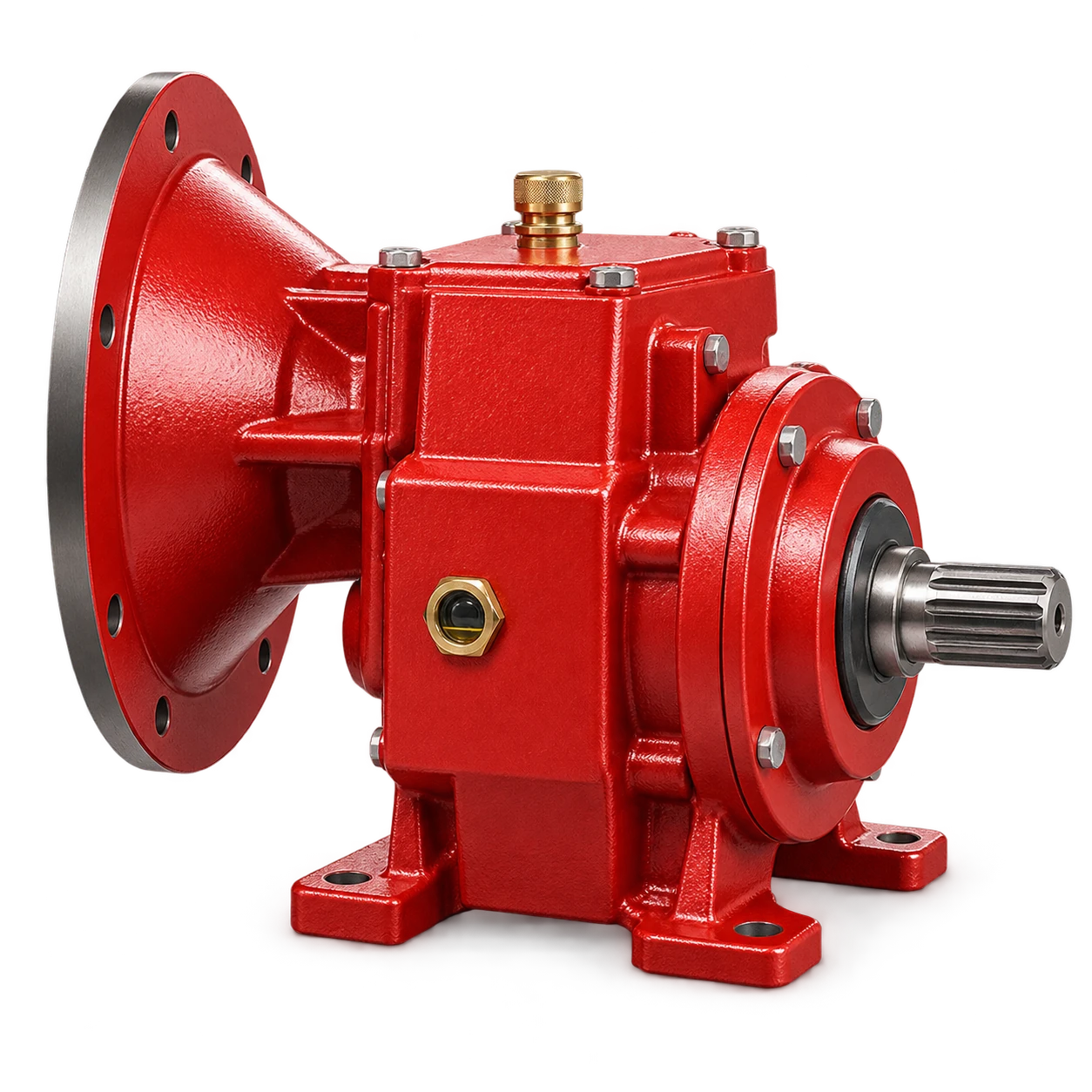
Gearbox thermal rating vs mechanical rating is a two-part approval question. Mechanical capacity addresses the load carried by the gears, shafts and bearings. Thermal capacity addresses whether operating losses can be rejected under the declared duty and installation conditions. Passing the torque check does not approve the temperature behavior.
The RM industrial gear reducer is a VOGO catalog family selected by motor power, ratio, output torque and mounting dimensions. The public product information does not provide a universal thermal rating or efficiency. Obtain those confirmations for the supplied assembly; numbers from another manufacturer’s manual cannot be transferred to an RM.
Gearbox thermal rating vs mechanical rating: separate the limits
Start with a duty point, not just the installed motor nameplate. Identify mechanical input power at the gearbox shaft, input speed, required output torque, operating hours and the load-time sequence. Motor electrical input, motor shaft output and gearbox output are different power boundaries.
A mechanical selection may pass continuous torque while a separate start or peak load still fails. Thermal approval is another check, not a substitute for either. Ask the supplier to identify the definition and units of each returned limit and the conditions to which it applies.
The gear reducer ratio selection guide covers speed and torque reconciliation. Keep those calculations there. The question here is what additional evidence makes a mechanically acceptable selection thermally acceptable at the site.
Explain the loss before predicting temperature
At a steady operating point, a simple mechanical-power balance is:
Power loss = gearbox shaft input power − gearbox shaft output power
For an explicitly hypothetical example, assume 22 kW mechanical input and 95% efficiency at that operating point:
Output = 22 × 0.95 = 20.9 kW; loss = 22 − 20.9 = 1.1 kW
The 95% value is an assumption, not an RM specification or a measured efficiency. The calculation estimates the heat-generation scale within that boundary. It does not predict an oil temperature, select a cooler or establish a universal permissible continuous power.
Losses can change across the operating range. Do not reuse one assumed efficiency for starting, low-speed holding and every load. A changing thermal state also stores energy in the gearbox, so a short trial cannot automatically establish continuous-duty equilibrium.
Ask for the installation-specific thermal review
SEW-EURODRIVE’s engineering instructions identify mounting and speed-related churning losses. This supports a configuration-specific review; it does not authorize changing an RM mounting position or lubricant.
Send a drawing and operating schedule with the enquiry. Include seasonal ambient conditions, nearby heat sources, enclosure, airflow restrictions and credible dust accumulation. Ask which supplied components and installation assumptions govern the returned approval.
| Review item | Project input | Required confirmation |
|---|---|---|
| Power boundary | Shaft input and actual load | Meaning of the thermal power limit |
| Operating range | Speed, torque and time sequence | Approved continuous and intermittent duty |
| Mounting | Delivered position and orientation | Oil arrangement and applicable restrictions |
| Site | Ambient, altitude and enclosure | Rating valid for those conditions |
| Heat rejection | Clearances and ventilation | Required cooling and its operating conditions |
| Monitoring | Measurement point and method | Applicable limits and response instructions |
The manufacturer’s thermal-calculation input schedule explicitly includes drive and installation data. Use it as an example of the questions to resolve, not as an approval sheet for another brand.
Reject an incomplete thermal approval
Consider a hypothetical offer that passes the specified mechanical load. It states an 18 kW continuous thermal input-power limit at the proposed site, while the application requires 22 kW shaft input continuously. On that explicitly common basis, it does not pass thermal review.
Do not fix the comparison by using the 1.1 kW calculated loss as though it were the same quantity as an 18 kW input-power limit. One is generated loss; the other is permitted transmitted input under stated assumptions. Keep the manufacturer’s definition attached to every number.
Ask the supplier for an approved alternative: a different assembly, a confirmed cooling arrangement or a genuinely revised duty. Do not prescribe a larger motor, a different oil or a local fan without review. The example demonstrates a rejection rule, not a catalog rating, design calculation for RM cooling or permission to operate an undersized unit.
Make a commissioning record that can be compared
Record load, speed, ambient temperature, elapsed run time, cooling state and measurement location together. A temperature without its operating condition has limited diagnostic value. Use the same instruments and locations for later comparisons.
Ask the supplier to define the test duration and evidence needed for the intended duty, including how the temperature trend is assessed. No generic stabilization time is prescribed here. An acceptable short no-load run cannot establish the thermal behavior of prolonged loaded service.
Distinguish a casing surface measurement from an oil-sump or embedded sensor reading. Follow the limit for the measured quantity and exact supplied equipment. Do not infer one from the other or use a generic temperature number to declare all gearboxes safe.
Review changes and inspect safely
A changed mounting position, sustained speed, production schedule, enclosure or cooling arrangement can invalidate the original thermal review. Keep these as engineering change triggers. A service-factor margin is not permission to ignore them.
HSE’s maintenance guidance requires safe isolation and consideration of hot components. Plan inspection and cooling checks around competent work and the delivered instructions. Do not reach through guarding or open a hot assembly to improve a temperature reading.
If temperature behavior changes, compare the operating record first and escalate abnormal conditions under the supplier’s instructions. Do not bypass a protective response while trying to prove that the original rating was correct. Release the drive only after the actual configuration and duty are documented.
Conclusion
Gearbox thermal rating vs mechanical rating requires two traceable decisions on the same application. Establish the shaft-power boundary, obtain site-specific thermal confirmation and preserve its mounting, duty and cooling assumptions. Use the loss example to understand the question; use the supplier’s approved data to accept the drive.