
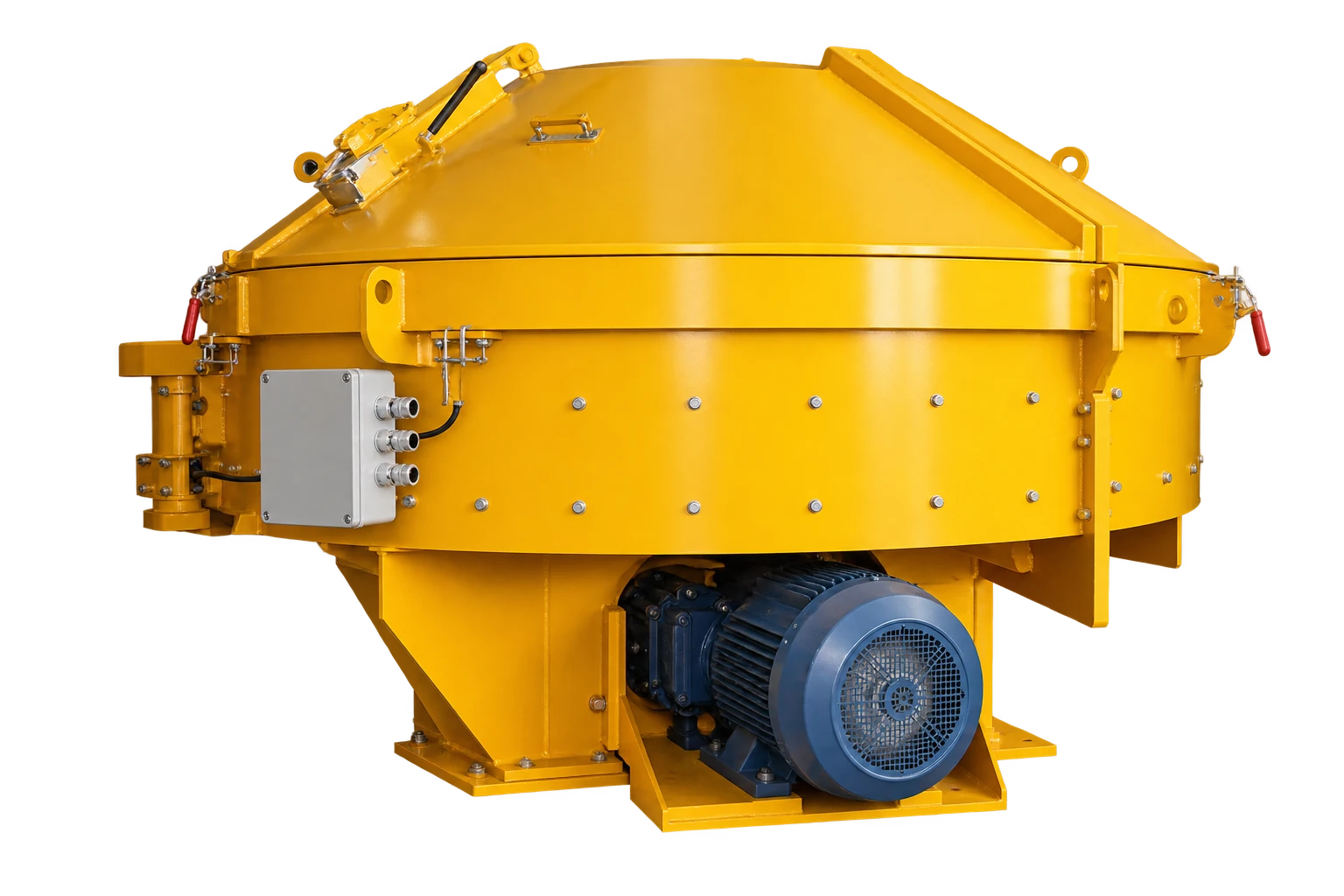
Pan mixer energy consumption should be measured at a declared electrical boundary and matched to accepted material output. Record real input power through the complete test period, integrate it to kWh, and divide by accepted cubic metres or tonnes on one stated basis. Do not substitute installed motor power for measured consumption or use a low energy figure as proof of mixing quality.
The TMR Vertical Turbine Mixer is published with 1,000–1,500 L discharge capacity for fibrous and formulated materials. Selection depends on discharge capacity, blade arrangement and material behavior. The catalog does not publish a universal kWh/batch, kWh/m³, mixing time or energy-saving percentage. Establish those values with the actual formulation and supplied configuration.
Define the pan mixer energy consumption boundary
Choose the question before fitting a meter. A mixer-drive measurement, complete mixer package and whole batching plant are different boundaries. Mark the electrical single-line diagram and list every included motor, pump, control circuit and ancillary device.
A mixer-only study may exclude aggregate transport, weighing, compressor supply and wash-water pumping. That can be useful, provided the exclusions are disclosed. A plant comparison must account for those services consistently rather than attributing their energy to one offer but not another.
Define the time window too: wet mixing only, complete batch cycle, production run or full shift. Start and stop at observable events. Record charging, dry mixing, liquid addition, final mixing, discharge, waiting and cleaning as separate states where relevant. The same meter total can support several analyses, but the labels must not change between trials.
Measure real input power, not a nameplate shortcut
The US Department of Energy motor guide distinguishes electrical input from shaft output and includes power factor in three-phase input calculations. Current alone does not establish kW, particularly when load and power factor change.
Use a suitable real-power/energy instrument and a competent electrical specialist. For a variable-frequency drive, choose the measurement point deliberately and use an instrument appropriate to that waveform. Keep the meter range, sampling interval, current-transformer ratio, calibration status and wiring record with the test.
A control-system current trend is useful context, but do not relabel it as calibrated energy. If input power is measured upstream of the drive, the total includes drive losses within that boundary. It is not the same as torque multiplied by speed at the mixing shaft, nor does all shaft work become useful mixing.
Calculate batch energy and specific consumption
For interval measurements:
Batch energy (kWh) = Σ [real input power (kW) × interval duration (s)] ÷ 3,600
Specific electricity (kWh/m³) = measured energy (kWh) ÷ accepted output (m³)
Hypothetical example: a meter records 18 kW for 30 s during charging, 30 kW for 60 s during mixing and 18 kW for 30 s during discharge.
Energy = (18 × 30 + 30 × 60 + 18 × 30) ÷ 3,600 = 0.80 kWh
If accepted discharge is assumed to be 0.80 m³:
Specific electricity = 0.80 ÷ 0.80 = 1.00 kWh/m³
All values are teaching assumptions, not TMR performance, load permission or a recommended cycle. This example also excludes idle time and other plant equipment. A full-shift metric must include their measured energy within its declared boundary.
Keep quality as an independent gate
The NIST review of concrete mixing warns that mixing energy depends on mixture, batch size and loading method and is not, by itself, evidence of mixer effectiveness. Use an energy trend to investigate a process, not to waive product testing.
For concrete within its stated scope, ACI’s mixing-adequacy explanation describes comparing samples from different discharge portions. Select the contract’s appropriate uniformity and product-property methods. A fibrous or other formulated material needs its own justified acceptance plan, not automatic adoption of a concrete test.
The related fiber-concrete mixer specification explains why fiber form, dosing, sequence and dispersion acceptance must be fixed. An energy comparison is meaningful only after those process conditions are controlled and both batches pass the required quality gates.
Compare like trials and explain deviations
Use a test matrix with the same recipe lot, moisture corrections, temperature band, batch basis, tool condition, sequence and measurement window. Record changes rather than adjusting several variables simultaneously.
| Observed result | Next question |
|---|---|
| Lower kWh, failed quality | Was mixing shortened, underloaded or otherwise changed? |
| Higher kWh, same accepted output | Did recipe, moisture, tool condition or cycle states change? |
| Same batch kWh, worse shift kWh/m³ | Did waiting, rejects or downstream interruptions increase? |
| Current changes without matching energy change | Are voltage, power factor or instrument boundaries different? |
Keep rejects in the record. For a shift indicator, divide all in-boundary energy by accepted output, not by every charged batch including rejected product. Report gross output and rejected material separately so the denominator is auditable.
Do not subtract an empty-run baseline without naming the new metric. Gross electrical consumption and a baseline-subtracted process estimate answer different questions. Neither creates a universal material-energy threshold.
Turn the study into a purchase or operating requirement
Give the supplier the meter boundary, recipes, loads, trial duration, acceptance tests and reporting format. Ask for repeatable measured data, not a saving percentage without a baseline. State uncertainty where differences are small relative to instrument accuracy or batch variation.
Electrical installation and intrusive inspection require the site’s safe-work procedures. Before servicing, apply an energy-control procedure appropriate to the machine; OSHA 1910.147 covers unexpected energization. Do not expose moving parts simply to obtain a power or speed measurement.
Conclusion
Pan mixer energy consumption is a measured, boundary-dependent quantity. Integrate real input power, reconcile accepted output and retain idle time and rejects in the correct metric. Select or operate a TMR configuration only after comparable trials demonstrate both product quality and the declared electrical result.