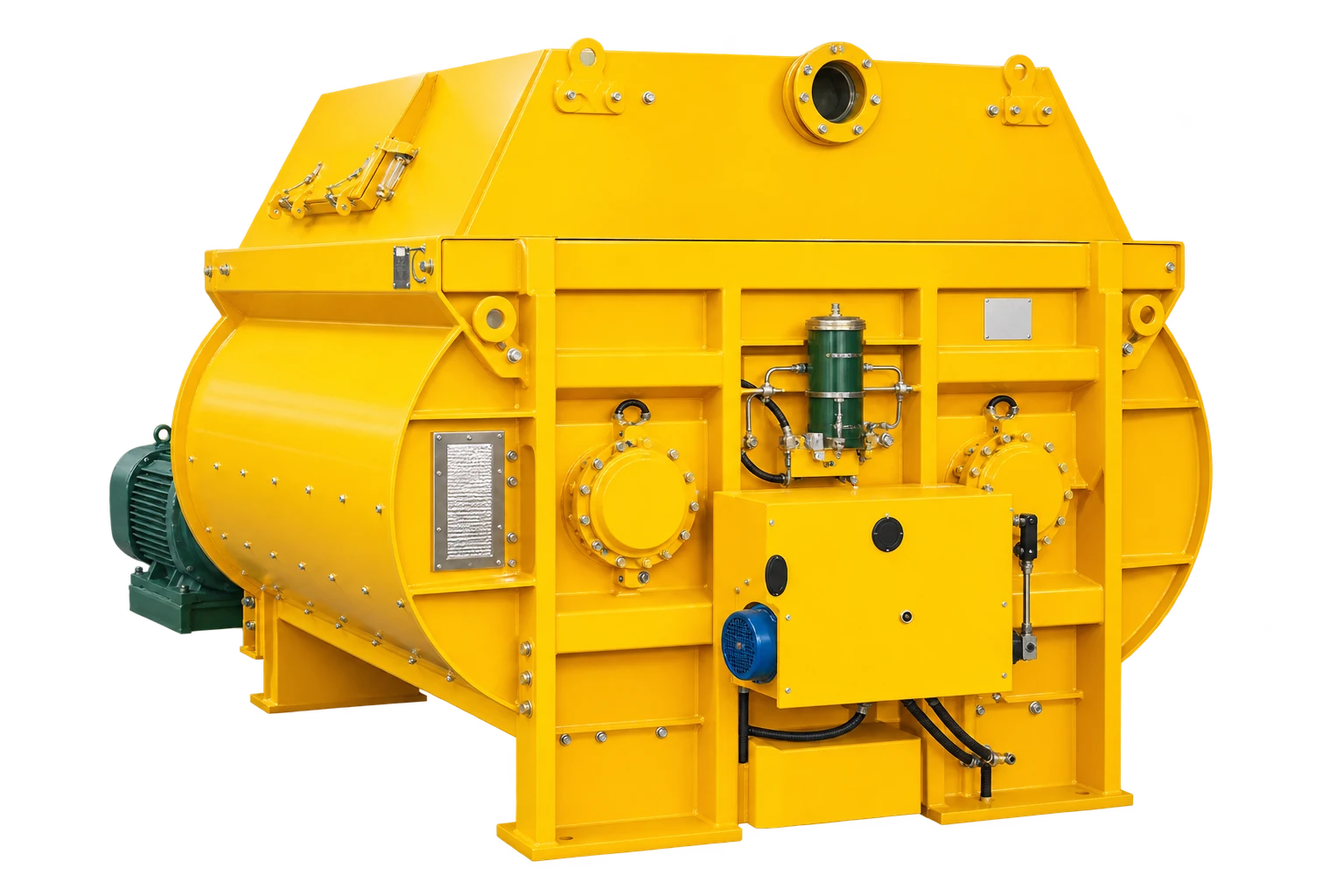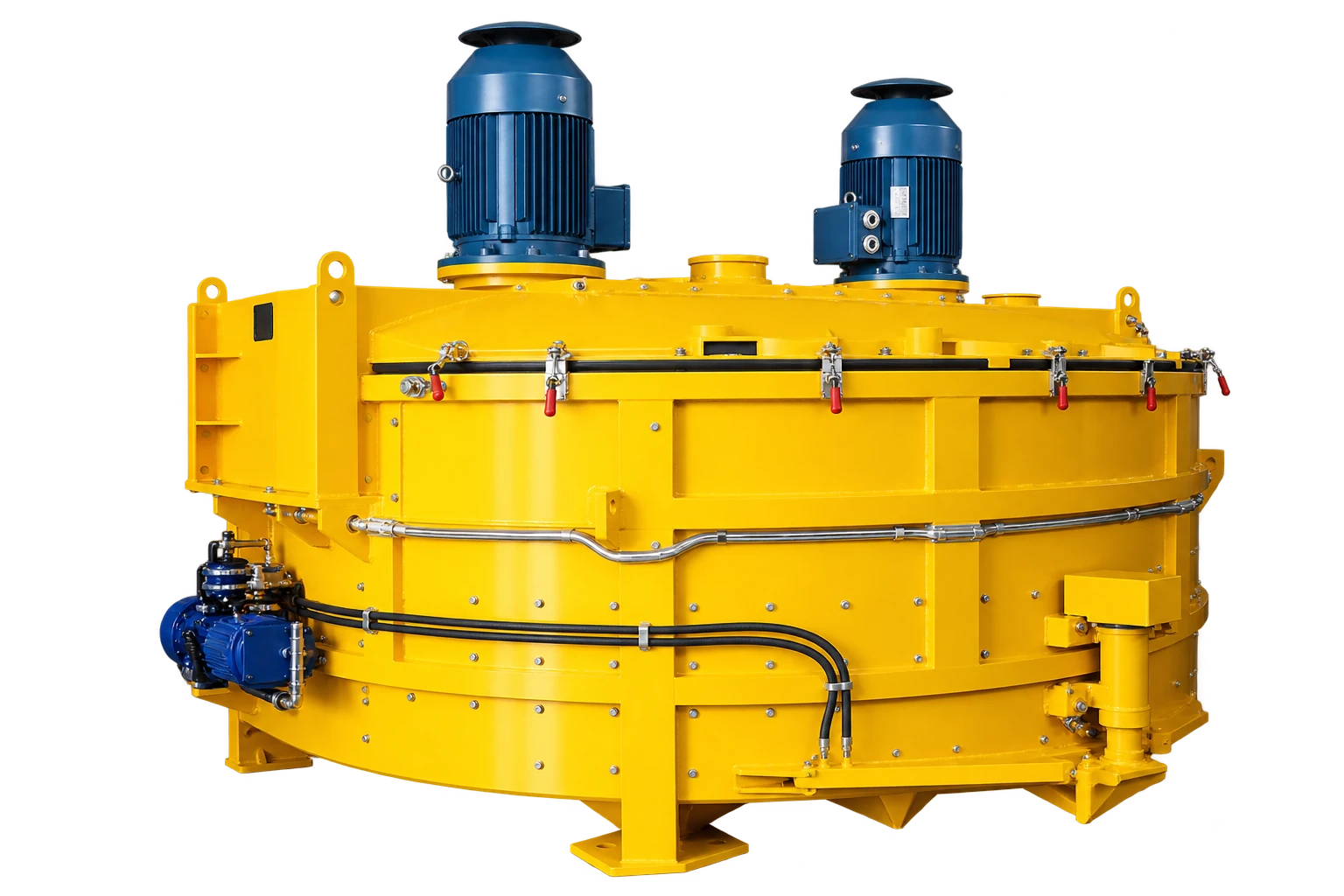
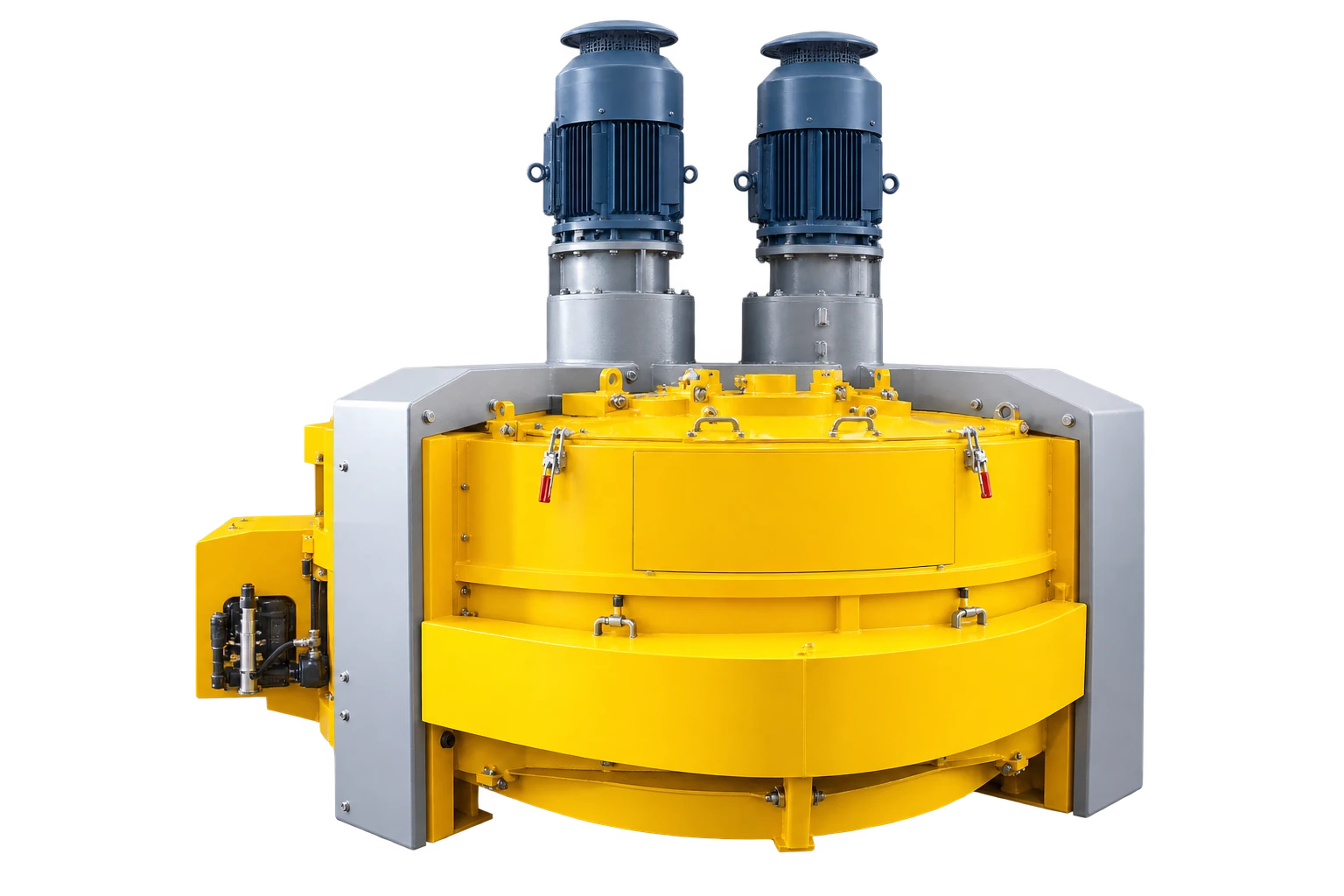
Planetary concrete mixer scraper maintenance begins with isolation and a clean inspection surface, not a guessed gap. Identify the supplied scraper and liner configuration, compare measurements with the correct manual, and distinguish deposits, wear, looseness and mechanical damage. Adjust only a serviceable assembly, using the approved method and limits.
The APM Planetary Concrete Mixer is a catalog range in a 1.5–3 m³ class, selected by batch volume, recipe and mixing intensity. Its public catalog is not a service instruction: it does not establish a universal scraper clearance, fastener torque, replacement thickness or maintenance interval. Obtain the serial-number-specific documentation before planning intrusive work.
Make access safe before inspecting scrapers
Stop feeding and identify every source that could move the mixer or release material. The boundary can include electrical drives, pneumatic or hydraulic discharge equipment, suspended loads, upstream gates and stored material. Secure components against the movements identified in the work plan.
OSHA 1910.147 addresses unexpected energization during servicing. Apply an equipment-specific isolation procedure and verify the isolated state before entering a danger zone. A stopped motor, emergency-stop button or open access cover does not by itself establish isolation.
Assign competent personnel, suitable tools, lighting and an access method. HSE maintenance guidance calls for planning, safe systems of work and control of stored energy. Assess entry conditions separately; do not assume that every open mixer is safe to enter.
Build a planetary concrete mixer scraper maintenance map
Clean using the machine supplier’s approved method so deposits are not mistaken for metal. Avoid damaging liner surfaces or loading the arm with an improvised cleaning tool. Record the machine condition before removing parts, including the locations of any buildup or contact marks.
Give each tool a stable identifier: outer-wall scraper, floor scraper where fitted, mixing tool, support and adjacent liner segment. Use the actual drawing, not a generic planetary-mixer diagram. Record the liner condition as well as the tool edge because the clearance belongs to the pair.
| Inspection field | Record to keep |
|---|---|
| Identity | Machine serial number, drawing revision, part number and position |
| Geometry | Approved measuring points, smallest and largest observed gaps |
| Condition | Edge profile, cracks, missing material, contact marks and buildup |
| Support | Distortion, movement, fixing condition and adjustment travel |
| Liner | Local damage, proud edges, loose fixings and surface deposits |
| Decision | Limit source, action, responsible person and recheck result |
The related twin-shaft mixer wear inspection guide illustrates condition mapping and traceable decisions. Its tool geometry and limits must not be applied to an APM planetary assembly.
Separate the fault before changing the gap
Use the observed pattern to decide the next check:
- Buildup at one location: inspect the neighboring liner and scraper path, then compare with the baseline.
- A changed gap after maintenance: verify part identity, seating and adjustment before blaming wear.
- Metal contact or a damaged support: stop and refer the assembly for inspection; do not run it to “bed in.”
- Progressive loss of edge profile: compare the condition with the model’s replacement criteria and order the correct part.
- Loose or displaced components: resolve the fixing and mating-surface problem before restoring the nominal position.
These are diagnostic prompts, not permission to operate a damaged mixer. A gap measurement cannot prove that an arm, bearing support or liner fixing is structurally sound.
Use the supplied adjustment procedure
The Winget R12 OEM manual gives specific procedures for its own mixing and scraper assemblies. It demonstrates why adjustment and replacement instructions belong to a particular machine. Its clearances, spring settings and assembly sequence are not APM instructions.
Likewise, MEKA’s planetary mixer data identifies different scraper and replaceable wear-component arrangements. Do not infer interchangeability from a similar appearance or a shared nominal mixer volume.
For the supplied APM configuration, request the approved gap envelope, measurement positions, allowable wear, fastening specification and locking method. Confirm whether an adjustment requires replacement hardware or supporting another component. If the document is missing, stop at inspection and obtain it; do not invent a millimetre value.
Where rotation is needed to inspect another position, use only the manufacturer’s safe maintenance method with its stated personnel-clearance and energy-control conditions. Never energize the normal drive while someone is inside or reachable by the tools. Do not improvise lever bars, spring preload or powered jogging.
Release the repair with mechanical and process evidence
Before removing isolation, account for tools, loose parts and personnel. Restore guards and access protection. Have an authorized person verify the approved clearances and fixing records, then follow the supplier’s staged return-to-service procedure.
Use a representative batch only after mechanical checks pass. Record recipe, load, cycle, discharge residue and the observations that triggered maintenance. Compare with the previous acceptable condition. If buildup returns immediately, investigate sequence, moisture, discharge and cleaning rather than repeatedly closing the gap.
Keep process acceptance separate from mechanical acceptance. A clean discharge does not prove uniformity, and an acceptable concrete sample does not excuse tool contact or an unsecured fixing. Record both outcomes and the next inspection trigger. Set the interval from the manual and observed condition, not a universal calendar copied online.
Conclusion
Planetary concrete mixer scraper maintenance is a controlled geometry-and-condition task. Identify the exact parts, isolate safely, map both scraper and liner, resolve damage before adjustment and verify the repair before production. For APM equipment, the supplied service documentation—not a generic gap—is the authority for intervention.