
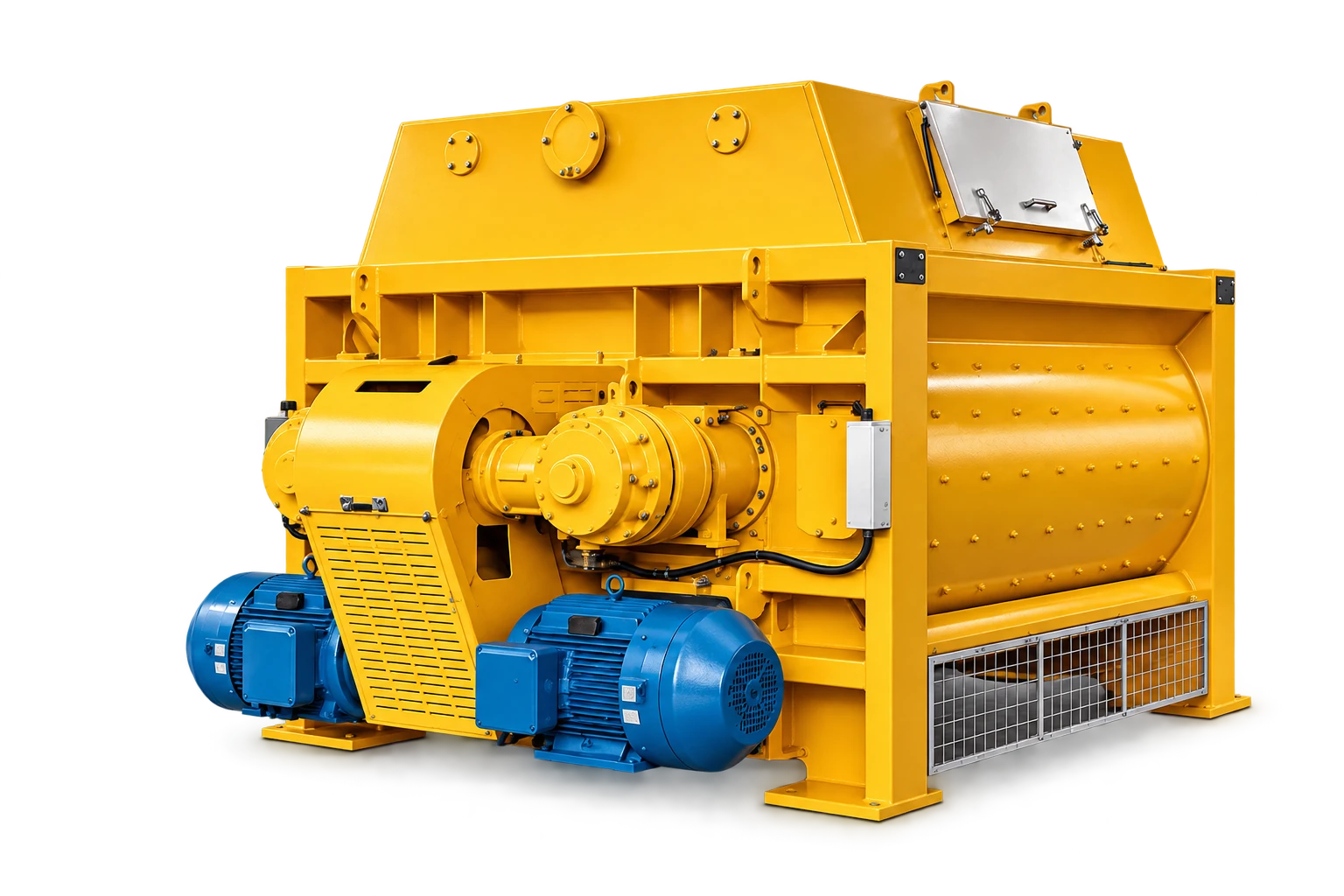
A twin-shaft concrete mixer wear inspection should turn condition into traceable measurements: identify each blade, arm, liner zone, shaft seal and gate area; isolate the machine; clean it safely; compare the same points with approved baseline dimensions; and trend the results. Replace or adjust parts only to the exact mixer manufacturer’s limits. A generic blade clearance or percentage-loss rule is not a defensible substitute.
The MAO Standard Twin-Shaft Concrete Mixer covers a published 1.5–6 m³ class for commercial concrete plants. Its catalog selection basis is compacted output, charging volume and cycle duty. Those facts define the product family, not a universal wear limit. Confirm the installed model, serial-specific drawings, liner and blade material, fasteners, torque values and allowable clearances before opening a work order.
Define the inspection boundary before entry
Wear inspection is intrusive maintenance, not an observation through an operating access door. The boundary can include electrical supplies, hydraulic accumulators, pneumatic gate circuits, gravity-loaded skip or hopper components, stored material and shafts that may move when hardened concrete is released.
OSHA’s concrete-equipment rule states that maintenance or repair must not proceed where inadvertent operation could cause injury unless potentially hazardous energy sources have been locked out and tagged. The broader OSHA hazardous-energy guidance also identifies electrical, mechanical, hydraulic, pneumatic, chemical and thermal energy. The site procedure and applicable local law govern the exact isolation method.
Before anyone enters or reaches into the chamber:
- stop production through the normal sequence and empty by the approved method;
- isolate every energy source and control upstream material admission;
- dissipate or block stored pressure and gravity hazards;
- verify the zero-energy state with the site’s test method;
- secure access covers, gates and any component that can move;
- control cleaning tools, lighting, communication and entry conditions.
The OSHA concrete equipment requirements are a useful minimum reference, but a mixer inside a fixed industrial plant may also fall under other jurisdiction-specific rules. A stopped HMI display or open disconnect is not, by itself, proof of isolation.
Build a repeatable twin shaft concrete mixer wear inspection map
Create a diagram that follows material flow and shaft rotation. Assign durable location codes, such as shaft A/B, blade position A1–A8, liner zone L1–L12, gate-left/gate-right and seal-drive/non-drive. Photograph from fixed viewpoints and record the measuring tool, units and inspector.
| Area | Record | Questions raised by the pattern |
|---|---|---|
| Blade leading and trailing edges | Profile, thickness or approved reference dimension | Is loss even, or concentrated at charging/discharge zones? |
| Arms and hubs | Section loss, cracks, fastener condition, movement marks | Is a loose interface changing blade position? |
| Floor and side liners | Remaining thickness or approved wear indicator, joint steps | Is a local gap exposing the shell or trapping material? |
| Shaft ends and seals | Leakage, contamination, temperature history, movement | Is the seal failing, or is shaft movement the initiating fault? |
| Discharge gate and seat | Buildup, contact pattern, leakage path, full travel | Does the gate close freely without being forced? |
| Spray and dosing points | Blockage, aim and physical damage | Is uneven liquid addition being mistaken for poor mixing? |
Use the manufacturer’s prescribed measurement method. A straightedge and feeler gauge may be appropriate for one design; a template, ultrasonic thickness measurement or wear indicator may govern another. Record buildup separately from metal loss. Hardened concrete can make a clearance appear smaller, while a polished edge can hide meaningful section loss.
An OEM product page for the Liebherr DW twin-shaft mixer highlights organized service positions and wear characteristics. It illustrates why access and wear provisions are design-specific. Its published dimensions and component claims must not be transferred to a VOGO mixer.
Separate wear, damage and process deposits
Classify each finding before deciding on corrective work:
- Progressive wear: gradual material loss from abrasion during normal duty.
- Impact damage: a chip, bend, crack or sudden deformation associated with oversize or foreign material.
- Loose-part damage: fretting, elongated holes or changing blade position caused by lost clamp load.
- Buildup: adhered concrete that changes effective geometry without proving base-metal loss.
- Corrosion or chemical attack: surface loss that may continue during idle periods or cleaning.
Asymmetric wear is diagnostic. One heavily worn zone can point to a concentrated charging stream, mispositioned tool, missing liner, loose arm, gate buildup or a recipe with unexpected abrasive aggregate. Replacing every blade without finding the cause can reset the appearance while leaving the failure mechanism intact.
Cracks, exposed shell, loose arms, missing fasteners, contact between rotating and fixed parts, or a gate that cannot be secured are stop-and-escalate findings. The equipment owner and qualified supplier should determine disposition. Welding, hardfacing or changing blade geometry without an approved procedure can alter balance, fatigue strength and mixing action.
Calculate wear rate without inventing a life claim
A simple trend converts two comparable measurements into a planning input:
Wear rate = (baseline dimension − current dimension) / operating interval
Assume a project-controlled blade dimension was 42.0 mm after installation and 39.6 mm after 1,200 operating hours. The measured rate is:
(42.0 − 39.6) / 1,200 = 0.0020 mm/h
If the exact manufacturer limit for that location were 36.0 mm, a linear projection would show 1,800 hours from the current point. That is only a planning example. Real wear may accelerate after geometry changes, a recipe becomes more abrasive, fasteners loosen or protective material is lost. Do not treat a projection as a guaranteed service life or defer a safety-related repair to reach it.
Trend by both hours and batches when possible. Hours reflect running time; batches can better reflect charging impacts and discharge cycles. Add recipe, aggregate source, maximum size, moisture condition, batch mass and abnormal events so a rate change has context.
Link mechanical findings to mix evidence
Worn tools can change circulation and mixing energy, but concrete test variation has several possible causes. ACI explains that samples taken at different points in discharge can assess uniformity and that large air-content or slump variation may indicate an inappropriate loading sequence or insufficient mixing. See the ACI guidance on mixing adequacy.
Use two evidence streams:
| Mechanical evidence | Process evidence |
|---|---|
| Wear map, approved clearances, loose parts, contact marks, leakage | Batch tickets, moisture correction, loading sequence, mix time, discharge samples |
| No-load current, noise and vibration after guarded restart | Slump, air, density, aggregate distribution or strength where specified |
Do not use one slump result as a blade gauge. Conversely, acceptable test results from one recipe do not authorize continued operation with a cracked arm or exposed shell. The planetary concrete mixer selection guide explains how recipe trials and plant-cycle evidence support a mixer decision; the same discipline helps separate machine condition from batching variation.
Decide repair scope and acceptance evidence
Use the approved limits and failure mode to choose among cleaning, adjustment, fastener replacement, individual wear-part replacement, matched-set replacement or supplier engineering review. Check whether mixing tools must remain balanced by mass or geometry and whether fasteners, locking devices or liners are single-use.
Before release, document:
- installed part numbers and material specification;
- final clearances at every specified location;
- fastener method and verified tightening records;
- free movement and secure closure of the discharge gate;
- seal, lubrication and wash-system condition;
- removal of tools, temporary supports and loose material;
- guard and access-cover restoration;
- rotation check, guarded no-load run and leakage inspection;
- controlled production trial and specified concrete checks.
Compare no-load current, noise and vibration with a prior healthy baseline under the same conditions. A difference is a reason to investigate, not an automatic failure threshold. Production acceptance should use the contract’s sampling and uniformity rules rather than an invented universal value.
Conclusion
A useful twin shaft concrete mixer wear inspection is a controlled measurement process, not a quick look inside the chamber. Isolate all energy, map repeatable locations, distinguish wear from buildup and impact damage, trend the rate with duty, and use only model-specific replacement limits. After repair, prove mechanical integrity and then confirm the mix with separate process evidence. For a commercial-plant selection review, view the MAO mixer details.