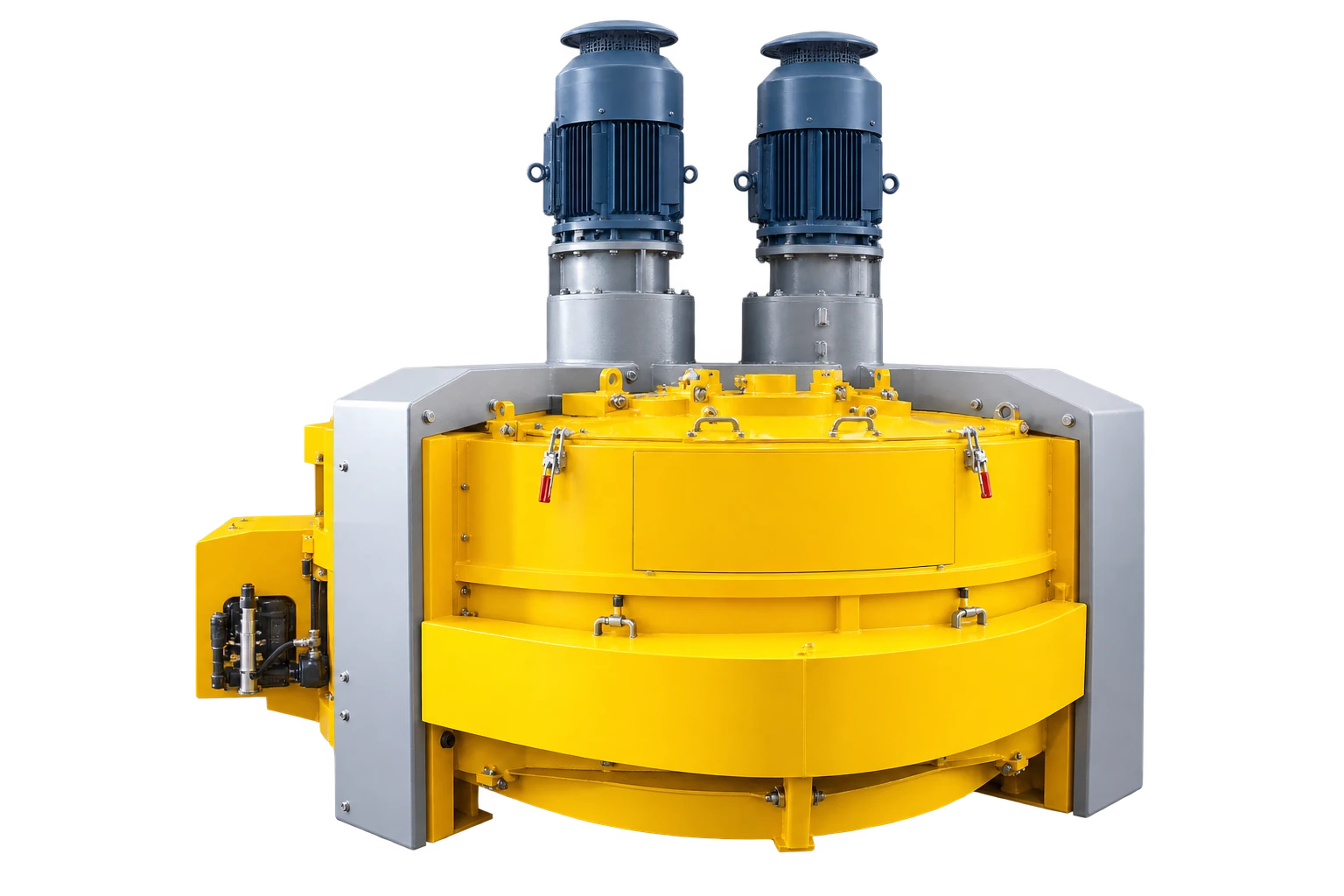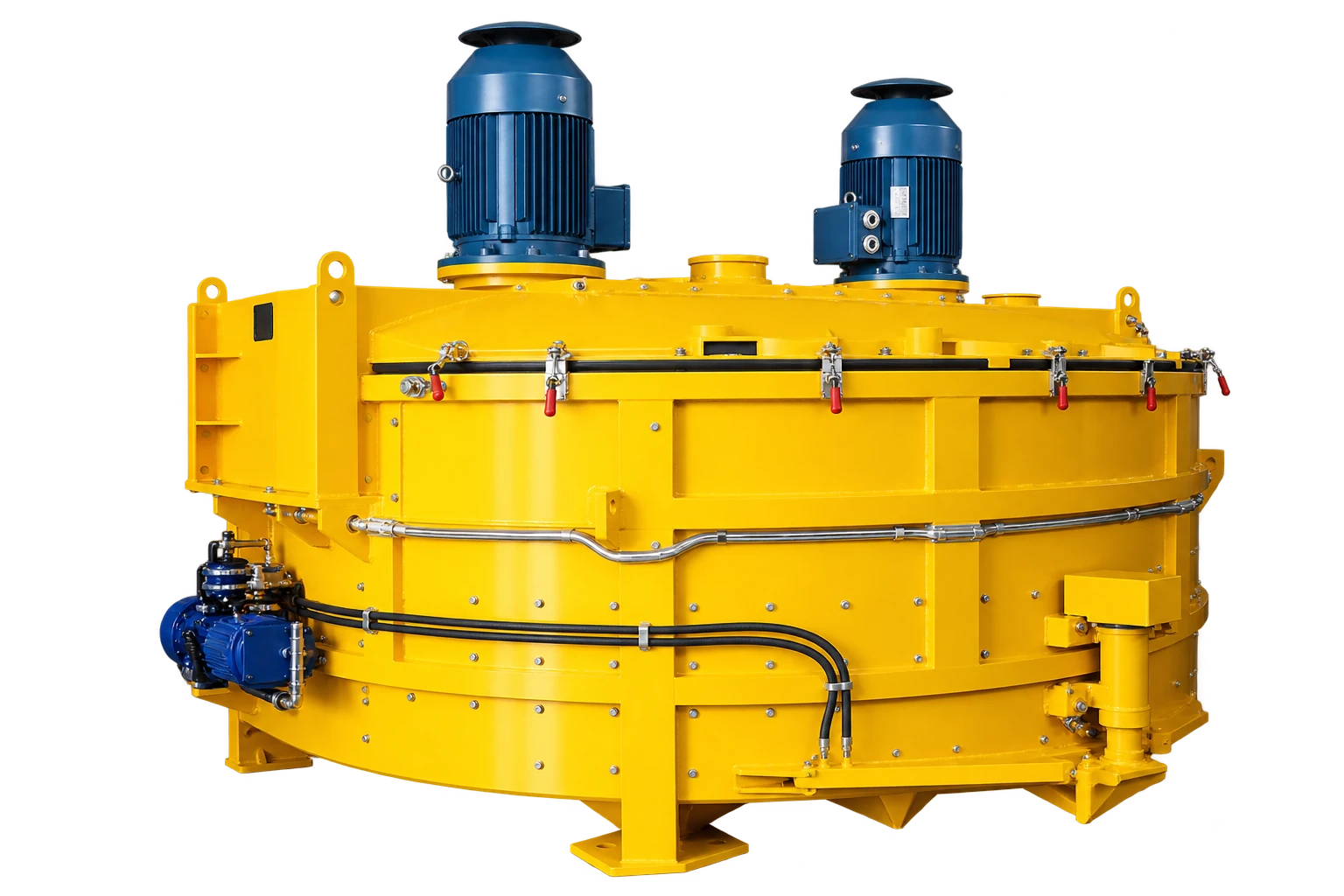
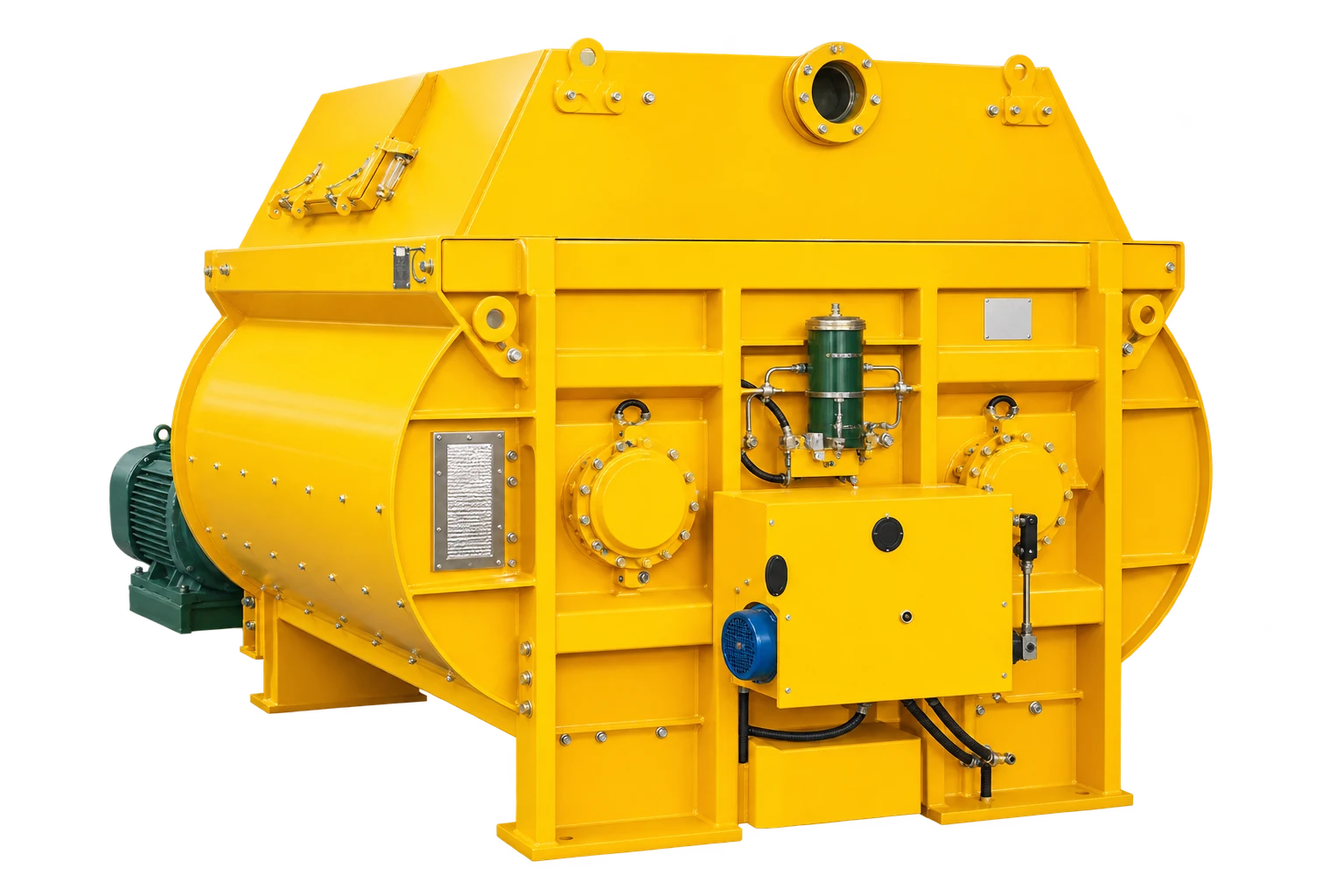
A twin shaft concrete mixer price should be compared only after the quotations describe the same job. Fix the recipe envelope, accepted batch output, complete cycle, operating duty and installation boundary. Separate the equipment amount from delivered, installed and accepted cost. A low headline figure can simply mean that another party must buy the missing items.
The MEO Economical Twin-Shaft Mixer range is published in a 0.75–2 m³ class for general concrete batching. The current catalog links model selection to compacted output, plant capacity and installation space. “Economical” is a range description, not evidence of the lowest installed cost or a guaranteed saving. Obtain a project quotation against the current model reference.
Establish a comparable twin shaft concrete mixer price
Issue the same input sheet to each bidder. Identify concrete type, ingredient masses, aggregate grading and maximum size, moisture variation, minimum and maximum batches, required output, electrical supply, shift pattern and site conditions. Attach the receiving-hopper opening, available headroom and maintenance envelope.
Do not ask only for “a one-cubic-metre mixer.” State whether the number means charging volume or accepted compacted discharge. Require the supplier to name the model and return its approved working range for the recipe. The related small concrete plant sizing guide handles the capacity calculation; this article addresses the commercial boundary after that duty is established.
Distinguish a firm offer from an estimate. Ask for currency, quotation date, validity, payment milestones, exclusions, drawings and the conditions that could trigger a price revision. A budget allowance based on incomplete inputs should not silently become a fixed procurement baseline.
Compare line items, not package labels
Use a supplier-return schedule rather than assuming that “complete mixer” has a common meaning.
| Cost boundary | What the offer should identify |
|---|---|
| Mixer assembly | Current model, drive, liner and blade arrangement, gates and supplied instruments |
| Integration | Supports, transitions, access platforms, utilities and control responsibility |
| Cleaning and service | Washing equipment, drains, lubrication, access and initial spares |
| Delivery | Packing, loading, transport, insurance, unloading and storage responsibility |
| Commissioning | Travel, labor, utilities, test material, training and repeat tests |
| Acceptance | Recipes, measured output, quality criteria, punch items and release conditions |
A purchaser may supply some items deliberately. The problem is not exclusion itself; it is an unpriced exclusion that appears only after award. Mark each line as included, buyer-supplied, separately priced or not applicable, and assign one owner at every interface.
The ICC description of Incoterms 2020 establishes their role in allocating buyer and seller responsibilities. Name the chosen rule, place and edition. Do not assume that a delivery rule also defines installation, performance acceptance or warranty; write those obligations into the contract.
Normalize installed cost with a transparent example
Hypothetical comparison, in arbitrary cost units: Offer A lists equipment at 100 units but excludes 12 for integration and 8 for commissioning. Offer B lists a 115-unit package, with 20 further units needed for site work.
A normalized initial cost = 100 + 12 + 8 = 120 units
B normalized initial cost = 115 + 20 = 135 units
These are invented teaching inputs, not VOGO prices, currency amounts or a market range. The calculation shows why the lowest equipment line and the lowest complete initial cost need not be the same comparison. Confirm that both totals include the same taxes and recoverable-tax treatment before using them internally.
A spreadsheet should retain the original quotation, every added allowance, its source and its owner. Use a separate unresolved-items column; replacing missing information with zero makes an incomplete offer look artificially favorable. Test whether a plausible allowance change reverses the ranking.
Keep operating cost separate from purchase price
NIST Handbook 135e2025 distinguishes initial investment from future operation, maintenance, replacement and residual value. Its federal-facility context does not prescribe a mixer price; use the economic structure with project-specific inputs.
For an equipment comparison, request evidence for electricity per accepted output, replacement-part cost, labor, wash water, waste handling and planned service. Use a common study period and consistent discount and escalation assumptions if presenting a lifecycle total. Do not mix discounted future costs with an undiscounted initial total and label the result a formal lifecycle analysis.
Do not multiply installed motor kW by all shift hours and call it measured consumption. Load, idle time, recipe and cycle matter. Likewise, a quoted blade price says little without a documented replacement basis. Where operating evidence is missing, show a sensitivity range as an assumption, not as a supplier performance fact.
Buy maintainability and acceptance explicitly
Ask how technicians reach seals, gates, liners and drives, what must be lifted, and which parts require replacement as a matched set. Request manuals, part numbers, drawings and agreed support arrangements before dispatch. Do not invent a wear life from the material name of a liner.
HSE maintenance guidance emphasizes planned work, competent personnel and safe isolation. Price the access and isolation provisions required by the project’s risk assessment. Guards, safe access and energy control are not optional cost reductions merely because an equipment offer omits them.
Define the factory and site tests, responsibility for material and failed-test costs, acceptance measurements and document handover. A no-load motor run cannot prove recipe output or product quality. Resolve whether payment milestones depend on dispatch, installation or demonstrated acceptance.
Conclusion
Compare a twin shaft concrete mixer price by normalizing a confirmed process duty and complete supply boundary. Keep initial cost, operating assumptions and acceptance obligations visible. The useful MEO quotation is one tied to a current model, installation interfaces and measurable handover—not an unsupported headline price.