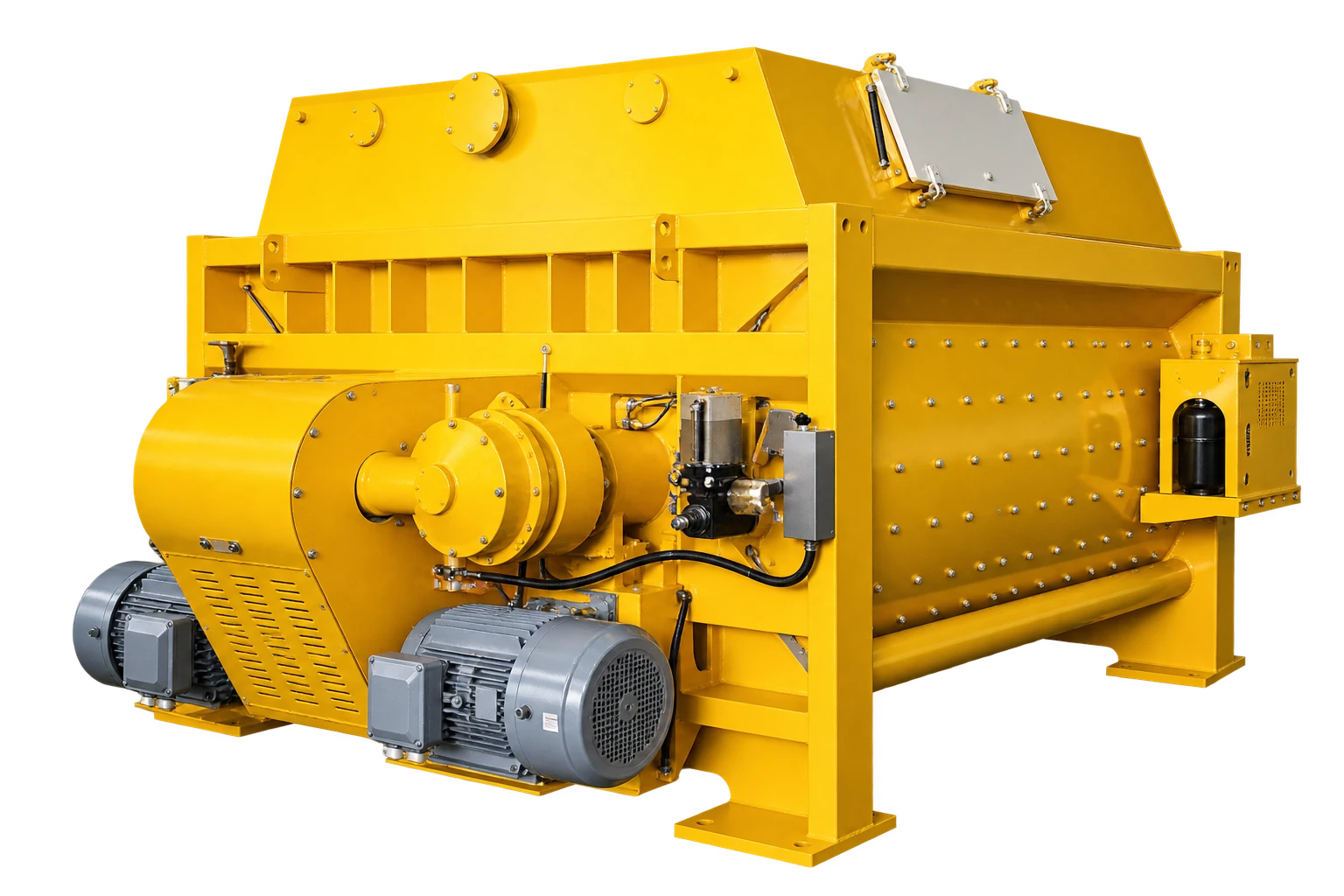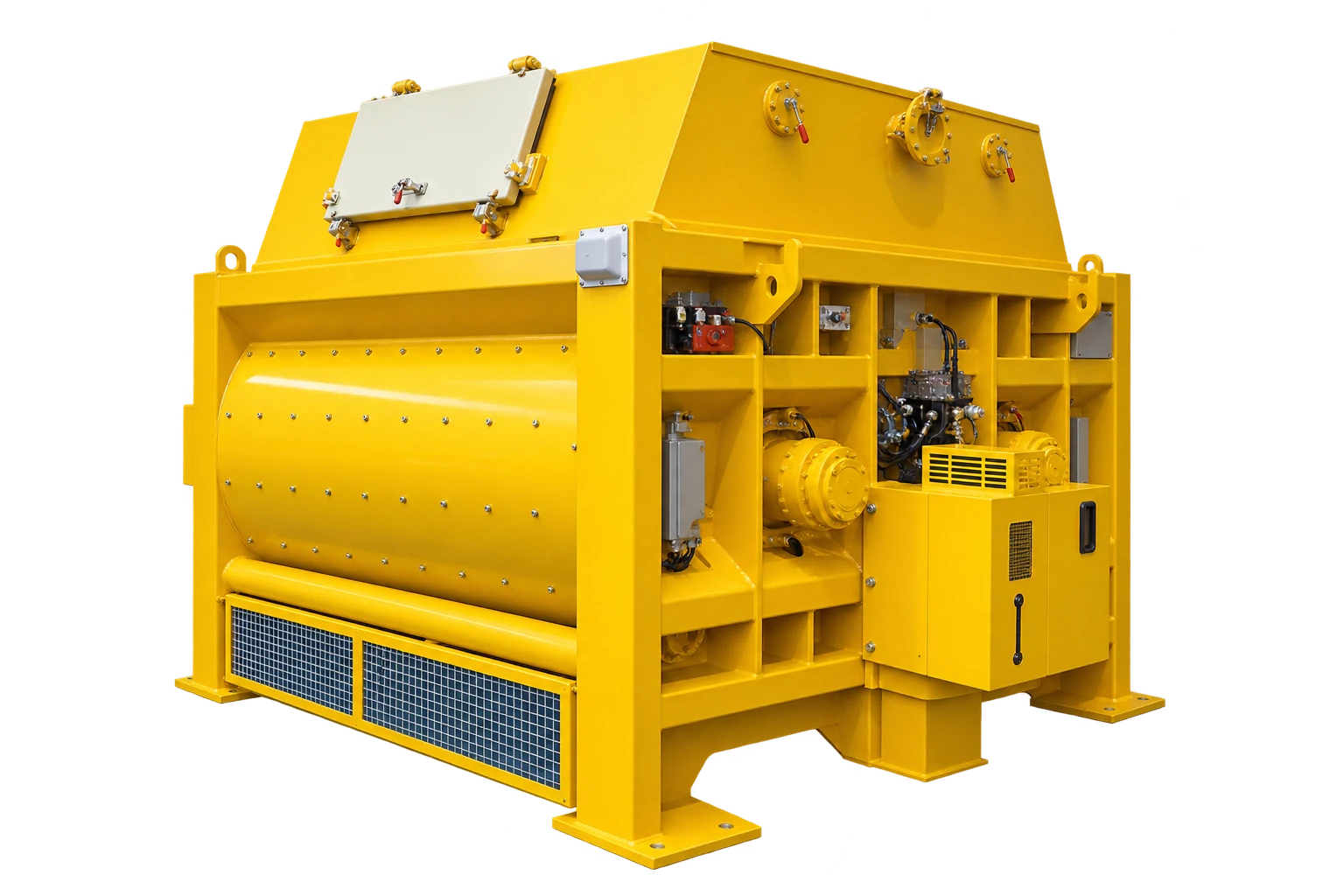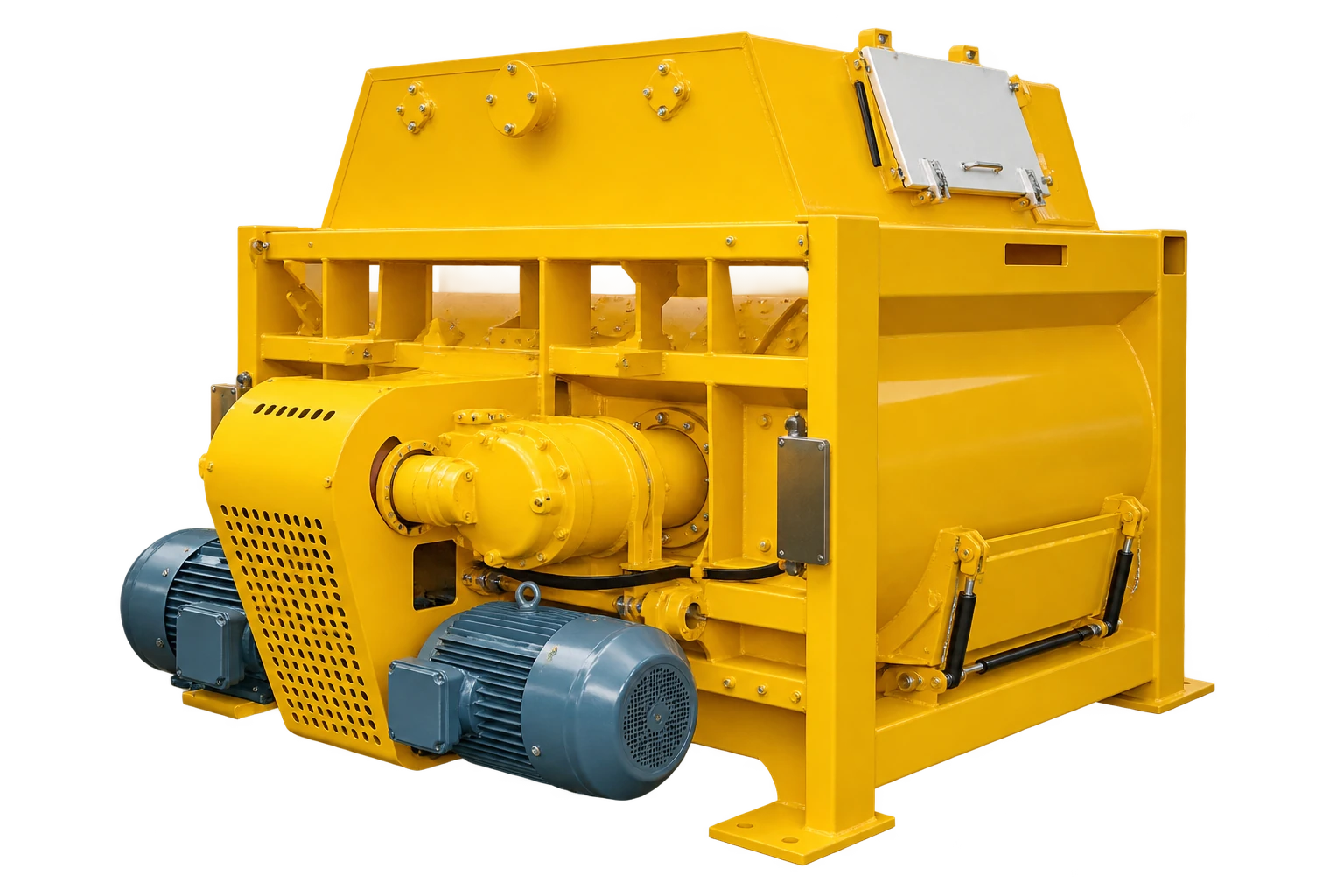
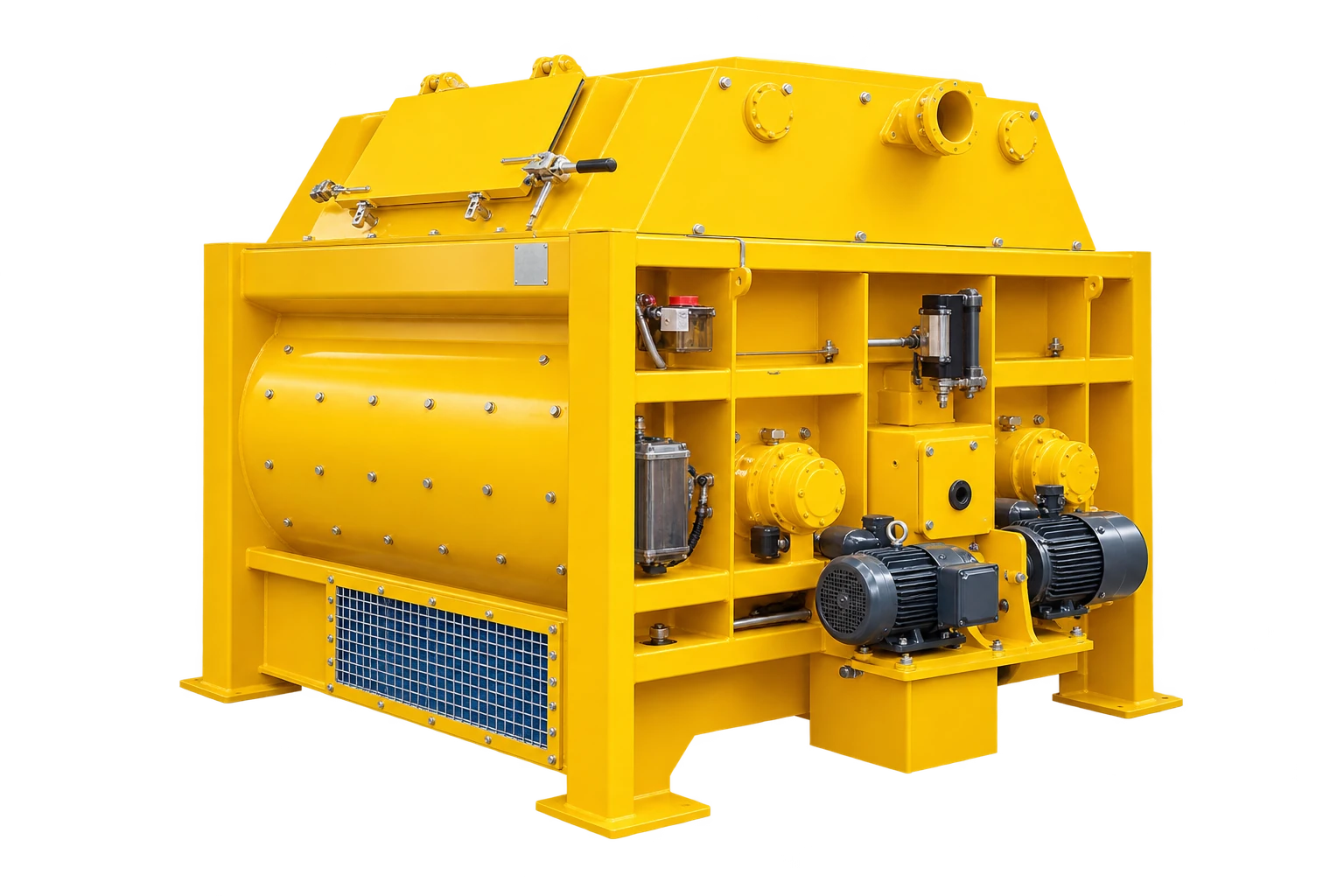
A small concrete batch plant mixer sizing decision should begin with accepted concrete required per hour, not the largest number printed beside a mixer. Convert demand into accepted batch volume using the complete charging, mixing and discharge cycle. Then check whether aggregate weighing, cement and water dosing, gates, skips or belts, discharge hoppers and concrete transport can sustain that cycle.
The MSO Small Twin-Shaft Mixer is a catalog range for smaller batching duties, published in a 0.5–1.5 m³ class. VOGO selects a candidate by batch size, charging volume and cycle frequency. Those catalog facts do not establish a project’s usable batch, mixing time, hourly production or concrete uniformity.
Define the output that the plant must accept
State demand at the point where the concrete is accepted for use. A sales target, theoretical mixer output and placed-concrete rate are different quantities. Record peak hourly demand, shift demand, pour continuity, permissible interruption, recipe changes, washout, sampling and expected rejected batches.
ACI PRC-304-00 covers material handling, measuring, batching, central mixing and transport as a connected process. That scope is useful for sizing: a mixer cannot compensate for a scale, conveyor, discharge gate or truck cycle that is slower than the proposed production rate.
Use one volume basis throughout. Compacted concrete output, loose charging volume and vessel volume are not interchangeable. Convert a recipe to mass with its documented yield or measured fresh density; do not infer batch mass from nominal litres.
Calculate batch size from the complete cycle
For a batch plant, a practical screening equation is:
Accepted output per hour = accepted output per batch × 3,600 ÷ complete cycle seconds × operating availability
Complete cycle time includes aggregate and binder charging, liquid dosing, mixing, discharge, gate movement, interlocks and routine pauses. Tecwill’s mixer-capacity explanation likewise treats filling, mixing and discharge as parts of the cycle and notes that a larger batch does not automatically create greater plant output.
Hypothetical example: a plant needs 20 m³/h of accepted concrete. The proposed complete cycle is 120 seconds and planned operating availability is 85%. Available accepted batches are:
3,600 ÷ 120 × 0.85 = 25.5 batches/h
The minimum accepted discharge per batch is:
20 ÷ 25.5 = 0.784 m³/batch
This is an arithmetic example, not an MSO capacity, cycle guarantee or recommendation. The supplier must confirm the recipe-specific working load and demonstrate it at the proposed minimum and maximum batch. Add project-defined margin only after identifying the real source of variability; arbitrary oversizing can worsen small-batch mixing, discharge coordination and capital utilization.
Check mass, charging volume and load range
Convert the chosen accepted volume into each ingredient mass using the approved mix proportions. Then compare the total charged bulk volume with the supplier-approved charging limit. Moisture corrections matter: surface water changes both the aggregate mass to weigh and the water to add.
ASTM C94/C94M-25a covers ready-mixed concrete supplied in a freshly mixed state and makes purchaser requirements part of the quality basis. Use the project’s specified version and acceptance clauses rather than quoting a universal mixer loading or mixing time. The US NRC batching and mixing training material also connects weighing, plant operation and mixer-efficiency evidence; it is not a substitute for the governing project specification.
Check both ends of the operating range. A mixer selected only at peak batch size may not perform acceptably when producing a half batch, a low-slump recipe or a mix with different aggregate grading. Ask the supplier to declare the permitted load window and the evidence used to set it.
Test the whole plant, not only the mixer
Build a time study for every operation and mark which steps can overlap. Verify:
| Plant element | Evidence required |
|---|---|
| Aggregate and binder weighing | Stable feed, scale resolution, cut-off control and complete discharge |
| Water and admixtures | Moisture correction, dosing accuracy and injection sequence |
| Mixer | Approved load range, drive trend, mixing endpoint and complete discharge |
| Downstream handling | Hopper or truck capacity, positioning time and no blocked discharge |
| Controls | Interlocks, recipe traceability, alarm handling and safe restart |
The related high-strength concrete trial-batch guide explains why process records, discharge samples and strength specimens are separate evidence. For a general small plant, define uniformity and fresh-property tests appropriate to the contract, then repeat them across representative loads. One acceptable batch does not prove sustained hourly output.
Write an acceptance run that exposes bottlenecks
Require a staged test rather than a no-load demonstration:
- Verify scales, liquid meters, gates, interlocks and data capture.
- Run the minimum intended batch with a representative recipe.
- Run the maximum intended batch without exceeding declared loading limits.
- Produce consecutive batches for the agreed duration and record every cycle component.
- Reconcile charged mass, accepted discharge, rejected material and downtime.
- Confirm fresh properties and uniformity with the project’s agreed methods.
Use measured accepted output, not the fastest isolated cycle, for handover. If the plant requires entry, cleaning or work near stored mechanical, electrical, pneumatic or gravity energy, apply an energy-control procedure; OSHA 1910.147 addresses unexpected energization during servicing. An emergency stop does not replace isolation.
Conclusion
Small concrete batch plant mixer sizing links accepted hourly demand to verified batch output, full cycle time and operating availability. Calculate the minimum batch on one volume basis, then test recipe mass, charging volume, minimum-load behavior and every upstream and downstream bottleneck. The MSO range is a candidate platform only after those project inputs and acceptance methods are defined.
References
ACI PRC-304-00 — Guide for Measuring, Mixing, Transporting, and Placing Concrete ↗ASTM C94/C94M-25a — Standard Specification for Ready-Mixed Concrete ↗US NRC — Batching, Mixing and Transporting Concrete ↗Tecwill — Choosing Concrete Plant Mixer Batch Size ↗OSHA — Control of Hazardous Energy ↗