A high-strength concrete trial batch must reproduce the intended production process closely enough to expose dosing, moisture, sequence, mixer-load and discharge risks. Freeze the materials and test methods, run a documented plant batch, sample the discharge deliberately, and evaluate fresh and hardened properties against project criteria. A strength result without a traceable process record is weak evidence for production release.
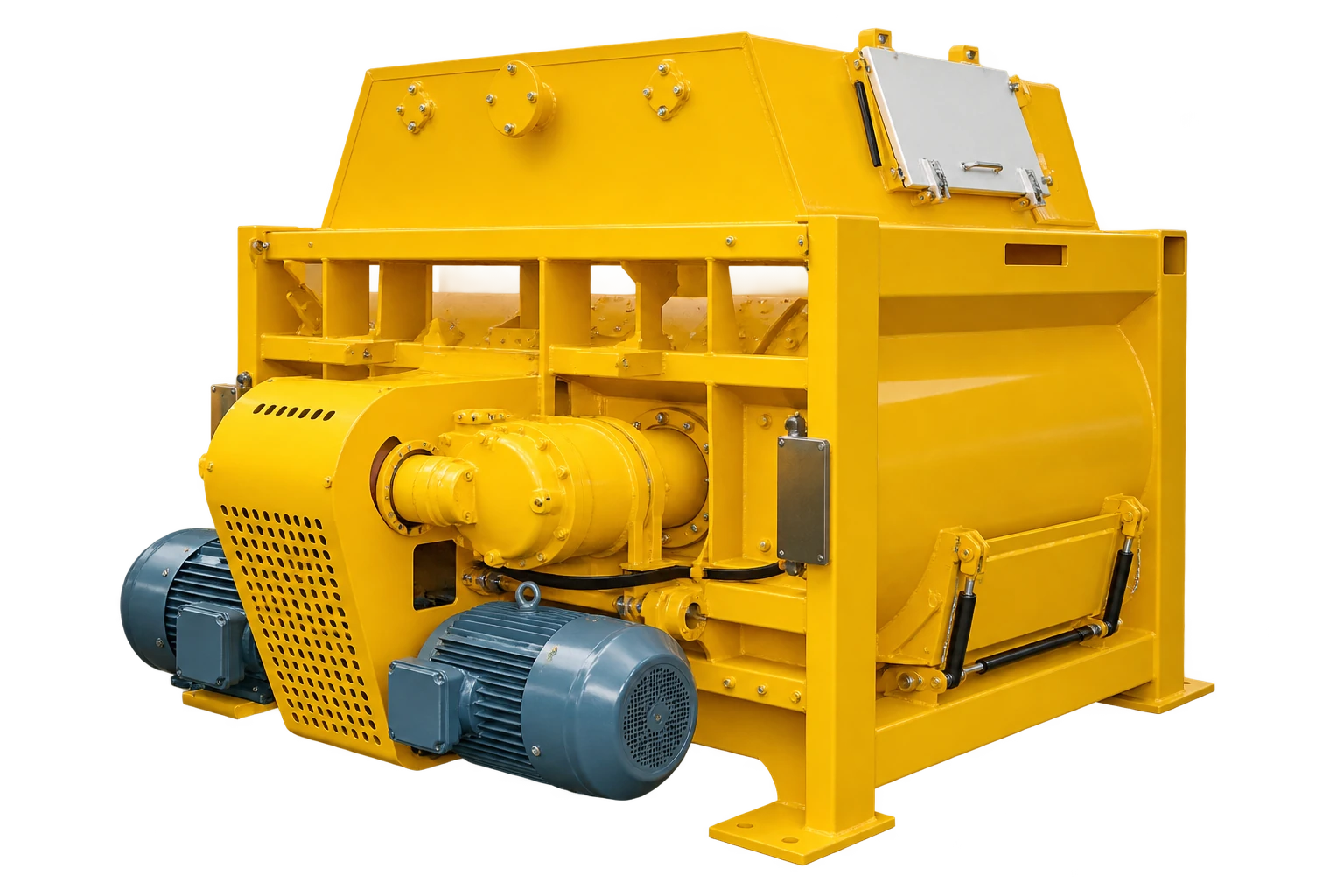
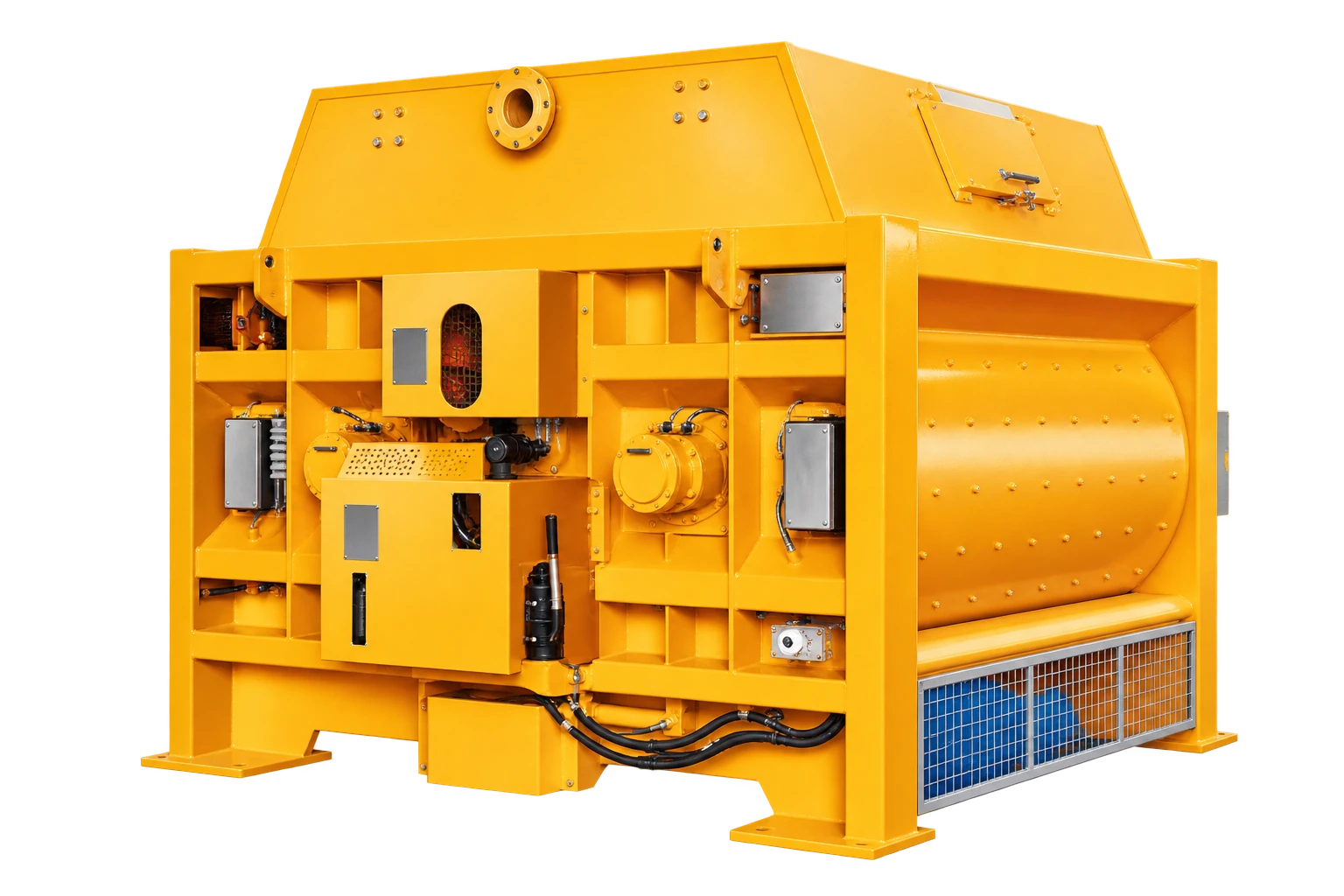
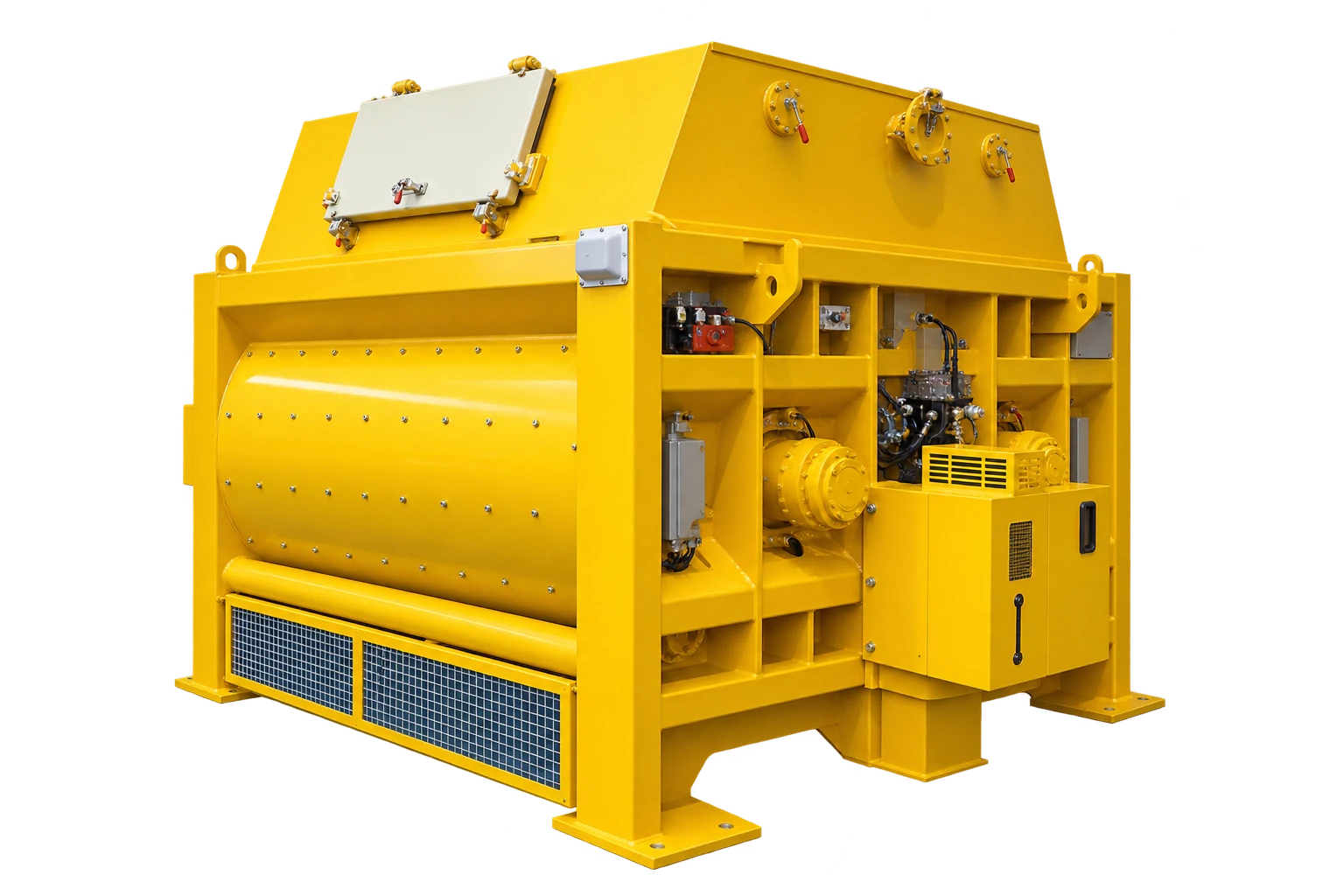
The MRC high-grade concrete mixer is a twin-shaft family with MRC2000 and MRC3000 models and a published 2–3 m³ class range. Select the actual configuration by the approved recipe, required compacted output and trial evidence; this article does not claim a universal mixing time or strength result for MRC equipment.
Define what the high-strength concrete trial must prove
ACI 363.2R-11 defines high-strength concrete within its scope as concrete with specified compressive strength of at least 55 MPa. It addresses planning, trial batches, supplier prequalification, plant control, delivery and testing. The threshold identifies the guide’s scope; it is not a recipe or an automatic acceptance limit for every project.
Separate four questions before the trial:
| Question | Evidence |
|---|---|
| Can the approved constituents produce the required properties? | Laboratory and preliminary mixture trials |
| Can the production plant dose and mix the formulation? | Full-scale process record and discharge samples |
| Can the concrete be transported, placed and cured? | Timed site simulation or production trial |
| Does the delivered concrete meet the contract? | Specified fresh tests, specimens and statistical acceptance |
ACI 363.2R-11 treats constituent selection, trial batching and production control as connected parts of high-strength concrete quality assurance. Use the proposed aggregates, supplementary cementitious materials and chemical admixtures in the trial; a convenient substitute does not validate the production combination.
Freeze materials, moisture and measurement rules
Record cementitious lots, aggregate sources and grading, admixture products and solution concentrations, water source, temperatures and moisture condition. Define whether aggregate quantities are oven-dry, saturated-surface-dry or as batched. A moisture correction must adjust both aggregate mass and added water on the project’s chosen basis.
Hypothetical correction: if 1,000 kg of weighed fine aggregate contains 0.8% measured free surface moisture, it contributes 1,000 × 0.008 = 8 kg of water. Reduce the separately added batch water by 8 kg and adjust aggregate solids using the approved calculation method. Assuming water density of 1 kg/L, 8 kg is approximately 8 L. This is an arithmetic example, not an MRC setting or a general moisture-test procedure.
High-strength mixtures often have limited water margin. Do not correct slump by adding unrecorded water. Record every manual addition and decide in advance whether it invalidates the batch. Include water in admixture solutions when the contract requires it in total mixing water.
Translate the laboratory process to the plant
The related laboratory-to-production scale-up guide explains why time and speed do not scale linearly with batch volume. For this high-strength trial, create an event log from first material entry to complete discharge:
- actual batch mass and percentage of approved mixer load;
- constituent charging order and overlapping feed times;
- dry, wet and post-admixture intervals where applicable;
- power or current trend if available and approved for process observation;
- fresh-concrete temperature and elapsed time;
- start, middle and end discharge sample identities.
The FHWA field manual recommends uniformity testing on trial batches to confirm that the plant can mix thoroughly. It supports testing the actual process rather than adopting a generic number of seconds.
Determine a defensible mixing endpoint
Begin with the equipment supplier’s permitted sequence and the project trial plan. Hold batch size and material temperature steady while evaluating a proposed time. Compare discharge portions for the properties specified by the project—such as density, air, consistency, temperature or composition-related tests—using safe representative sampling.
FHWA’s concrete materials manual explains that final mixing time can be based on mixer performance tests and that uniformity should be checked periodically. Longer mixing is not automatically better: it can change temperature, air content, workability and cycle output. Shorter mixing must not be accepted merely because one strength set passed.
When the batch does not reach the expected consistency, diagnose the process before changing the recipe. Check moisture input, delayed admixture, charging overlap, scale zero, material temperature and actual load. Change one controlled variable in the next trial and preserve the failed record.
Sample without hiding discharge variation
Do not combine all material into one composite before deciding whether the discharge is uniform. Identify early, middle and late portions, then apply the project sampling standard. Keep specimens, fresh-test results and batch data under the same identifier.
Predefine specimen geometry, preparation, curing, test ages and laboratory responsibility. The ACI FAQ cautions that cube and cylinder results are not directly interchangeable because geometry affects apparent strength. Use the contract’s specimen and evaluation method; do not convert informally after the result is known.
Repeat representative batches. One successful trial shows possibility, while repeated trials reveal moisture-control, dosing and sequence variability. If production will use minimum and maximum batch sizes, test both or justify the selected worst case. A partial load changes the material-to-tool relationship and may not behave like the normal batch.
Use a release checklist with separate gates
Release production only after every applicable gate is closed:
- Materials: approved sources, lots and certificates match the trial plan.
- Process: actual masses, moisture corrections, sequence, load and mixing endpoint are within the agreed window.
- Fresh concrete: specified consistency, air, density and temperature criteria pass.
- Uniformity: discharge-position results meet the project comparison rule.
- Hardened concrete: specimens meet the contract evaluation at the required ages.
- Operations: discharge, transport, placing, cleaning and cycle time are workable without undocumented intervention.
Strength does not waive a failed process gate. A uniform batch does not guarantee later-age strength. Keep both evidence streams and define who can approve a deviation.
Before inspecting or cleaning the chamber, isolate all drives, gates, hydraulic or pneumatic sources and upstream feeds. OSHA’s hazardous-energy guidance addresses unexpected startup during servicing. An emergency stop is not a substitute for the site isolation procedure.
Conclusion
A high-strength concrete trial batch validates the production chain, not only a compressive-strength number. Control materials and moisture, reproduce the intended charging sequence and load, sample the discharge deliberately, and repeat enough trials to expose variation. Use those results to agree the MRC configuration and plant procedure without inventing a universal mixing time or guaranteed strength.