A fiber-reinforced concrete mixer specification should tell every bidder what must be dispersed, how it will be fed, which batch loads must work and how uniformity will be accepted. Name the fiber, formulation and sequence; define the dosing and discharge interfaces; and require representative trials. A mixer type, nominal volume or speed setting cannot by itself guarantee dispersion or eliminate fiber balls.
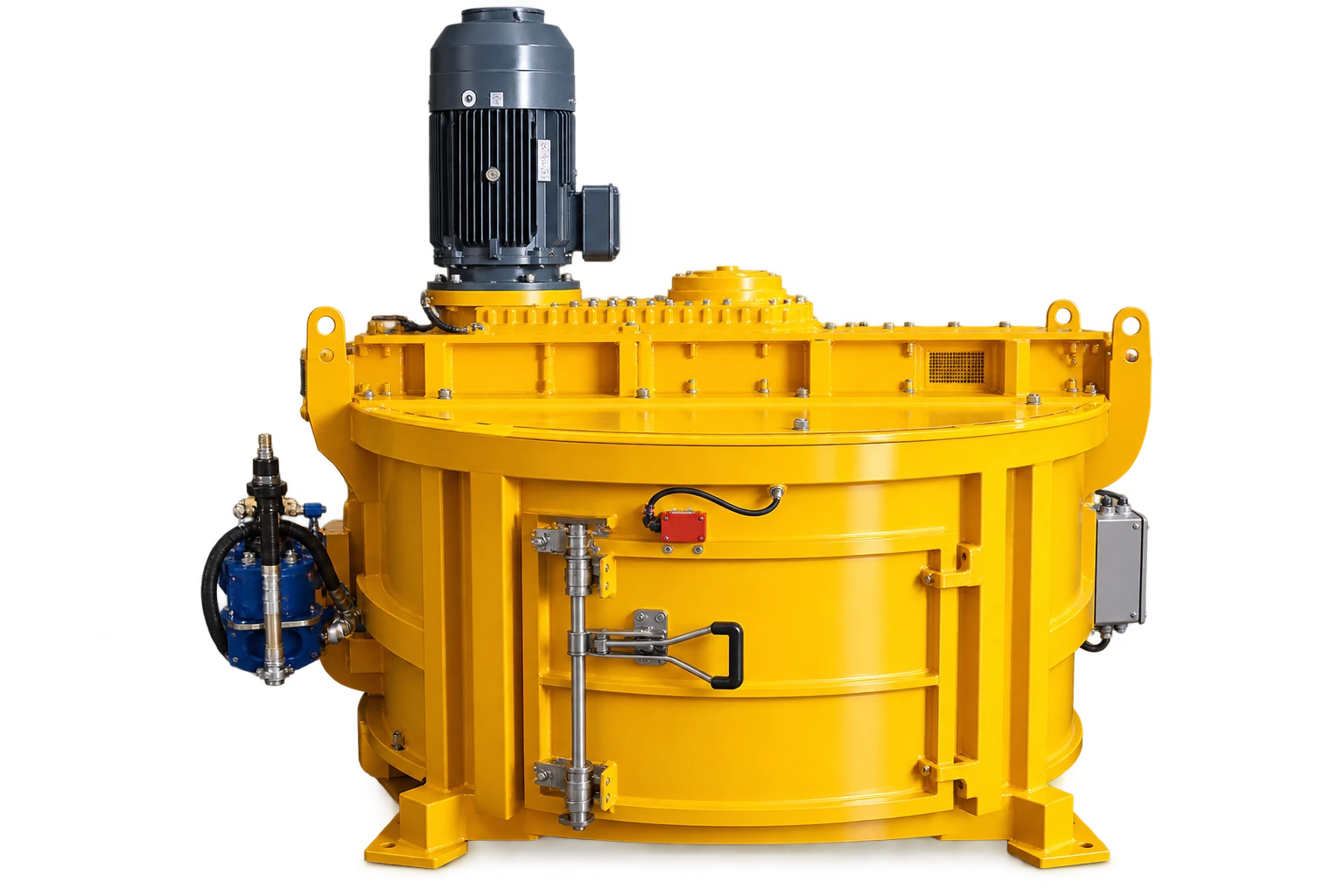
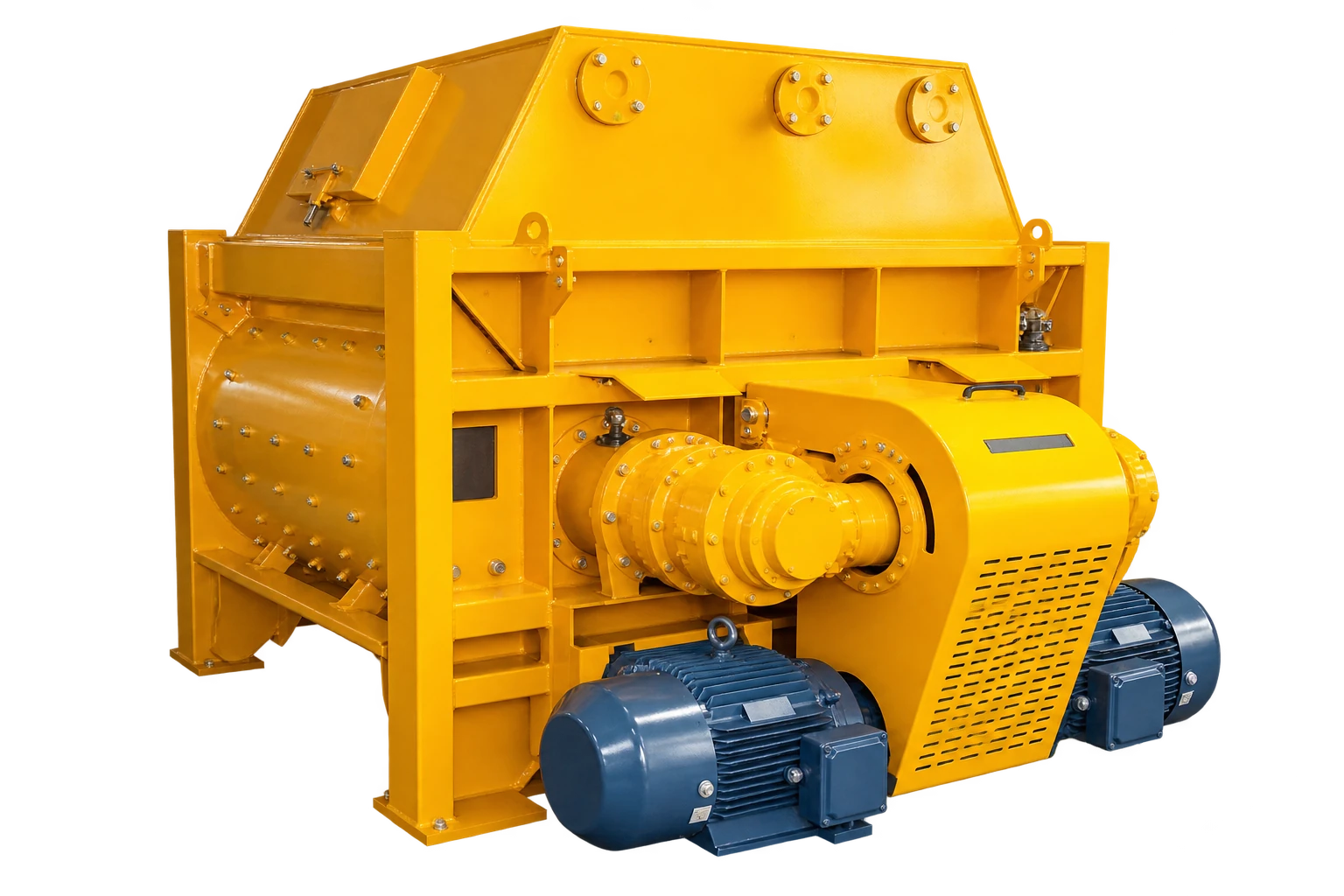
The MLO-DS-T Double-Speed Mixer is a 1,000 L-class catalog product for fiber and lightweight-material formulations. VOGO’s selection basis is working volume, fiber content and required speed stages. The catalog does not publish a universal fiber dosage, usable batch mass, mixing time or dispersion result, so those items must remain project inputs and supplier-confirmed trial outcomes.
Define the fiber-reinforced concrete purchase basis
State whether the material is conventional fiber-reinforced concrete, mortar, lightweight formulation, UHPC or another proprietary matrix. Give bidders the full constituent envelope without hiding the variables that change mixing behavior:
| RFQ item | Minimum information |
|---|---|
| Fibers | Material, dimensions, geometry, coating, loose/bundled form and dose range |
| Matrix | Cementitious materials, aggregate grading, water, admixtures and fresh-property window |
| Batch | Minimum, normal and maximum accepted mass or volume on a declared basis |
| Feeding | Package size, opening method, feeder ownership, addition rate and sequence |
| Quality | Workability, air, density, fiber-dispersion and finished-product tests |
| Operations | Required batches per hour, changeover, cleaning, access and waste route |
ASTM C1116/C1116M-23 covers specified forms of fiber-reinforced concrete delivered with the ingredients uniformly mixed and states that applicable material should be free of fiber balls. It also distinguishes fiber classes. Use the project edition and contract language; the standard does not choose a mixer or validate a VOGO model.
The ACI 544.3R-08 abstract confirms that fiber-reinforced production needs guidance specific to proportioning, mixing, placing and finishing, including techniques for uniform mixtures. This makes fiber delivery and sequence part of the equipment specification, not an operator note added after purchase.
Specify dosing before discussing speed
Define how fibers arrive and enter the mixer. Loose steel fibers, glued bundles, macro-synthetic fibers and fine microfibers may need different opening, conveying and feed-rate controls. Ask the fiber supplier for handling limits, then require the mixer bidder to return the compatible addition point and sequence.
Hypothetical dosing example: a 1,500 kg accepted batch calls for fibers at 20 kg/t of total batch mass. The required fiber mass is:
1.5 t × 20 kg/t = 30 kg
If the fiber feeder delivers that mass over 45 seconds, the average feed rate is 30 ÷ 45 = 0.67 kg/s. These values explain the interface calculation only; they are not MLO-DS-T settings, a recommended dosage or evidence that a given fiber can enter at that rate.
Require mass verification, empty-package control and a response to bridging or stalled feed. A timer alone does not verify fiber mass. If bags are manually opened, include ergonomics, dust or loose-fiber containment and a safe loading platform in the scope.
Build a sequence around observable matrix states
Do not write “run slow, then fast” without defining when and why the transition occurs. A sequence may identify dry blending, initial wetting, admixture addition, matrix development, controlled fiber feed and final dispersion, but the actual stages must follow the approved formulation.
The FHWA study on UHPC material characterization documents a specific sequence in which fibers were added after the matrix developed into a viscous paste. That is evidence that sequence matters for that studied material, not a universal instruction for all fibers or MLO-DS-T equipment. The broader FHWA batching lesson likewise treats correct charging sequence as a condition for uniform mixing.
For each proposed speed stage, ask the supplier to state its purpose, duration or endpoint, permitted working load, drive-load limit and interlocks. Validate temperature rise, air content, workability and fiber condition. Higher speed is not automatically higher quality.
Define a trial that can reject poor dispersion
The acceptance plan should expose weak mixing rather than average it away. Identify at least early, middle and late discharge samples. Apply project-approved tests to each portion, and preserve sample identity through fresh and hardened testing.
A practical trial matrix includes:
- the minimum intended batch, where tools may engage the material differently;
- the maximum supplier-approved working load;
- the highest fiber dose or most difficult fiber form;
- the lowest-workability matrix in the approved envelope;
- a repeated normal batch to measure process variation.
Record actual constituent masses, addition times, speed-stage transitions, mixer current or power if available, total time, discharge time and operator interventions. Inspect the agreed samples for fiber balls using a defined rule. Where fiber content or distribution is measured, name the method, specimen locations and acceptance limits in the contract.
The related UHPC mixing-sequence guide explains why formulation, moisture, temperature, liquids and fiber stage should be frozen during production validation. Link to that procedure rather than copying its UHPC-specific timing into a different matrix.
Procure discharge, cleaning and controls with the mixer
Uniform material can still fail in a restrictive hopper or slow gate. Require a discharge trial into the real downstream opening or a representative fixture. Check retained fiber, dead zones, gate sealing and the risk of segregation during transfer.
Define the cleaning method, frequency, access, wash-water or dry-residue route and changeover release rule. If personnel may inspect or clean the chamber, design the system for isolation of electrical, pneumatic, hydraulic and gravity-fed energy. NIOSH lockout guidance addresses unexpected startup during maintenance; an emergency stop is not a substitute for isolation.
The supplier return should list included and excluded feeders, platforms, guards, dust extraction, controls, recipes, instrumentation, commissioning, training and trial material. A low quotation that omits fiber dosing or safe cleaning is not directly comparable with a complete system.
Conclusion
A fiber-reinforced concrete mixer specification ties fiber form and dose to a controlled feeding method, observable sequence, approved load range and measurable dispersion. Require difficult-condition and repeat trials, sample the discharge deliberately, and include discharge, cleaning and energy isolation in the purchase boundary. Use the MLO-DS-T range as a candidate only after the formulation and acceptance plan are defined.
References
ACI 544.3R-08 — Guide for Specifying, Proportioning, and Production of Fiber-Reinforced Concrete ↗ASTM C1116/C1116M-23 — Standard Specification for Fiber-Reinforced Concrete ↗FHWA — Material Property Characterization of Ultra-High Performance Concrete ↗FHWA — Best Practices for Batching and Mixing ↗NIOSH — Using Lockout and Tagout Procedures During Machine Maintenance ↗