Aggregate moisture correction keeps the approved aggregate solids and total mixing water unchanged when stockpile moisture differs from the saturated-surface-dry (SSD) basis used in a concrete recipe. For each aggregate, measure total moisture, compare it with absorption, correct the batch mass and then correct separately added water. The calculation does not authorize a recipe change.
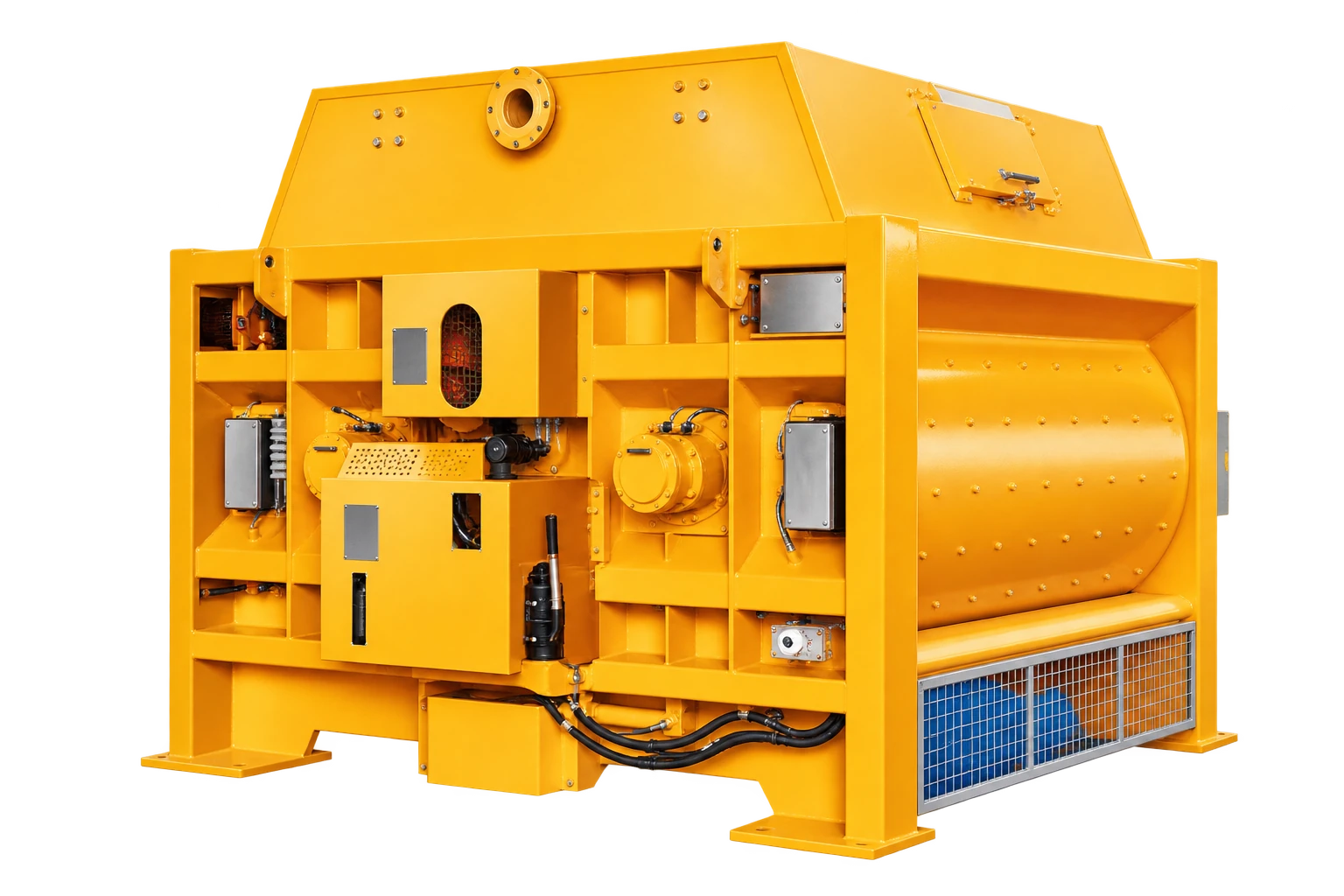
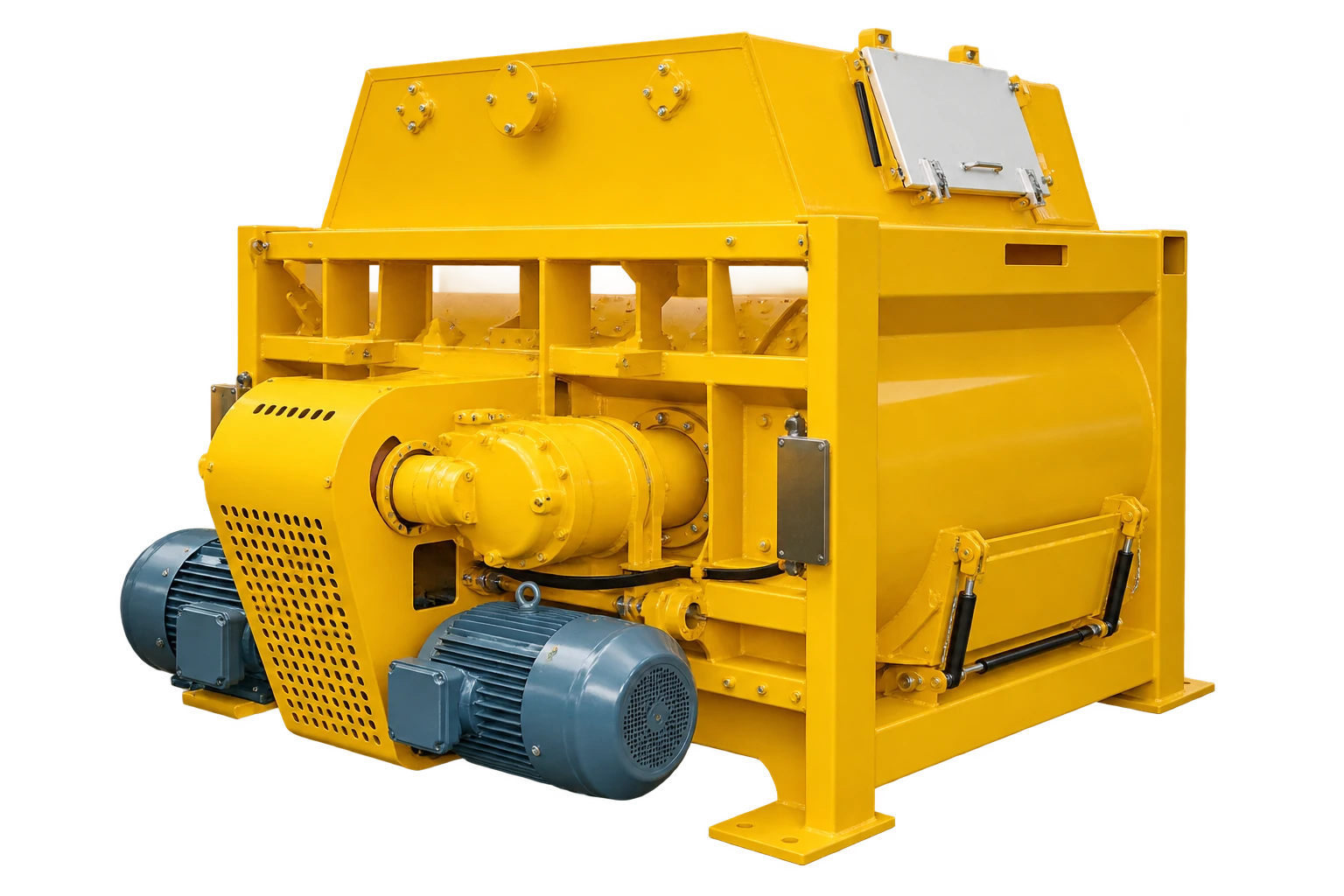
The MPO precast concrete mixer range is selected by compacted output, mix design and production cycle. Those catalog fields do not determine aggregate moisture or the corrected water dose. A procurement specification should state how the batching controls receive, timestamp and retain moisture corrections before material enters the mixer.
Separate absorbed water from surface water
NRMCA TIP 6 distinguishes oven-dry, air-dry, SSD and wet aggregate. On an SSD recipe basis, water held inside saturated pores is already accounted for in the aggregate definition. Free water coating the particles contributes to mixing water. Aggregate below SSD will instead take water from the mixture.
Use the same mass basis for moisture and absorption:
| Condition | Total moisture M versus absorption A | Batch action |
|---|---|---|
| Wet above SSD | M > A | Increase aggregate batch mass and reduce added water |
| At SSD | M = A | Batch the SSD mass; no moisture-water correction |
| Below SSD | M < A | Reduce aggregate batch mass and add water for the deficit |
ACI’s technical answer states that wet aggregate surface water is part of mixing water, while dry aggregate needs water to fill permeable pores. Keep this accounting separate from later water additions, ice and water carried by high-dose admixtures.
Use equations that preserve aggregate solids
Let WSSD be the recipe mass at SSD, M the measured total moisture fraction on the oven-dry basis, and A the absorption fraction on that same basis.
Wwet = WSSD × (1 + M) ÷ (1 + A)
Surface-water correction = Wwet − WSSD
For aggregate above SSD, subtract the positive correction from the water to be added. For aggregate below SSD, the correction is negative; its absolute value is additional water needed to retain the SSD water basis. Confirm the governing recipe convention before applying these equations because some control systems store oven-dry rather than SSD masses.
The public scope of ASTM C566-25 identifies drying as suitable for adjusting concrete batch quantities and warns that sampling representation can be a larger uncertainty than the moisture determination. Obtain and follow the complete applicable procedure; this article does not reproduce the standard.
Work a hypothetical sand correction
Assume a recipe calls for 800 kg of sand at SSD. Laboratory records give 6% total moisture and 2% absorption. These invented values illustrate arithmetic and are not MPO operating data.
Wwet = 800 × 1.06 ÷ 1.02 = 831.37 kg
Surface water = 831.37 − 800 = 31.37 kg
If the approved total mixing-water target is 170 kg and no other water source changes:
Water to add = 170 − 31.37 = 138.63 kg
The plant would therefore batch 831.37 kg of wet sand and 138.63 kg of separately added water for this isolated example. Repeat the correction for every aggregate fraction. Then include ice, admixture water and any authorized later addition in the same total-water reconciliation. Do not round controller entries until the plant’s resolution and approved rounding rule are applied.
Build a moisture record that can survive a quality review
Record the stockpile or bin, sample location, sample time, test method, wet and dry masses, absorption source, calculated correction, recipe revision and batch IDs affected. A value taken from the top crust of a stockpile may not represent material discharged from the bin.
NPCA’s testing guidance notes that moisture can change with storage and weather and describes ASTM C566 for fine or coarse aggregate. Its stated testing frequencies belong to the cited NPCA program; another project may require a different plan. The general lesson is to define the frequency and verify instruments against representative reference samples.
| Control question | Evidence required | Hold condition |
|---|---|---|
| Which material was measured? | Aggregate source, fraction and bin | Identity is unclear |
| Does the sample represent the next batches? | Location, time and handling route | Rain, refill or segregation occurred |
| Is absorption current? | Approved material test record | Supplier or aggregate source changed |
| Is the probe credible? | Calibration and reference-test comparison | Drift or bias exceeds the plant rule |
| Was the correction applied once? | Controller record and batch ticket | Manual and automatic correction may overlap |
The related concrete batch yield calculation guide addresses measured fresh volume after batching. Moisture correction happens earlier and should not be adjusted merely to force a later yield result to match a target.
Treat probes as controlled instruments
Locate a probe where it sees the material actually delivered and account for transport delay between measurement and weighing. Check for buildup, uneven flow and changes after bin refill. A stable display is not proof that the reading is representative.
Compare the online reading with a documented reference test across the operating range. If the difference is outside the plant’s rule, isolate affected batches according to the quality plan, correct the instrument or sampling issue, and verify before relying on automatic compensation again.
Avoid using mixer power, slump or operator feel as a substitute for aggregate moisture. Those signals respond to several variables. They can trigger investigation, but a water correction still needs an authorized basis and traceable input.
Close the batching and mixer interfaces
The mixer supplier needs the maximum corrected wet charge, loading sequence, water-meter range, signal timing and any allowed trim-water logic. The batch-control supplier needs the recipe basis, absorption values, probe mapping and rules for stale or invalid readings. The producer must define who may override a correction and how that action appears on the ticket.
During acceptance, challenge the workflow with representative dry and wet conditions within the approved material envelope. Verify the calculation, controller transfer, actual weighing, water total and retained record. Evaluate concrete with the project tests; correct arithmetic alone does not prove conformity.
Conclusion
Aggregate moisture correction starts with a stated SSD or oven-dry recipe basis and a representative measurement. Correct wet aggregate mass to preserve solids, reconcile surface water with all other mixing-water sources, and retain the calculation with each affected batch. Verify probes and controller logic before treating an automatic correction as evidence.