
Concrete batch yield is the fresh concrete volume represented by a known batch mass and a representative measured fresh density. Calculate Y = M ÷ D, with mass M in kg and density D in kg/m³, to obtain yield Y in m³. Keep this measured volume separate from vessel size, loose charging volume and the volume eventually placed in the structure.
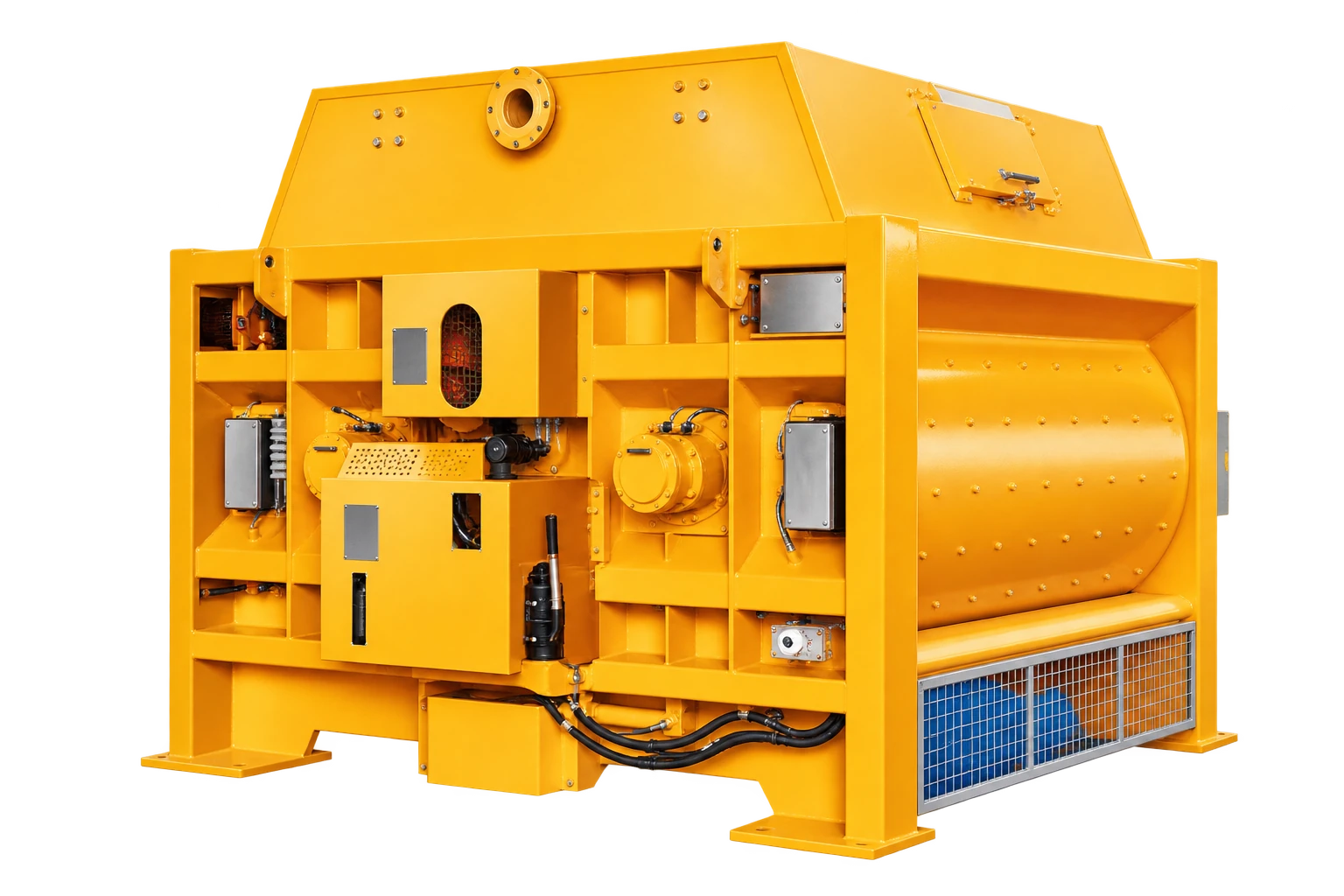
The MAW hydropower concrete mixer range publishes separate charging and discharge data. Those catalog entries help identify equipment; they do not establish the measured yield of a particular formulation. A batch-volume check should accompany the accepted recipe and test method, rather than be inferred from a model code.
Define the boundary of a concrete batch yield check
ACI’s yield definition links fresh volume to total material mass and measured fresh density. Use the mass of the same mixture that the density sample represents. A density taken after an undocumented water addition cannot be combined confidently with an earlier batch ticket.
Choose whether the accounting boundary is the complete material charge, discharged concrete or a delivered load. State that boundary on the record. If concrete remains in the mixer or a transfer hopper, the charge-based yield and the quantity delivered downstream answer different questions. Do not silently subtract a guessed residue from the ticket total.
This guide explains volume accounting for a representative fresh-concrete test. It does not prescribe a density procedure for every consistency. The existing RCC mixer selection guide discusses the separate stiff-mixture testing boundary. A conventional fresh-density procedure should not be applied to very dry RCC merely because the same mixer can handle a related duty.
Assemble a mass and density record that can be checked
Use actual delivered ingredient masses, not only recipe targets. Keep aggregate moisture accounting consistent: if aggregate mass already includes its moisture, adding that moisture again as a separate mass would double count it. Include actual separately added water and admixtures on their documented mass basis. Volume-dose records need a verified conversion before joining a kg total.
| Record field | Evidence to retain | Reason to hold the calculation |
|---|---|---|
| Batch identity | Ticket, recipe revision and timestamps | Sample cannot be matched to the ticket |
| Ingredient mass | Actual masses and later additions | Only nominal proportions are available |
| Density measure | Identified, verified container volume | Container volume is assumed |
| Sample | Location, time and representative sampling basis | Sample follows an unrecorded process change |
| Weighing | Empty and filled masses, scale identification | Tare or units cannot be established |
| Method | Applicable procedure and operator record | Compaction method does not suit the mixture |
| Material disposition | Residue, spills, held or returned concrete | Charged volume is confused with delivered volume |
The public ASTM C138/C138M scope identifies fresh density, yield and related calculations. Its public summary is not a substitute for the complete applicable procedure. The laboratory must select the project-required edition, equipment, sampling and consolidation method; this article does not reproduce the standard or certify a test.
Work through a hypothetical batch calculation
Assume an intended fresh batch volume of 3 m³, an actual recorded material mass of 7050 kg and a valid representative density of 2400 kg/m³. Assume all mass entries refer to the same accounting boundary. These values are invented solely for arithmetic and are not MAW operating data.
Y = 7050 ÷ 2400 = 2.9375 m³
Relative yield = 2.9375 ÷ 3 = 0.9792 = 97.92%
Volume difference = 2.9375 − 3 = −0.0625 m³
This shows the calculated difference, not a universal rejection threshold. The contract and applicable test rules govern repeat measurements and acceptance. Avoid rounding intermediate values so early that a small difference disappears.
If the same hypothetical ticket includes 1050 kg of cement, its content per measured fresh volume would be:
Cement content = 1050 ÷ 2.9375 = 357.45 kg/m³
That differs from dividing by the intended 3 m³, which gives 350 kg/m³. It is an accounting consequence of the assumed data, not permission to change cement or water. Any mix adjustment requires the approved formulation and quality review.
Investigate an apparent shortage in the right order
First check identity and arithmetic. Confirm units, tare, measure volume and actual additions. Reconcile the mass total before interpreting a percentage. A transcription error in density can make an otherwise sound batch look short.
Next examine the measurement and mixture conditions. NRMCA CIP 8 separates real yield discrepancies from apparent shortages caused by placement dimensions, waste and other site effects. It also identifies batching and air-content variations as relevant. Follow the applicable multi-load verification plan for a supply investigation instead of treating this single hypothetical batch as a compliance test.
Then compare the production and placement records. A form that is larger than the estimate, retained material in transfer equipment and a spill should be documented separately. Even an accurate fresh-yield calculation cannot locate an unmeasured loss along the delivery path.
Do not add water to make a load occupy more volume. An increased yield caused by a composition change may fail other requirements. Keep water control, air, consistency, temperature and strength acceptance as separate checks under the project plan. A larger calculated volume is not automatically a better batch.
Use density sensitivity as a reason to verify inputs
With the same assumed 7050 kg mass, a density of 2350 kg/m³ would calculate to 3 m³. This comparison isolates the arithmetic sensitivity to density; it does not predict how the actual mixture behaves or establish that either density is correct.
A plausible-looking density value should therefore be supported by raw measurements. Review the empty mass, filled mass and container volume, then the sampling and consolidation record. If the sample is unrepresentative, repeating the division more precisely cannot repair the evidence.
Trend measurements by recipe, batch identity and material condition. An abrupt change needs investigation against ingredient and test records. A slow shift should not be assigned to mixer wear from yield alone. Several different causes can change fresh density or the recorded mass basis.
Preserve the result for procurement and process acceptance
For an equipment trial, agree on the volume definition before calculating hourly output. Report measured fresh yield, accepted product quantity and complete cycle separately. A supplier’s rated discharge volume and a project’s accepted recipe output may have different evidence and conditions.
Keep a reconciliation sheet with raw data, formulas, rounding, deviations and material disposition. Name who may authorize a correction and what must be retested. A useful record allows another engineer to reproduce the result without guessing which mass or density was used.
Conclusion
Concrete batch yield calculation requires a matched batch mass and representative fresh density. Use the result to investigate volume accounting, with measured and intended volumes shown separately. Confirm the test boundary and inputs before changing a recipe, rejecting equipment or attributing a placement shortage to the mixer.