
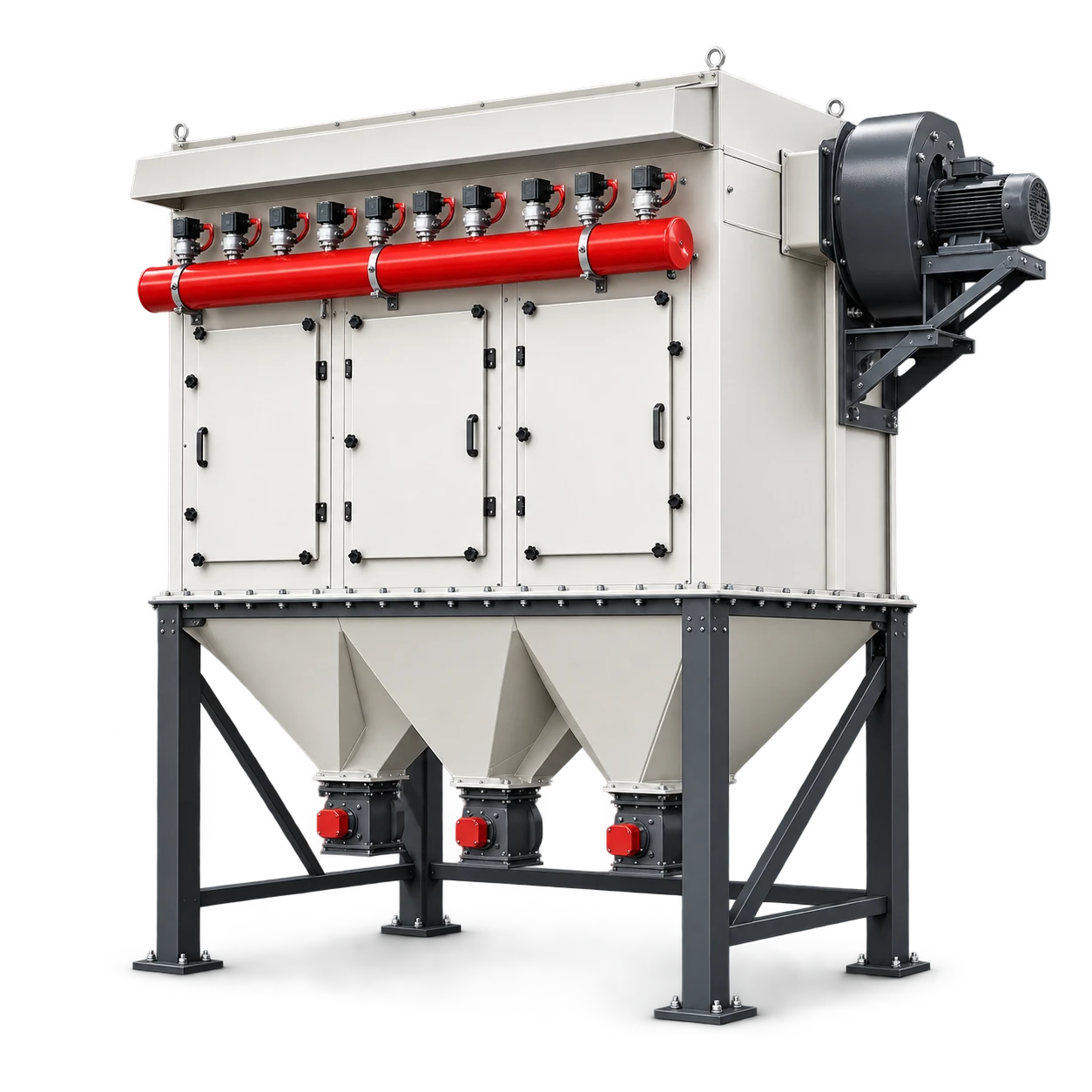
A dust collector emissions specification should define the required outlet particulate concentration, gas-volume reference conditions, operating duty and acceptance test. A removal-efficiency percentage alone cannot establish the outlet result without an inlet loading and flow basis. Put the performance boundary and evidence into the purchase specification before comparing quotations.
The DMC pulse bag dust collector has published airflow, filtration-area and configuration tables. Those entries support an equipment discussion; they do not establish a project-specific outlet-emissions guarantee. Ask for a written response to the actual dust and gas duty rather than assigning a guarantee from the catalog size.
Separate collection efficiency from outlet concentration
Removal efficiency compares incoming and outgoing particulate mass rates. Outlet concentration expresses particulate mass per stated gas volume. If inlet and outlet gas flows use the same conditions and are equal, the concentration ratio can simplify the efficiency calculation. Otherwise, use the corresponding mass flows rather than silently assuming equal volumes.
The EPA pulse-jet fabric-filter fact sheet explains why outlet concentration and percentage efficiency behave differently as inlet loading changes. Its historical performance ranges are not guarantees for DMC or a particular mineral powder. The purchase question is what the complete collector will demonstrate under the declared conditions.
Also separate filter collection from source capture. Dust that never enters the extraction hood cannot be removed by the collector. A good outlet test does not establish worker exposure control, capture at every transfer point or the absence of casing leaks. Those need their own system evidence.
Write a supplier-return schedule with an explicit basis
State whether gas volumes are actual or referenced to defined temperature and absolute pressure. Identify dry or wet gas basis and any applicable oxygen correction. The abbreviation “normal cubic metre” is incomplete unless its reference conditions are specified. Do not compare two concentrations whose gas bases differ.
| Specification field | Supplier response required | Evidence gap to close |
|---|---|---|
| Dust envelope | Materials, particle characteristics, moisture and variability | Only the product name is given |
| Gas duty | Minimum, normal and maximum flow with reference basis | Actual and reference flow are mixed |
| Outlet requirement | Concentration, units, averaging and applicable conditions | Only a percentage is offered |
| Equipment boundary | Collector, seals, elements, cleaning and discharge scope | A media-only test is presented as whole-unit evidence |
| Test arrangement | Method, location, access, operating load and responsible party | Sampling cannot represent the actual outlet |
| Acceptance rules | Reporting limit, uncertainty, repeats and disposition | Pass/fail is decided after seeing results |
| Ongoing evidence | Monitoring, alarms, records and maintenance responsibilities | An instrument signal is treated as a guaranteed concentration |
The existing silo filter media selection guide covers element construction and compatibility. Use that separate approval process where relevant. A media selection does not by itself close the emissions specification for a different complete collector.
Compare two hypothetical performance statements
Assume a dry gas stream whose inlet and outlet flows are equal at the same declared reference conditions. Let inlet concentration be 10000 mg/m³ and flow be 1000 m³/h. These are calculation assumptions, not DMC ratings or a regulatory limit.
Offer A states only 99.9% removal efficiency. For the assumed conditions, its implied outlet concentration is:
Cout = 10000 × (1 − 0.999) = 10 mg/m³
Outlet mass rate = 10 × 1000 = 10000 mg/h = 10 g/h
If the project’s hypothetical acceptance criterion were 8 mg/m³ on exactly that basis, the stated percentage would not demonstrate acceptance. Offer B instead states 5 mg/m³, but still needs the same operating envelope and an agreed test before it can be accepted. Neither statement proves installed performance by itself.
Illustrative comparison: 10 mg/m³ > 8 mg/m³; 5 mg/m³ < 8 mg/m³
Do not extrapolate the assumed efficiency to another inlet loading as though the collector necessarily holds that percentage. The example only translates an offer’s stated basis. A useful clarification asks each supplier to commit to the same outlet metric and identify every exclusion, including startup, cleaning and unusual material conditions.
Agree on a test that measures the promised result
Specify who develops the test plan and confirms its applicability. EPA Method 5 describes isokinetic sampling and gravimetric particulate measurement for stationary sources. It is an example of a defined measurement method, not the automatically applicable method for every collector, outlet geometry or jurisdiction. The project must select the required method and edition with the competent testing party.
Include the sampling location and access in the equipment layout before purchase. A collector exhausting directly through a roof opening may need a specifically engineered test arrangement. Do not assume that a portable dust reading beside the outlet is equivalent to a representative emissions test.
Record dust identity, production rate, gas conditions, cleaning sequence and discharge operation during testing. Define whether starts, stops and cleaning events belong within the acceptance period. A short favorable snapshot should not silently replace the agreed operating window.
Ask the laboratory to report raw conditions, corrections, detection or reporting limits and the treatment of measurement uncertainty. If a proposed limit is below what the planned method can resolve reliably, close that issue before commissioning. An unquantified “not detected” result should not be rewritten as zero emissions.
Distinguish monitoring from acceptance measurement
The EPA fabric-filter monitoring overview identifies outlet particulate evidence alongside operating indicators such as pressure differential and cleaning operation. Pressure drop helps describe operation, but its value alone does not establish outlet concentration.
The EPA bag-leak detection guidance, section 1, limits its suggested triboelectric approach to upset detection rather than quantified emission rates. Its setup also depends on site conditions. Specify whether an offered device is a leak alarm or a calibrated concentration measurement system, with the evidence appropriate to that role.
Agree on alarm response, record retention and who reviews a change in signal. Do not invent a universal alarm setting. An enclosed collector is not automatically airtight or pressure-rated; sealing and pressure conditions remain separate approvals.
Close commercial and technical exclusions together
Ask bidders to separate the collector price from testing access, duct changes, instruments and independent measurements. Assign responsibility for failed-test investigation, corrective work and repeat testing in the contract. These are suggested procurement headings, not existing VOGO service commitments.
Keep permit obligations and contractual equipment acceptance distinct. A supplier test can support a compliance assessment, but it does not replace the project’s applicable regulatory decision or exposure evaluation. Obtain the relevant local requirements without importing a limit from an unrelated industry.
Conclusion
A usable dust collector emissions specification connects an outlet metric to defined gas conditions, material duty and a measurable acceptance plan. Normalize those fields before comparing price or efficiency claims. Keep source capture, filter compatibility, monitoring and whole-unit emissions evidence as separate decisions with named responsibilities.