
Batch versus continuous dry mortar mixing should be decided from the production campaign, ingredient dosing and material-release plan. Batch mixing gives a defined charge and discharge boundary. Continuous mixing needs synchronized ingredient flows and a way to identify material affected by starts, stops and feeder disturbances. Required tonnes per hour alone cannot decide the process.
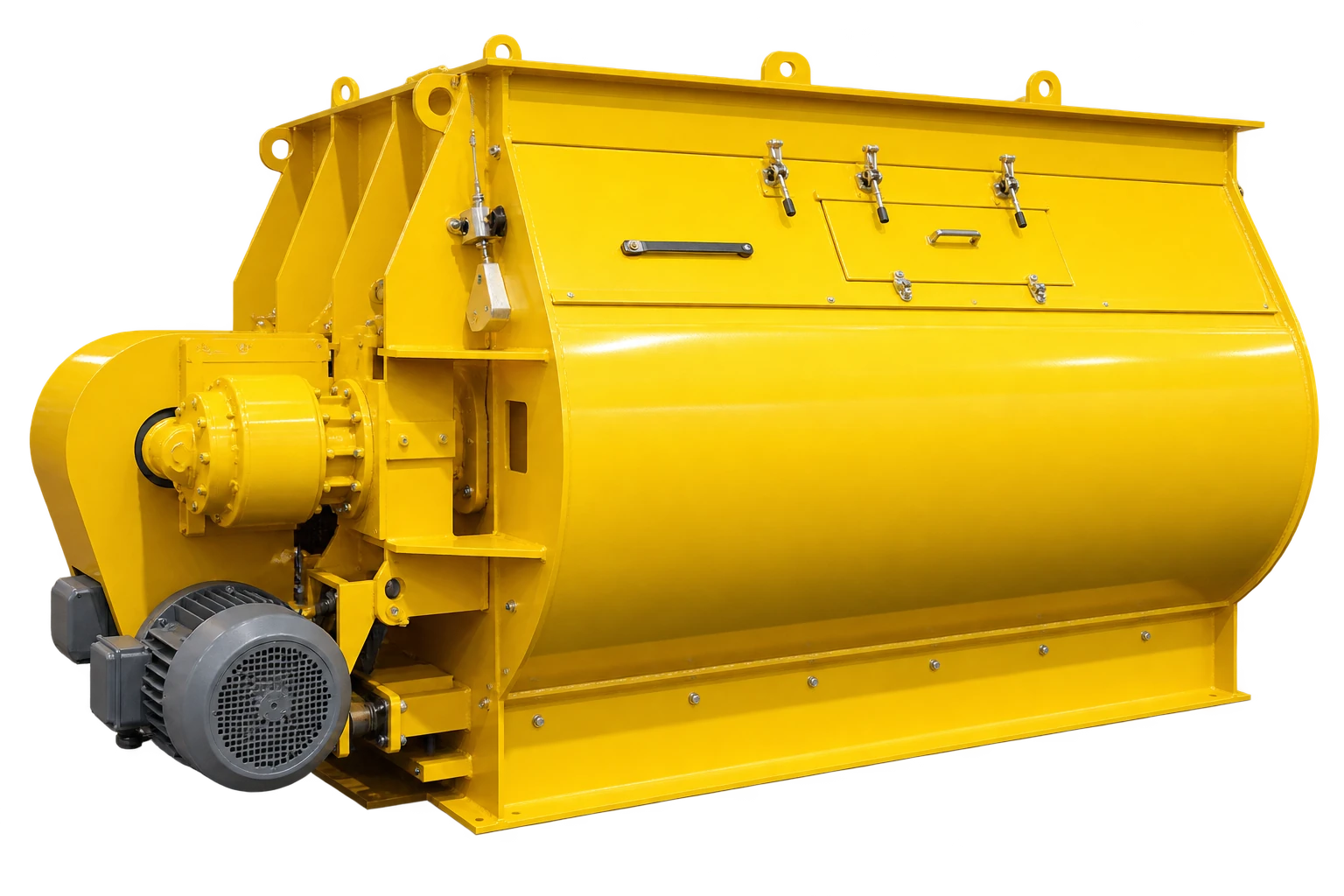
The MSD twin-shaft dry mortar mixer is a catalog option for large dry-mix batches. Its total and working volumes are separate entries. This article compares process concepts; it does not present MSD as a continuous mixer or guarantee a recipe-specific output. Confirm the intended operating mode and working load with the supplier.
Define the product before comparing processes
Write down the dry formulation, ingredient lots, bulk-density range, particle-size differences, moisture condition and any liquid addition. Identify the constituent whose distribution matters most to product acceptance. A low-dose additive may govern the decision even when sand and binder account for most of the mass.
Also define the saleable product. An industrial line blending dry powders for bags or silos is different from a site mixer adding water to a finished dry mortar. A continuous wet-mortar machine is not automatically an alternative to an industrial dry-blending plant.
Hosokawa Micron’s process comparison distinguishes fixed charges from simultaneous metered feeding and discharge. It treats formulation changes and feeding stability as selection inputs. Neither operating mode establishes the shear intensity or proves that fragile particles will survive a particular mixer.
Compare the decisions that change the line design
Use the following project review table rather than a universal production-rate threshold. The entries are engineering questions for supplier comparison, not promises about either technology.
| Decision | Batch proposal must show | Continuous proposal must show |
|---|---|---|
| Minor ingredient delivery | Actual delivered mass in each charge | Stable ratio through normal feeding and refill |
| Recipe change | Emptying, cleaning and next-batch release | Transition route, retained material and release boundary |
| Downstream interruption | Safe hold time and discharge disposition | Feeder/mixer coordination and affected-material disposition |
| Traceability | Ingredient lots associated with each batch | Time-linked feed, residence and discharge records |
| Quality sampling | Representative portions of identified batches | Time-resolved samples across stable operation and disturbances |
Check how the proposed bagging or storage system receives the mixture. A buffer may decouple packaging from mixing, but it introduces another inventory and segregation boundary. Include that boundary in trials instead of assuming that an acceptable mixer sample guarantees every filled bag.
For each ingredient, ask how delivery is verified when a feeder refills, empties or loses material. In a batch line, a correct scale total does not establish that all the weighed material reached the vessel. In a continuous line, a correct campaign total can conceal a temporary composition error. Both need an actual delivery record.
Compare accepted campaign output with the same assumptions
Consider an original hypothetical planning example. Both proposals have an 8 h production window. Three product changes consume 15 min each. The batch proposal assumes 2 t of accepted product per complete 6 min cycle, including charging and discharge. These are assumed process figures, not MSD ratings.
Available time = 8 × 60 − 3 × 15 = 435 min
Complete batches = floor(435 ÷ 6) = 72
Accepted batch output = 72 × 2 = 144 t
For a continuous proposal, assume the same available 7.25 h, a demonstrated running rate of 20 t/h and an additional 3 t of material diverted during transitions. The changeover time and diverted mass describe separate losses here; they must not count the same material or time twice.
Accepted continuous output = 7.25 × 20 − 3 = 142 t
The similar totals do not identify a winner. Replace every assumption with trial evidence and include any other losses consistently. A faster mixer may still wait for ingredient weighing, while a continuous line may be limited by its least stable feeder. Compare accepted product over the entire campaign, with the same quality requirement.
Treat residence time as a distribution
A continuous mixer does not give every particle one identical mixing time. The Chalmers powder-mixing thesis, section 2.1, explains residence-time distribution and tracer measurement. Its pharmaceutical equipment results are not dry-mortar operating settings. The useful selection question is how the proposed system maps a feed disturbance to affected discharge material.
An FDA-hosted research poster examines material properties, flow rate and blender speed as inputs to residence-time models. The poster represents its authors’ research, not an approval policy for mortar. It supports asking for a justified, validated material-tracking method; it does not supply a universal diversion interval.
Request evidence for the actual formulation and operating envelope. A supplier should explain how the line identifies startup product, a missing minor ingredient, a refill event and a stop followed by restart. A nominal average residence time by itself cannot define when all affected material has left the system.
Run a comparison trial that exposes the differences
Agree on the required composition and finished-product tests before comparing offers. Use representative ingredient lots and document any preblending. A successful trial with a prepared additive premix does not validate an offer that feeds the same additive directly without that step.
For the batch concept, capture charge identity, delivered ingredient masses, complete-cycle timestamps and separate discharge samples. For the continuous concept, capture synchronized feeder histories, refills, mixer conditions, outlet sampling times and diversion events. Include an approved disturbance trial where safe; never create an uncontrolled loss of feed on a live production line.
The existing dry mortar homogeneity guide addresses marker selection and discharge sampling. Use it for that separate validation task. Here the additional decision is whether the proposed production mode can maintain and trace the required composition through the whole campaign.
Record accepted output, held material, rejected material and cleaning residues separately. State how returned or diverted material may be handled under the product’s quality rules. Do not assume unlimited rework, or count a rejected tonne as saleable capacity.
Close the purchase decision with an evidence schedule
Ask each bidder to return a process diagram showing storage, weighing, transfer, mixer, buffer and packaging boundaries. Assign responsibility for feeder control, sampling access, records, interlocks and material diversion. An offer for a mixer alone cannot be compared fairly with an integrated continuous line.
Keep unresolved assumptions visible. If the continuous proposal lacks disturbance tracking, hold its quality acceptance open. If the batch proposal excludes charging or cleaning from its rate, request a complete campaign calculation. If neither can demonstrate the formulation, a material trial remains the next engineering step rather than an unsupported equipment award.
Conclusion
Compare batch and continuous dry mortar mixing by accepted campaign output, formulation control and traceable material release. The useful distinction is how each complete line handles ingredient delivery, changes and disturbances. Choose only after the proposed system demonstrates those duties with representative material and an agreed acceptance record.