
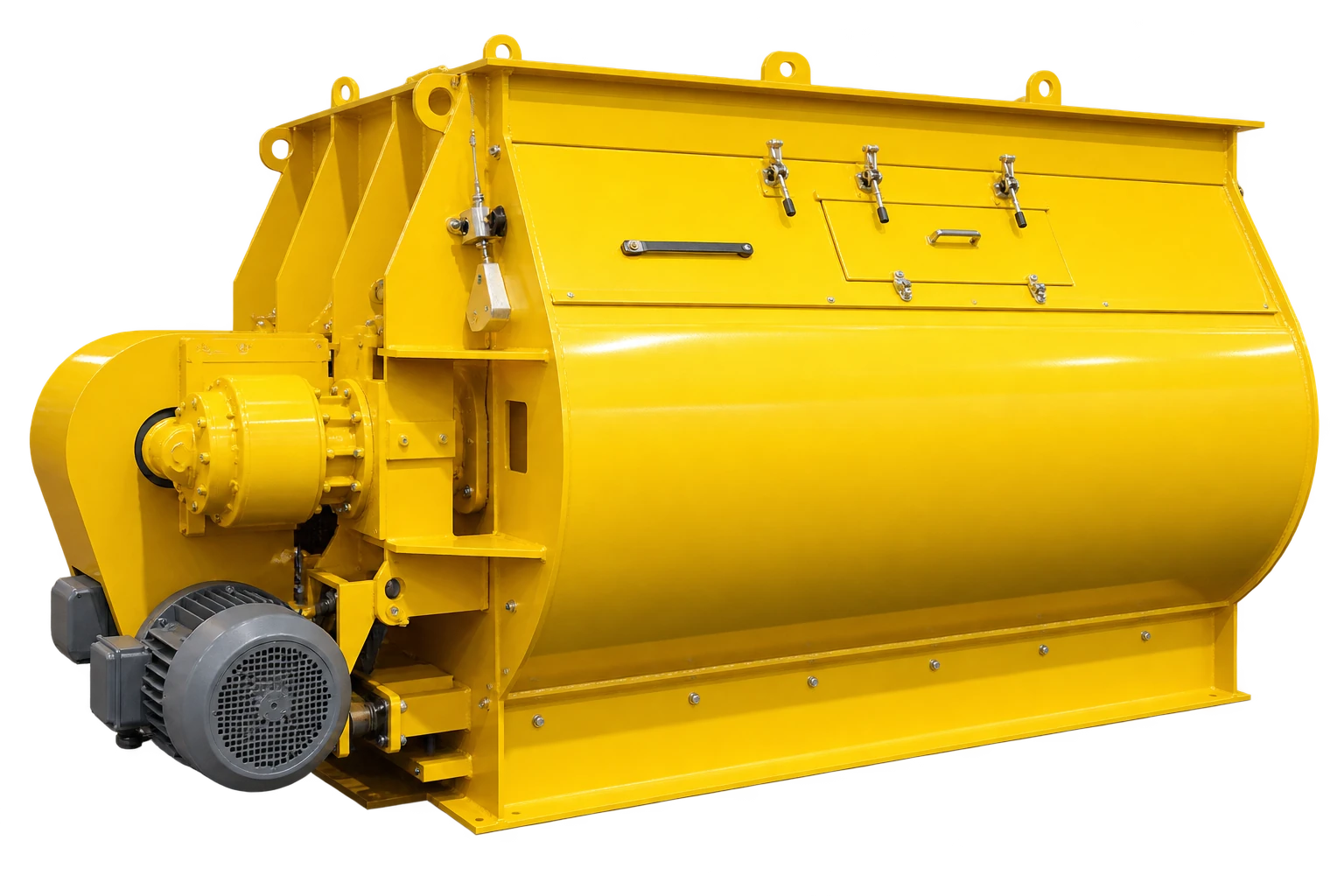
A dry mortar mixer homogeneity test should show whether composition remains acceptably uniform through the discharge. It needs a predefined sampling plan, a suitable chemical or physical marker, a laboratory method with known precision and repeat batches. A single wet-mortar flow result cannot prove that a dry blend was homogeneous.
The MSD Twin-Shaft Dry Mortar Mixer is a large dry-mix range with published total volumes of 6,000–15,000 L. Select a model by total volume, working volume and required mixing cycle. The product page does not publish a universal homogeneity percentage, mixing time or sample method, so those items must come from the formulation, contract and validation plan.
Separate the three validation questions
The word “uniformity” often combines evidence that should remain separate:
| Question | Evidence | What it does not prove |
|---|---|---|
| Is one batch uniform? | Composition across early, middle and late discharge | That the next batch will match |
| Are batches repeatable? | Same defined result across repeated batches | That every low-dose additive is distributed |
| Does the mortar perform? | Flow, water demand, air, density, retention, strength or other specified tests | Dry composition at every discharge point |
ASTM C780 covers preconstruction and construction evaluation of masonry mortars and includes procedures used to examine consistency and batch-to-batch behavior. ASTM C387/C387M covers packaged dry combined materials for concrete and high-strength mortar and identifies product-performance tests within its scope. These standards are useful references for a validation plan, but neither creates a universal dry-mixer homogeneity limit for every formulation.
Write the objective before running the mixer. For example: “demonstrate that the chosen marker remains within the project limit across six identified discharge portions for three consecutive production batches.” The governing specification must supply the marker, method, number of samples and limit. Do not invent those rules after seeing the data.
Freeze the formula and process conditions
A mixer trial cannot isolate mixing performance if the ingredients or process keep changing. Record:
- formula revision and target mass of every constituent;
- supplier, lot and moisture condition of major powders and aggregate;
- identity and target mass of each low-dose additive;
- actual scale readings and scale resolution;
- loading order, feed duration and any overlap;
- the exact event that starts and stops measured mixing time;
- mixer working volume or batch mass and discharge-gate sequence;
- environmental temperature and humidity where relevant;
- previous product, cleaning state and cross-contamination risk.
Minor ingredients require special attention. A scale that rounds a 2 kg target to the nearest kilogram creates a dosing uncertainty before the mixer starts. An additive stuck in a transfer line cannot become homogeneous through longer mixing. Reconcile actual ingredient delivery before attributing variation to the mixing tools.
The related laboratory concrete mixer repeatability guide explains why controlled weighing, moisture, timing and sampling are prerequisites for comparing batches. The same evidence discipline applies at production scale even though the material and test methods differ.
Choose a meaningful marker and method
The marker should be stable during mixing, distributed through the formulation, measurable at the expected concentration and relevant to product performance. Possible project-selected markers include a soluble ion, pigment, fine mineral constituent or another ingredient with a validated analytical method.
Do not assume the easiest major component is enough. Uniform binder content may coexist with poor distribution of a much smaller cellulose ether, pigment or other functional additive. Where a low-dose constituent drives water retention, color or workability, the validation plan may need a direct marker for that constituent or a justified combination of dry and wet tests.
Before the production trial, establish:
- sampling container and minimum sample mass;
- sample-reduction method, if the laboratory portion is smaller;
- storage and contamination controls;
- preparation and analytical method;
- repeatability or measurement uncertainty of the method;
- calculation and rounding rules;
- treatment of results below detection or reporting limits.
Run duplicates on a known uniform reference or split sample where practical. If the laboratory method varies by nearly as much as the proposed acceptance band, the test cannot distinguish mixer variation reliably.
Design the dry mortar mixer homogeneity test
Never take one scoop from a collection bin and call it representative of the batch. Define positions by discharged mass, time or packaging sequence. A simple plan may identify early, middle and late portions; a large batch or long discharge can require more points.
For six equal discharge intervals, labels could be D1 through D6. Collect each sample using the same safe method, container, sample mass and delay. Keep them separate. A composite sample can estimate the batch average, but it hides segregation across the discharge and therefore cannot replace position samples.
Avoid these sampling errors:
- scooping only from the accessible surface of a pile;
- allowing one sample to collect for much longer than another;
- taking samples after material has passed through different downstream equipment;
- changing the discharge-gate opening during the sequence without recording it;
- pouring portions together before the individual tests are complete;
- excluding the first or last material because it “looks unusual.”
The American Concrete Institute’s mixer-adequacy guidance discusses comparing samples from different parts of a concrete discharge and notes that large property differences can point to loading-sequence or mixing problems. Dry mortar needs its own methods and limits, but sampling across the discharge follows the same sound principle: an average cannot reveal where variation occurs.
Calculate variation without hiding the pattern
Show every position result before reducing the data to one number. Depending on the contract, useful statistics can include the range, standard deviation or coefficient of variation. The chosen metric and pass limit must be agreed before the trial.
Consider a hypothetical marker result for six discharge positions: 9.8, 10.1, 10.0, 10.2, 9.9 and 10.0 units.
mean = (9.8 + 10.1 + 10.0 + 10.2 + 9.9 + 10.0) ÷ 6 = 10.0 units
range = 10.2 − 9.8 = 0.4 units
relative range = 0.4 ÷ 10.0 × 100 = 4.0%
These values are a calculation example, not MSD performance data and not an acceptance limit. Also plot result against discharge position. A steady upward trend can indicate segregation or an ingredient introduced unevenly even when the numerical range happens to pass.
Repeat the planned trial batches. One acceptable batch establishes possibility; repeated batches provide evidence of control. Compare both within-batch position spread and batch means. If batch means move while discharge profiles stay flat, investigate dosing or raw-material variation before changing mixer time.
Use wet-mortar tests as separate evidence
Prepare wet mortar from identified dry samples only when the validation plan requires it. Control water mass, mixing procedure, rest time, remixing, temperature and test delay. Otherwise, preparation variation can overwhelm the dry-blend difference you are trying to observe.
ASTM’s C780 scope and procedures support evaluation of masonry-mortar consistency and construction variables. The ASTM C387/C387M specification identifies requirements for packaged dry combined materials within its stated scope. Use the current editions and project documents to choose applicable tests; do not apply either standard to a product outside its scope by name alone.
Flow-table results also depend on equipment and procedure. NIST’s flow-table reference-material study addresses calibration and rheological characterization of the test method. That reinforces a practical boundary: wet flow is valuable performance evidence, but it is sensitive to preparation and measurement and is not a direct assay of every dry ingredient.
If wet results fail while dry marker results are uniform, investigate water demand, raw-material properties, admixture compatibility, wet mixing and test technique. If both dry and wet results trend with discharge position, investigate loading, mixing, segregation and gate operation.
Diagnose a failed homogeneity trial
Preserve samples and process records before changing settings. Use the result pattern:
| Result pattern | First checks | Possible action to test |
|---|---|---|
| Early discharge differs | Gate pocket, dead zone, previous-product residue | Inspect and repeat after approved cleaning |
| Late discharge differs | Segregation, incomplete emptying, gate geometry | Map residue and discharge sequence |
| Random positions differ | Sampling or laboratory error, agglomerates | Duplicate tests and inspect sample reduction |
| All positions low or high | Dosing, scale zero, loss in transfer | Reconcile ingredient mass |
| One low-dose marker varies | Addition point, agglomeration, insufficient dispersion | Review feeder delivery and loading order |
| Batch means drift | Raw-material lot, moisture, weighing or carryover | Trend batch records before changing time |
Do not automatically extend mixing time. Extra time may help incomplete distribution, but it cannot recover a missing ingredient, correct a biased sample or eliminate every segregation mechanism. It can also reduce output and alter temperature. Change one controlled variable, then repeat the planned sampling sequence.
Release the process with an acceptance record
The release package should contain the approved formulation, mixer and batch identification, actual ingredient weights, loading and time records, sample map, laboratory methods, raw results, calculations, deviations and disposition. State the working-volume basis used for the trial without claiming that the catalog’s total volume equals permissible working volume for every recipe.
Before internal inspection, cleaning or removing hardened material, isolate the drives, discharge mechanism, feeders and stored pneumatic or gravity energy. OSHA’s hazardous-energy overview explains that servicing requires control of electrical, mechanical and other stored energy against unexpected startup or release. A stopped HMI command is not an isolation procedure.
The planetary concrete mixer selection guide provides a related framework for connecting material trials, discharge behavior and the full plant cycle. Use those system checks when the validation result will support a new production-equipment decision.
Conclusion
A dry mortar mixer homogeneity test is credible when it uses a formulation-relevant marker, predefined discharge positions, a capable laboratory method and repeated batches. Keep dry composition, batch repeatability and wet performance as separate evidence streams, then investigate dosing, sampling and raw materials before changing mixer time.
For MSD selection, provide the complete formulation, target batch mass and working volume, low-dose ingredients, loading sequence, required cycle and proposed homogeneity test plan.