
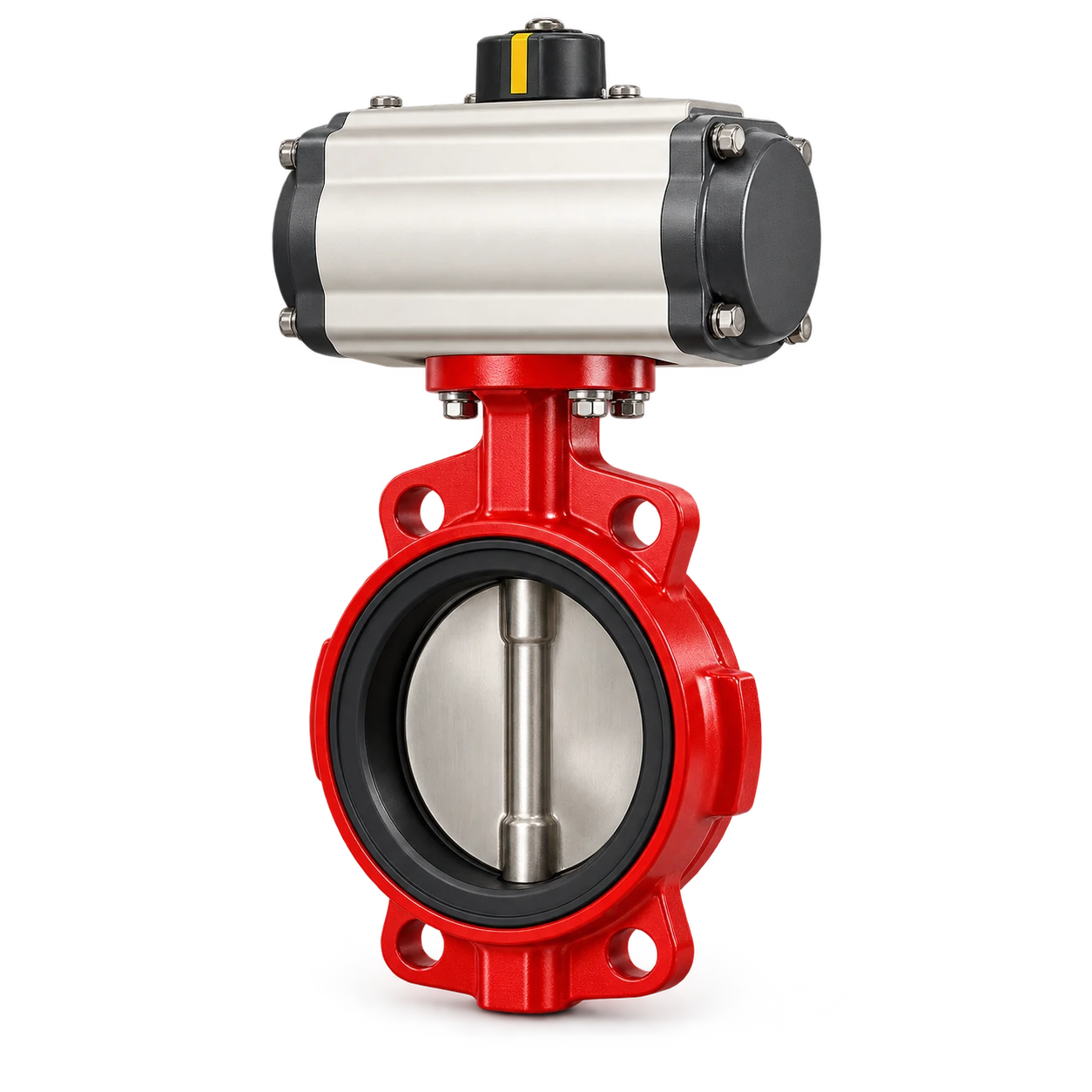
Butterfly valve pressure drop cannot be selected from pipe diameter alone. Start with flow, liquid properties and available differential pressure, calculate a preliminary required Cv, then compare every operating point with the proposed valve’s tested Cv-versus-opening and pressure-recovery data. The simple calculation is a screening step, not final valve sizing.
The VOGO water butterfly valve range lists DN50-DN200 sizes and identifies working pressure and actuation as selection inputs. It does not publish a universal Cv curve. Request the exact body, disc, seat, shaft, pressure class, actuator and certified or tested flow data for the offered configuration.
Define the hydraulic duty before calculating Cv
Record the liquid, temperature, density or specific gravity, viscosity, normal/minimum/maximum flow, upstream pressure, downstream pressure and pipe size. State whether pressures are gauge or absolute. Cavitation calculations need absolute inlet pressure and vapor pressure at operating temperature.
| Input | Normal point | Minimum point | Maximum point | Why it matters |
|---|---|---|---|---|
| Flow Q | Required | Required | Required | Sets capacity range |
| P1 and P2 | Required | Required | Required | Defines available ΔP |
| Temperature | Required | Required | Required | Changes vapor pressure and materials |
| Specific gravity | Required | Required | Required | Enters liquid sizing |
| Viscosity | Check | Check | Check | May require correction |
| Valve opening | Predicted | Predicted | Predicted | Links duty to tested Cv curve |
Do not use pump differential pressure as valve ΔP without subtracting static head and losses in pipe, fittings and equipment at the same flow. Also define failure position, shutoff requirement and allowable leakage separately; Cv does not prove isolation performance.
Calculate a preliminary liquid-service Cv
The traditional water-like liquid relation in US units is:
Cv = Q × √(SG ÷ ΔP)
Q is flow in US gpm, SG is specific gravity relative to water, and ΔP is valve pressure drop in psi. Emerson’s traditional sizing reference treats this as a basic relation and then introduces corrections and limits for viscosity and pressure recovery.
Assume, only as a hypothetical screening case, 500 gpm of water, SG = 1.0, and 4 psi available across the valve:
Cv = 500 × √(1.0 ÷ 4) = 250
The result means the selected operating position needs at least the corrected required capacity under the sizing method. It is not a claim that any DN size in the VOGO range has Cv = 250. Obtain the proposed model’s curve and check the opening at all three flow points.
Reject three common shortcuts
First, do not substitute a generic table for model data. Disc profile, shaft, seat and body geometry change the coefficient. Second, do not size only at the maximum flow. A valve that meets maximum capacity nearly closed at normal flow may control poorly. Third, do not treat full-open Cv as the throttling curve.
Reducers, expanders and nearby fittings can change the effective capacity. The Emerson Fisher control-valve material uses a piping geometry factor when a valve is installed with attached fittings. Ask the supplier to show whether the quoted calculation includes the actual reducer and pipe arrangement.
Check cavitation separately from pressure drop
A butterfly valve is a high-recovery rotary valve. Pressure falls to a minimum at the vena contracta and then recovers downstream. If the local minimum reaches liquid vapor pressure, vapor bubbles form; their later collapse can produce noise, vibration and pitting.
Bray’s sizing presentation explains that recovery factors come from valve flow tests and are published by the manufacturer. Emerson likewise warns that significant cavitation in butterfly and ball valves can begin below the pressure drop associated with choked flow. A basic Cv result therefore cannot establish cavitation safety.
Give the supplier P1, P2, liquid temperature, vapor pressure basis and operating points. Require the recovery or cavitation factor for the exact valve and the calculation method used. If risk remains, change system pressure distribution or select equipment intended for the duty. Do not promise that a larger nominal butterfly valve alone cures cavitation.
Include velocity, materials and actuator duty
Calculate pipe velocity at minimum and maximum flow and compare it with the project’s hydraulic criteria. The valve disc remains in the flow path, so evaluate local velocity, vibration and downstream straight-run needs using project and supplier guidance.
Seat and body materials must suit the liquid, temperature, pressure and cleaning chemicals. The existing butterfly-valve seat material guide covers that separate compatibility decision. A suitable elastomer does not prove acceptable Cv or cavitation behavior.
The actuator must overcome seating/unseating, bearing, seal and hydrodynamic torque over the pressure and flow envelope. Use the offered valve’s torque data and the required safety basis. Do not size an actuator from pipe pressure times disc area as a substitute for manufacturer torque curves.
Put auditable data in the quotation
Ask each bidder to return the selected size and pressure class, Cv at relevant openings, normal/minimum/maximum predicted openings, calculated valve ΔP, correction factors, cavitation result, maximum velocity basis, materials, actuator torque basis and failure action.
| Supplier return | Acceptance question |
|---|---|
| Cv-versus-opening curve | Is it for the exact offered construction? |
| Three operating points | Are normal and low flow controllable? |
| Cavitation calculation | Are pressure units absolute where required? |
| Piping geometry | Are reducers and nearby fittings included? |
| Valve/actuator torque | Does it cover the full differential pressure? |
| Test and document references | Can the calculation be reproduced? |
Treat missing inputs as open technical deviations. A quotation containing only DN and actuator voltage is not enough to compare hydraulic performance.
Conclusion
Use the basic Cv equation to screen butterfly-valve capacity, then size with model-specific curves, correction factors and cavitation data. Check normal, minimum and maximum conditions together. Purchase only when the supplier’s hydraulic, material and actuator records match the actual piping duty.