
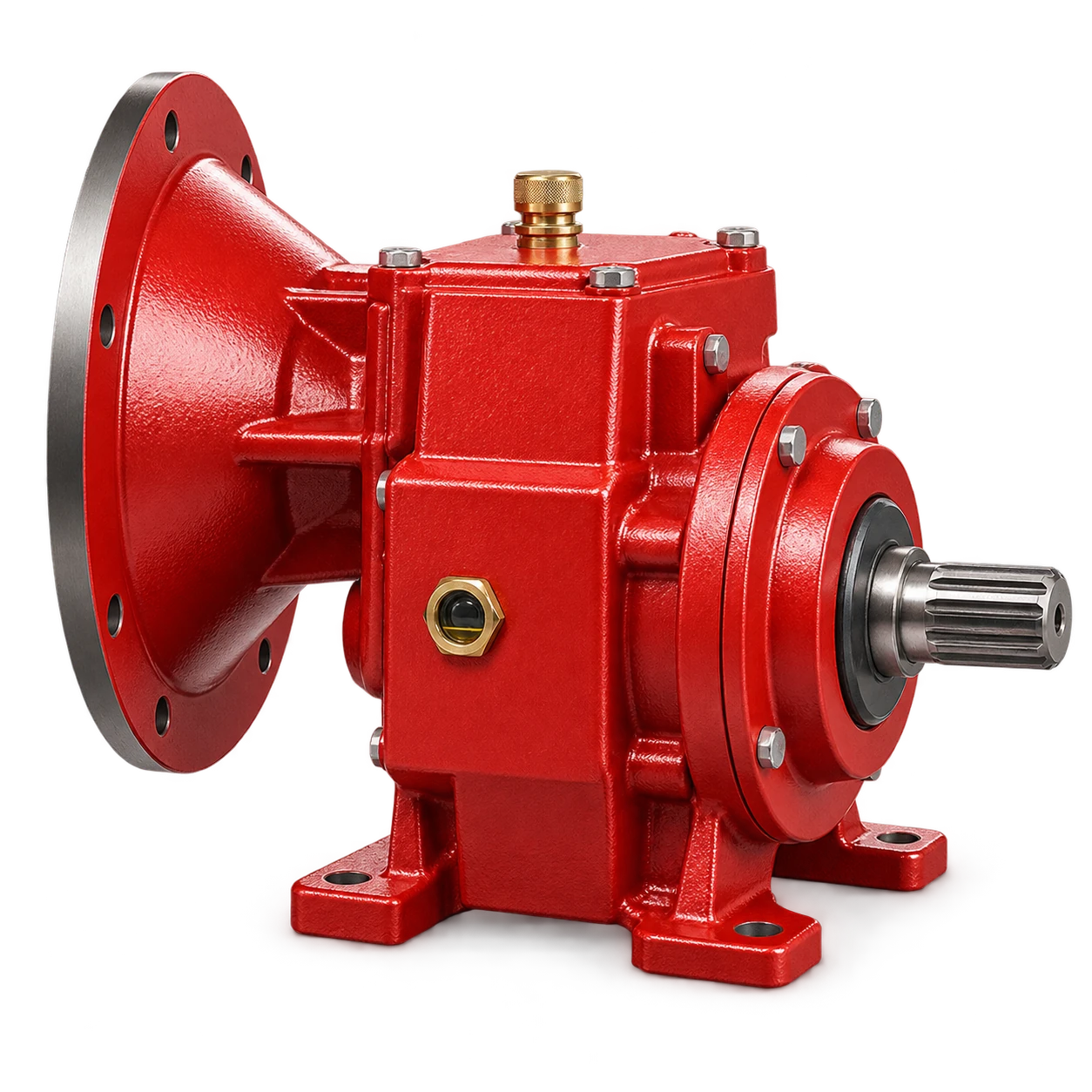
Gear reducer oil viscosity selection begins with the exact reducer manufacturer’s instruction, not a universal chart. Confirm the reducer identity, gear type, speed, load, temperature, lubrication method, mounting position and required performance class. ISO VG describes a viscosity range at 40°C; it does not by itself define a suitable gear oil.
The RM industrial gear reducer family is selected from motor power, ratio, output torque and mounting dimensions. The catalog does not publish a lubricant approval list or fill quantity. Obtain the manual and nameplate data for the supplied configuration before filling or changing oil.
Collect the reducer and duty data first
Record model and serial identity, ratio, input and output speed, transmitted torque, service factor basis, gear geometry, bearing arrangement, mounting position and rotation. Then record minimum startup ambient, maximum ambient, stabilized oil or housing temperature, starts per hour and expected shock loading.
| Decision input | Evidence | Why it changes lubrication |
|---|---|---|
| Exact reducer configuration | Nameplate and approved manual | Determines sump and lubrication path |
| Gear type and speed | Drawing or manufacturer data | Changes entrainment and film demand |
| Load and duty cycle | Driven-equipment record | Changes contact stress and heat |
| Mounting position | Installation drawing | Changes fill level and bearing supply |
| Temperature envelope | Measured or specified values | Changes operating viscosity and startup mobility |
| Lubrication method | Splash, pump or external system | Sets flow and cold-start limits |
| Seals and materials | Manufacturer confirmation | Screens base oil and additive compatibility |
Do not infer the lubricant from another reducer with a similar power rating. A vertical mounting position or auxiliary pump can change both oil quantity and startup instructions.
Treat standards and tables as a secondary screen
AGMA 955-A22 covers general lubrication for open and enclosed metallic gearing and states that it does not replace specific manufacturer instructions. Use it to organize questions when a manual is incomplete, not to override an approved oil list.
Idemitsu’s engineering tables illustrate how speed, power, ratio, gear type and temperature can lead to different viscosity ranges. The tables are reference guidance for their stated conditions, not RM recommendations. They show why “industrial gearbox equals ISO VG 220” is not a valid rule.
The related gearbox thermal versus mechanical rating guide explains heat balance at the drive-selection level. Lubricant selection must use the resulting operating temperature and duty, but changing viscosity is not a substitute for a reducer that lacks thermal capacity.
Distinguish viscosity grade from complete oil specification
ISO VG identifies nominal kinematic viscosity at 40°C. Procurement also needs the base-oil family, viscosity index or temperature behavior, applicable performance classification, oxidation and corrosion performance, load-carrying or anti-scuff properties, and any required micropitting or foam tests.
Check seal, coating and yellow-metal compatibility. Some worm-gear or specialty materials require different chemistry from a conventional steel helical drive. “EP gear oil” is too broad without the approved specification and product.
At low temperature, the oil must reach meshes and bearings without creating excessive drag or starving a pump. At operating temperature, it must retain the viscosity required by the manufacturer. Pour point alone does not prove cold-start circulation, and the 40°C grade alone does not prove hot operating viscosity.
Use a controlled selection worksheet
Create one row for every permitted operating condition:
| Field | Project entry | Supplier confirmation |
|---|---|---|
| Startup ambient range | ___ °C to ___ °C | Approved oil and preheat rule |
| Stabilized oil temperature | ___ °C | Required operating viscosity |
| Input/output speed | ___ rpm / ___ rpm | Lubrication method valid |
| Continuous/intermittent duty | ___ | Change interval basis |
| Mounting position | ___ | Fill level and quantity |
| Environment | Dust, washdown or outdoor | Breather and contamination controls |
| Existing oil | Product and batch if known | Compatibility/changeover method |
Regal Rexnord’s published instructions provide a useful manufacturer example: they direct users to the nameplate/manual, ambient-temperature range and correct oil quantity for the particular drive. Those values belong to the cited equipment and must not be copied to RM.
Plan the oil change without assuming compatibility
Identify the existing product before topping up. If identity is unknown, sample and consult the reducer and lubricant suppliers. Two oils with the same ISO VG can use incompatible base stocks or additive systems, and mixing may affect foam, demulsibility, seal behavior or deposit formation.
Agree whether the change requires draining warm, cleaning magnetic plugs, replacing filters, flushing or shortening the first interval. Never use a solvent flush unless the reducer and lubricant suppliers approve the procedure and disposal controls.
Fill according to the correct mounting-position level, not a generic volume from another installation. Rotate or run only as the manual permits, let the oil settle, recheck level and inspect for leaks. Overfilling can increase churning and temperature; underfilling can starve gears or bearings.
Verify the change under real duty
Record oil product, batch, quantity, date, old-oil condition and work performed. At controlled startup, verify pressure or flow if the unit has a pump, listen for abnormal noise, check leakage and trend temperature to a stable condition.
Noria’s technical discussion emphasizes balancing load, speed, ratio, geometry and environment and beginning with OEM recommendations. Use oil analysis intervals and alarm limits defined for the plant; a single appearance check cannot establish remaining life.
Investigate an abnormal temperature rise before changing grade. Confirm load, alignment, oil level, ventilation, contamination and measurement location. A thicker oil can raise churning loss, while a thinner oil can reduce film protection. Neither is a general repair.
Specify what the supplier must return
For a new reducer, require approved lubricant products or a complete performance specification, viscosity grade for the stated temperature range, fill quantity by mounting position, change interval basis, breather/filter requirements, storage preservation and cold-start restrictions.
For an oil change, require written compatibility and flushing guidance. Keep the response with the reducer record so that a later maintainer does not have to reconstruct the decision from a drum label.
Conclusion
Select gear reducer oil from the exact manual and the real speed, load, temperature, mounting and lubrication method. Use ISO VG as one property within a complete specification. Control brand or chemistry changes, fill to the correct configuration, and verify the reducer under duty before closing the work order.