
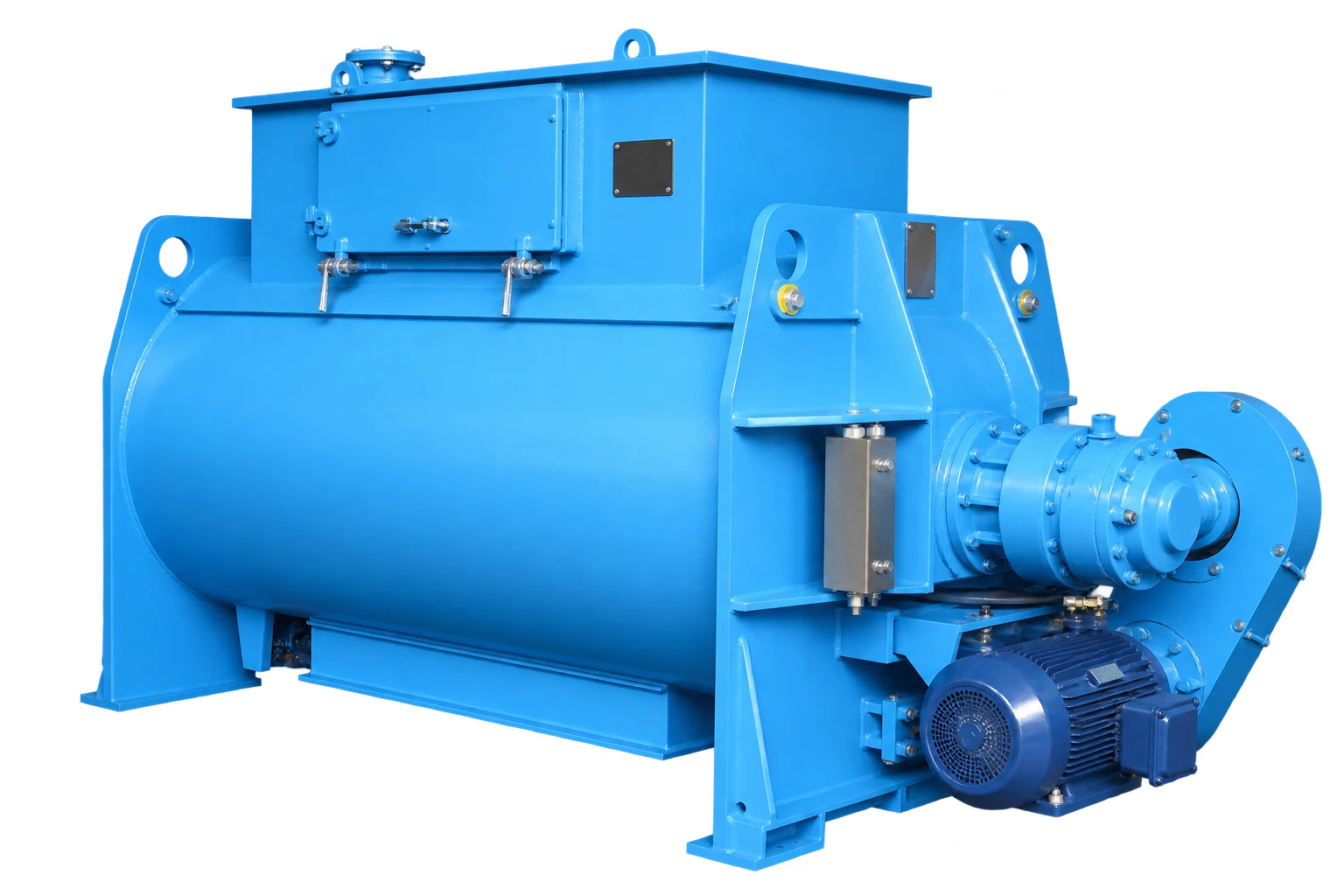
Lightweight concrete mixer selection should start with the aggregate type, its moisture condition, usable batch volume and an agreed production trial. A large nominal vessel does not establish accepted concrete output. This guide covers concrete made with lightweight aggregate; foamed concrete and aerated products require a separate process assessment.
The MLO lightweight concrete mixer range is a product shortlist for this duty. Its catalog classes are not a recipe-specific output guarantee. Give the supplier your material data and ask which capacity definition applies before comparing models or prices.
Define the material before selecting the mixer
Identify the lightweight aggregate supplier, grading, particle condition, batch recipe and intended use. Distinguish fresh concrete density from the hardened-density basis named in the project. Do not choose equipment by a density label alone: two mixes with similar final density can present different loading and discharge conditions.
ACI’s Aggregates for Concrete bulletin explains that lightweight aggregate absorption rate matters when proportioning concrete. For procurement, turn that observation into a requirement: document the aggregate condition used in the trial and the method used to maintain it in production. A trial with one moisture state does not automatically qualify another.
Specify a moisture-control procedure
Ask the aggregate supplier and concrete technologist to define conditioning, drainage and measurement. Separate absorbed water from surface water and water deliberately added to the mixer. State the reference basis for batch masses; otherwise a moisture correction may be applied twice or omitted.
The ESCSI structural lightweight concrete brochure discusses prewetting for pumping and the distinction between fresh and cured density. This does not establish one universal soaking time. Obtain the procedure for the actual aggregate and verify transport and pumping separately from mixer acceptance.
Include sampling responsibility in the quotation brief. Who measures moisture, when is a new measurement required, and how is the batch controller updated? Resolve those questions before comparing automation options. A moisture probe proposal should identify calibration, access and validation requirements rather than promise a fixed water correction for every aggregate.
Compare capacity on the same basis
Use the following project-input table as a purchasing worksheet. Values must come from your formulation and the supplier’s defined capacity basis.
| Input | Evidence to request | Decision it supports |
|---|---|---|
| Charging volume | Component volumes and loading sequence | Whether the initial load fits |
| Usable batch output | Measured discharge volume for the recipe | Accepted output per cycle |
| Aggregate condition | Moisture and conditioning records | Repeatable batching |
| Complete cycle | Charging, mixing, discharge and reset times | Sustainable hourly output |
| Discharge interface | Opening, receiving level and residue observations | Integration with the plant |
| Acceptance method | Sampling plan and agreed criteria | Objective comparison |
Ask the supplier to identify total vessel volume, charging capacity and output separately. Do not convert kilograms into litres using a density taken from a different material condition. Also check the smallest intended batch: successful operation at maximum load is not evidence for all partial loads.
Calculate hourly output from accepted batches
A planning relationship is hourly accepted output = accepted volume per batch × 3,600 ÷ complete cycle in seconds × operating fraction. The operating fraction is an explicitly chosen allowance, not a measured reliability claim. Avoid counting a delay both inside the cycle and again in that fraction.
Hypothetical example: assume 1.0 m³ accepted output, a complete cycle of 180 seconds and an operating fraction of 0.80. The planning output is 1.0 × 3,600 ÷ 180 × 0.80 = 16 m³/h. These are assumed project values, not MLO specifications or test results. Changing the cycle to 240 seconds at the same assumptions gives 12 m³/h.
Record the cycle boundary during trials. Time spent waiting for weighed materials, confirming discharge closure or clearing the receiving hopper must be included wherever it limits the next accepted batch. A mixing-time figure alone cannot describe the plant’s output.
Build a trial that can reject an unsuitable configuration
Agree the minimum and maximum production recipes, batch sizes, sampling points and acceptance criteria before the demonstration. Record density and workability at defined times, discharge behaviour, residual material and drive loading. Compare repeated batches under the same moisture-control procedure, then examine the intended range of material conditions.
The Concrete Society’s batching guidance notes the segregation tendency of low-density aggregate, especially at higher workability. Inspect the discharged material rather than judging only what is visible through the mixer access opening.
ACI’s mixing-adequacy guidance describes comparing samples across a discharge for normal-density concrete. Apply that sampling principle cautiously here: the technologist must choose suitable lightweight-concrete tests and contractual criteria. This article does not assert automatic ASTM compliance.
Make the quotation include commissioning evidence
Request a capacity definition, approved recipe envelope, electrical requirements, discharge arrangement, cleaning access, spare-parts list and the proposed acceptance record. Ask what happens if the production trial misses the agreed output or uniformity criteria. Keep commercial comparison tied to that deliverable, not an unsupported claim of a shorter mixing time.
Use the laboratory-to-production scale-up guide to prepare the formulation evidence. The mixer trial must still use representative production materials and interfaces; laboratory success alone is insufficient.
Conclusion
Lightweight concrete mixer selection is a comparison of verified recipe performance, moisture control and complete-cycle output. Confirm what each capacity number means, calculate output with stated assumptions and agree a trial that can identify an unsuitable configuration before ordering.