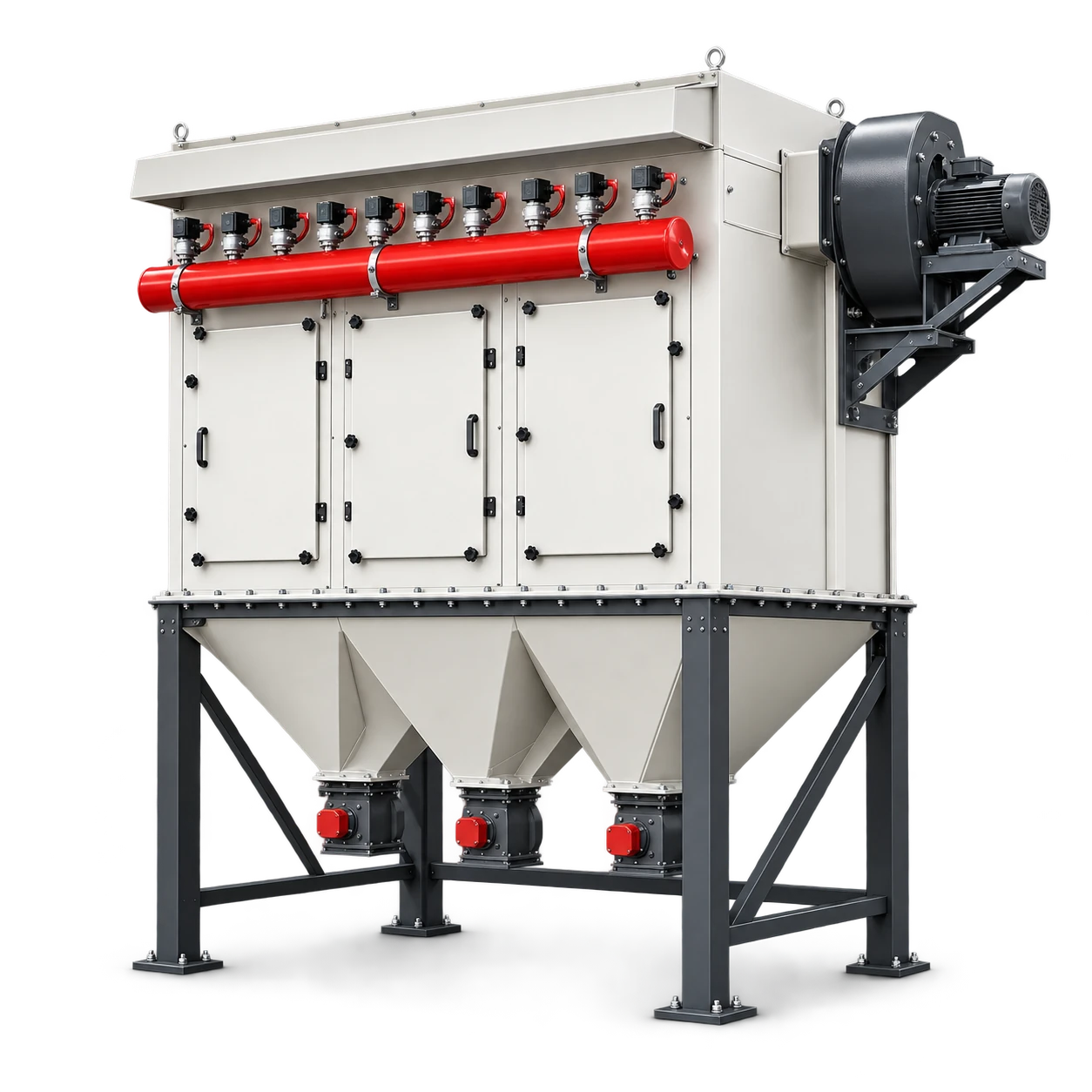
High differential pressure in a pulse-jet dust collector calls for a controlled diagnosis, not an automatic increase in pulse pressure or immediate replacement of every filter element. Verify the instrument, compare readings at known airflow, check the cleaning supply and sequence, then inspect the material and filter condition under a safe maintenance procedure.
The DMC pulse dust collector series provides a product reference when discussing filter configuration, airflow and installation constraints. This workflow is not a DMC alarm-setting manual. Obtain limits and cleaning instructions for the actual supplied assembly before changing any settings.
Identify which pressure is being measured
Differential pressure across filter media measures the difference between the designated dirty-side and clean-side pressure locations. It is not the same as silo internal pressure or pressure at a tanker compressor. Mark both taps on a drawing and confirm the instrument units and range.
The EPA fabric-filter monitoring overview lists pressure differential alongside gas flow, cleaning operation and emission indicators. Use a record that includes these operating conditions rather than treating one gauge value as a complete diagnosis.
Check whether this is a central extraction collector with a fan or a silo-top vent driven by incoming filling air. Fan-related observations do not transfer unchanged to a passive vent. Record when filling starts, which line is active, the material and whether the unusual reading appears during steady delivery or the final air-rich stage.
Validate the measurement before changing the process
Review calibration and inspect accessible impulse lines for kinks, deposits, water and loose connections under the approved procedure. Compare the installed instrument with an appropriate reference using designated test ports. Do not disconnect a live pressure line casually or blow contamination toward the media.
The EPA operation and maintenance manual identifies plugged pressure taps and lines as practical measurement problems. A fixed or implausible reading needs instrument investigation before the operator concludes that the bags are blinded.
Build a time record around the cleaning sequence. Does the reading respond to a pulse, remain fixed, or rise with a process change? Use the response as evidence for further checks, not proof of one fault. Confirm that timestamps align across the controller, pressure record and delivery log.
Use a symptom-to-evidence worksheet
The following is a proposed diagnostic worksheet. It gives hypotheses to test, not permission to work on operating equipment.
| Observation | Candidate explanation | Evidence before corrective action |
|---|---|---|
| Reading remains fixed through process changes | Instrument or impulse-line problem | Reference measurement and tap inspection |
| High pressure accompanies weak or missed pulses | Cleaning-supply or sequence fault | Header behaviour, valve operation and controller outputs |
| Pressure rises after wetter material or cold weather | Moisture-related deposits | Material history, temperature and isolated media inspection |
| Pressure increases with higher airflow | Changed operating point | Measured flow and the approved duty |
| Pressure suddenly falls while dust escape increases | Media damage, bypass or instrument fault | Emission evidence and isolated inspection |
Log the last verified normal operating condition. Include what changed, which checks have ruled out a cause and who approved the next step. This prevents repeated “adjust and observe” work without a stable baseline.
Check pulse cleaning within the supplier’s limits
Observe header pressure before and during the sequence, recovery between pulses, compressor availability, drains, leakage and the controller’s actual outputs. Check whether each commanded valve responds. A lit controller output does not establish that a valve delivered a useful pulse.
Do not prescribe one pulse pressure, duration or interval for all units. Ask the supplier to confirm the permitted settings, compressed-air quality and cleaning method for the media. Aggressive cleaning may conceal an airflow problem or create a different failure.
The EPA maintenance manual discusses ineffective cleaning, excessive air-to-cloth loading and condensation as possible causes of high pressure drop. This guide uses those categories to structure investigation; it does not reuse the manual’s historical numerical settings as current DMC instructions.
Compare like operating conditions
Hypothetical example: a collector records 900 Pa at 2,000 m³/h, then 1,500 Pa at 3,000 m³/h. Those assumed readings do not prove blocked media because airflow also changed. Compare the unit at a verified comparable operating point, within its approved duty, and investigate the cleaning response. Neither pressure is a universal alarm or VOGO specification.
Where airflow cannot be measured directly, document the available process evidence and its uncertainty. Do not present a compressor nameplate value as measured collector flow. If the duty has genuinely increased, review sizing rather than compensating with unapproved cleaning settings.
The silo dust collector sizing guide covers that separate design task. Keep diagnosis focused on changes from a known and approved operating condition.
Inspect safely and define return-to-service evidence
For intrusive work, follow the applicable energy-isolation procedure. OSHA 1910.147 addresses hazardous and residual energy in US servicing; other jurisdictions require their own applicable rules. Confirm mechanical, electrical and pneumatic isolation and avoid exposure to stored material.
During the approved inspection, document deposits, media condition, seals and dust removal arrangements. Keep findings tied to the suspected mechanism before ordering parts. Replacement media should have the confirmed material, dimensions and installation method for the supplied collector.
For silo service, keep filter resistance separate from the independent pressure-protection system. The UK cement-handling guidance PG3/01(12) discusses filter blockage and inadequate venting as contributors to silo pressurisation. Use its engineering warning with current local requirements, not as a universal legal rule.
After correction, verify the measurement, cleaning sequence and operating trend under an authorised restart. Investigate abnormal dust escape or silo-pressure events through the site’s protective procedure before further deliveries. A lower differential-pressure reading alone is not evidence that filtration is restored.
Conclusion
High differential pressure in a pulse-jet dust collector is a symptom to explain with instrument, airflow, cleaning and material evidence. Preserve an operating record, change settings only within confirmed limits and close the investigation with safe restart and filtration evidence.