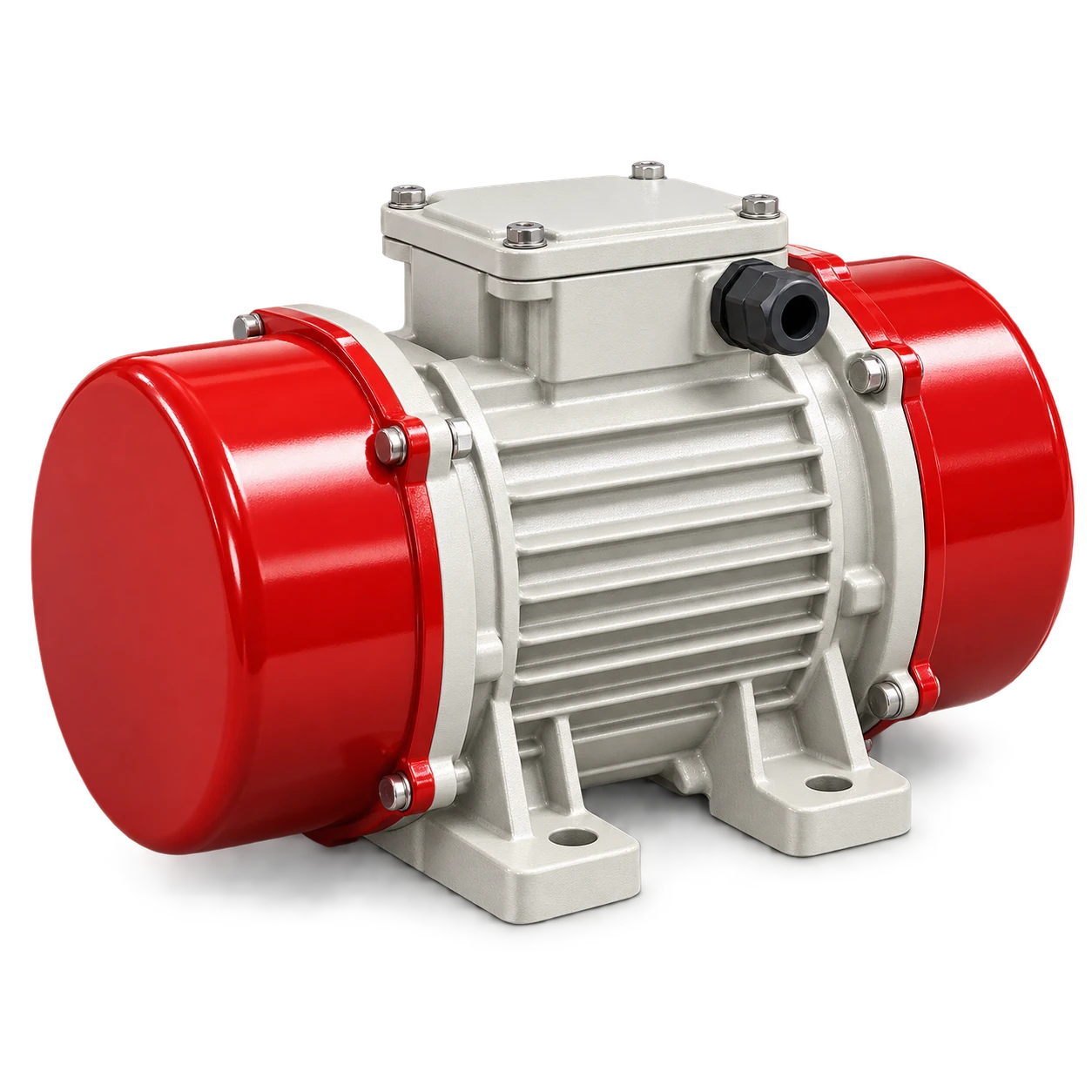
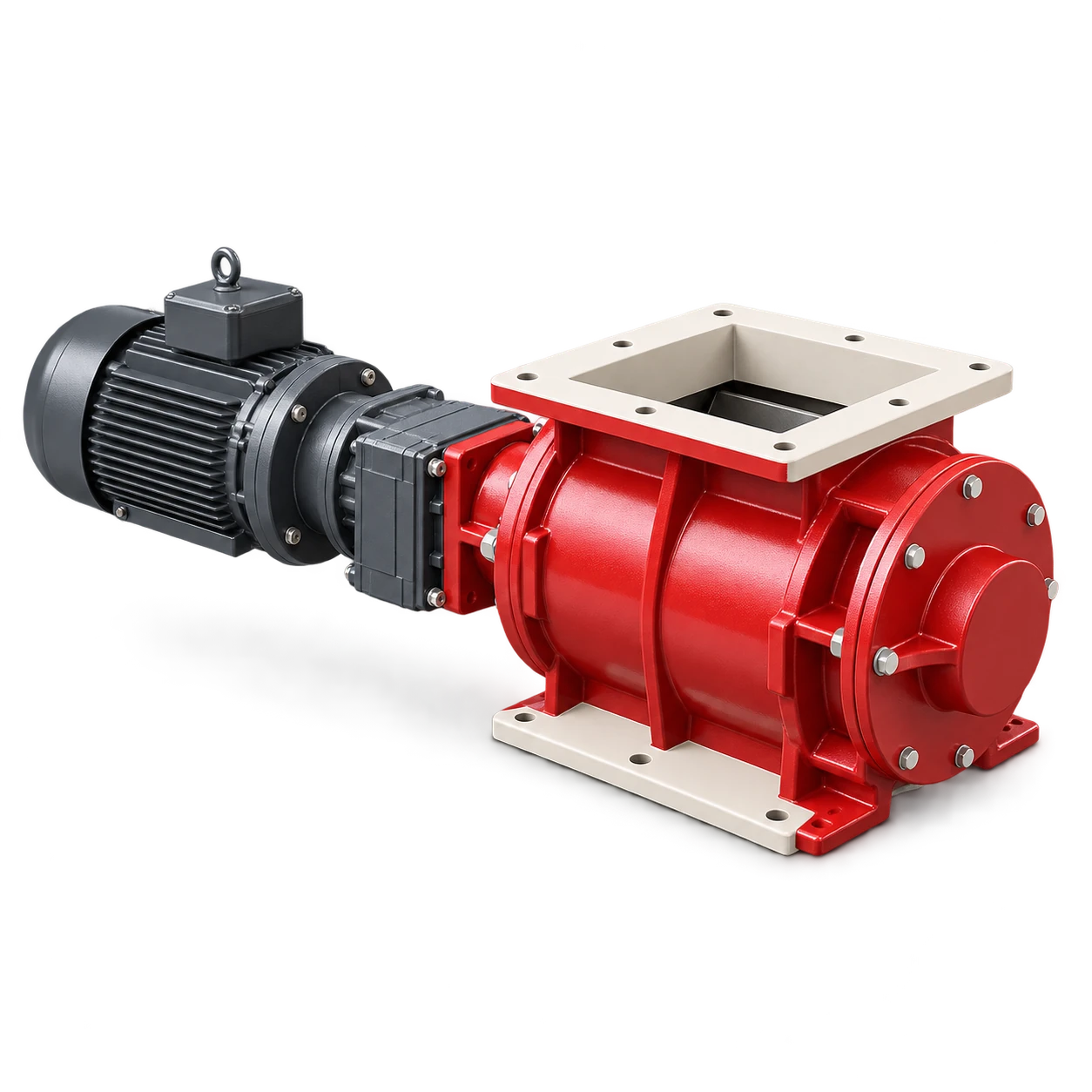
A rotary airlock valve quotation is comparable only when bidders price the same material duty and supply boundary. Provide the mass-flow range, material properties, pressures above and below the valve, temperature, connection drawings and required controls. A request for a flange diameter alone leaves the capacity and leakage questions unanswered.
The YJD rotary airlock valve range publishes model-specific displacement, motor power, speed and dimensions, with A and B flange configurations. Use the current table and approved drawing rather than inferring displacement from a model number. The catalog does not establish an application-specific leakage limit or explosion-isolation approval.
Start the rotary airlock valve quotation with the material
Send a representative material description and sample where testing is required. Include bulk-density range in the condition that reaches the valve, particle-size distribution and largest particles, moisture, temperature, cohesiveness, abrasiveness, friability and any contamination restrictions. Identify startup, shutdown and upset conditions separately from normal running.
State whether the valve discharges a filter, feeds a pneumatic line, meters into a process or empties a hopper. Show equipment above and below it. A valve under a pressurized receiver does not face the same gas flow or filling conditions as a gravity discharge at equal pressure.
Coperion’s engineering explanation relates throughput to displacement, speed and a filling correction influenced by the material and operating conditions. Its discussion of leakage gas also explains why opposing gas flow can interfere with product entry. These are system questions, not reasons to assume every valve has the same derating.
Separate displacement from a throughput commitment
Ask each bidder to return both geometric displacement per revolution and a justified filling basis for the specified duty. Avoid an unexplained “capacity” number with no density, speed or pressure attached.
For a preliminary mass balance:
Q = V × n × 60 × η × ρ / 1000
Q is kg/h when V is L/rev, n is rev/min, η is the effective filling fraction and ρ is kg/m³. The factor 1000 converts litres to cubic metres. The filling fraction is a project assumption until supported by appropriate testing or supplier evidence.
Hypothetical example: 10 L/rev × 20 rev/min × 60 × 0.50 × 600 kg/m³ ÷ 1000 = 3600 kg/h = 3.6 t/h.
None of these inputs is a selected YJD operating point. The calculation does not predict a safe speed, leakage or a stable hopper withdrawal pattern. At a lower bulk density or poorer filling, the same geometric valve gives less mass flow.
The DMN AL/AXL engineering leaflet explicitly labels its displacement at 100% filling and distinguishes enlarged inlet arrangements for difficult-flowing products. Its dimensions, pressure ratings and certifications belong to the named DMN configurations; none transfers to YJD.
Give bidders a return schedule
| RFQ field | Required response |
|---|---|
| Material duty | Accepted material envelope and sample-test requirement |
| Capacity | Displacement, speed, density and effective filling basis |
| Pressure | Inlet and outlet pressure, differential and upset limits |
| Gas leakage | Predicted or tested rate with temperature and reference-volume conditions |
| Mechanical scope | Rotor, housing, seals, bearings, drive and material-contact specification |
| Interfaces | Opening, flange drilling, height, orientation and service space |
| Controls | Speed control, feedback, overload response and interlocks |
| Acceptance | Tests, documents, exceptions and responsibility for retesting |
Identify included, optional and buyer-supplied items. A low valve-only price and a complete drive-and-controls offer are not equal scopes.
Price the leakage and pressure boundary explicitly
Do not confuse differential pressure across the valve with the pressure rating of the complete assembly. Require the supplier to state both, including seal arrangements and permissible temperature. A matching bolt pattern is not proof of a pressure class.
For a pneumatic system, agree where leakage gas goes and who supplies any vent, filter, purge or connection. Specify whether a reported gas flow is actual volume or normalized volume and give its reference conditions. The process designer should check its effect on the conveying-air balance and upstream filling.
An “airlock” is not airtight. Nor is an ordinary rotary valve automatically a certified explosion barrier. Where combustible dust may be present, the responsible hazard assessment must define the protective function and the evidence required for the exact assembly. Do not accept a general brochure symbol as project-specific approval.
Include safe service access in the commercial scope
Draw the removal space for the drive, end cover and rotor and identify lifting responsibilities. Request instructions, spare-part identification and model-specific inspection limits. If material can remain above the valve, define a safe isolation arrangement rather than relying on the rotor to protect a person below it.
OSHA 1910.147 covers unexpected startup and stored-energy hazards during servicing. The project isolation plan must address electrical drive energy, pressure and retained material, as applicable. A stopped rotary valve or closed control command is not a complete maintenance isolation procedure.
Use the related rotary-airlock maintenance guide for inspection and clearance mapping after delivery. This RFQ should procure the instructions and access needed for that work, not invent a universal running gap.
Agree how an offer becomes accepted equipment
Separate document review, mechanical checks and loaded process testing. Record the proposed material, test duration and repeats, weighing method, speed measurement, leakage-test boundary and witness responsibilities. If the site cannot reproduce the specified material condition, identify that limitation before the acceptance date.
Ask bidders to list deviations rather than quietly selecting an easier duty. Keep delivery terms, exclusions, commissioning attendance and unresolved technical items visible in the comparison. No universal price band is meaningful without this scope.
Conclusion
A rotary airlock valve quotation should make the capacity assumptions, leakage boundary and supplied equipment auditable. Compare the same duty, require model-specific evidence, and close the pressure, safety and service interfaces before award. The model code and flange size are starting references, not the finished specification.