
An air slide fabric specification should pair every permeability value with its test pressure difference, units, method and sample condition. Two quotations with the same number may describe different air resistance. Establish a common comparison basis before choosing the lower-priced cloth, then confirm that its construction and installation suit the actual powder and temperature duty.
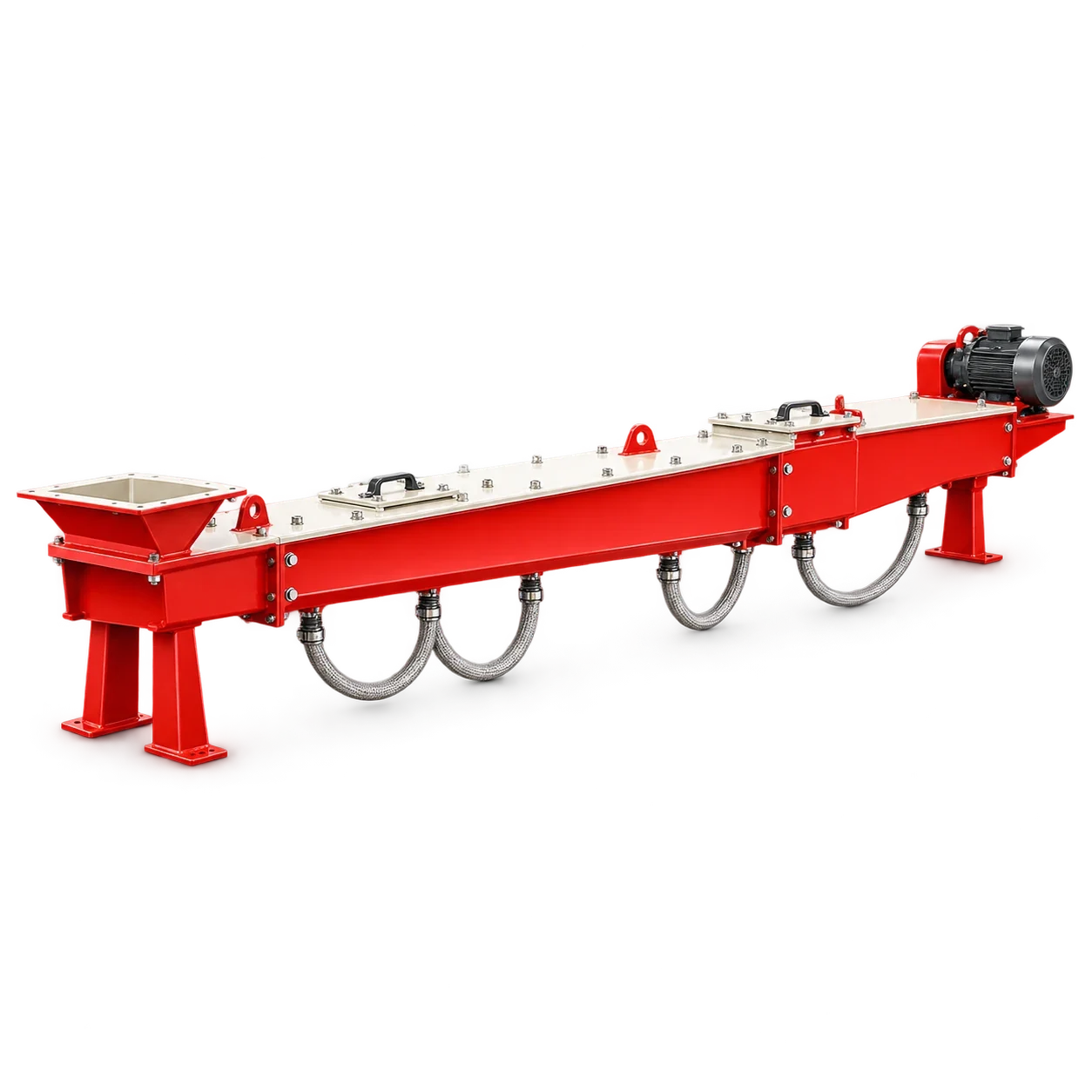
The VOGO air slide conveyor range is selected by conveying rate, chute width, air pressure and route length. Its catalog does not identify a universal replacement-fabric permeability. A published conveyor air-pressure value is not automatically the differential pressure used to test a bare textile specimen.
Define the replacement duty before comparing cloth
Record the original media identification, installed orientation, active width and length, supports, clamps, seams and gasket arrangement. Add material identity, moisture condition, normal and abnormal temperatures, operating hours and the reason for replacement. A cloth that failed after a process upset presents a different purchasing problem from a routine replacement with a stable operating history.
Retain a traceable unused reference piece if available. A removed cloth may document damage or deposits, but its measured permeability is not necessarily the original purchase value. Identify where each specimen came from and whether it was cleaned; do not silently compare a dirty used sample with a conditioned new one.
Put the permeability basis on the quotation
ASTM’s public D737-18(2023) scope and significance cover textile air-permeability testing and explain that construction, finishing and airflow direction can affect results. ISO 9237 also addresses permeability testing, including industrial textiles. Naming a standard alone does not supply the missing test conditions or an application acceptance limit.
| Supplier return | Required comparison basis | Hold the comparison when… |
|---|---|---|
| Permeability value | Flow volume per fabric area per time, with units | Only a number or an undefined “airflow” is given |
| Pressure difference | Pressure across the specimen, in Pa | One offer uses a different pressure or none is stated |
| Method and specimen | Method/version, test area, conditioning and flow direction | Samples or procedures are not comparable |
| Construction | Fiber, weave or felt, finish, thickness and supplied orientation | A generic fiber name replaces an identifiable grade |
| Uniformity and tolerance | Agreed lot sampling and acceptance range | Only a favorable single result is provided |
Request a pressure-versus-flow curve when the application needs more than a single test point. NASA’s fabric measurement study defines permeability as volume per area per time and reports it at specified pressure differences. Its parachute test data are not air-slide design values; the useful lesson here is the stated measurement basis.
Worked example: convert flux without inventing a blower duty
Assume a hypothetical fabric test reports 1.2 m³/(m²·min) at 200 Pa across clean media. If the active permeable area is 5 m² under that same condition:
Q = q × A = 1.2 × 5 = 6 m³/min = 360 m³/h.
Here q is measured volumetric flux and A excludes clamped or blocked area. This arithmetic assumes the reported condition applies uniformly. It is not a recommendation for fabric grade, operating airflow or pressure. An offer quoting 1.2 m³/(m²·min) at 500 Pa cannot be treated as equivalent without comparable test data. Do not scale linearly between the pressures without a justified material relationship.
Separate textile data from the operating air system
The hypothetical flow above describes clean media at a test point. An operating conveyor adds powder-bed behavior, air-distribution losses, inlet restrictions and an outlet venting condition. Specify where pressure will be measured and which operating state it represents. The system designer must establish blower flow and pressure for the complete installation.
Ask the supplier to return the required air-system duty separately from the fabric test certificate. Distinguish measured flow at actual conditions from a flow normalized to stated reference conditions. If an air-system modification is proposed, check its effect on the receiving equipment and dust collection as well as the conveyor. Enclosed construction alone does not prove airtightness or a pressure rating.
Qualify construction and exposure together
The Fuller Airslide engineering brochure distinguishes woven and felt media and limits some constructions by application. Those supplier-specific choices illustrate why fiber identity is insufficient; their ratings are not VOGO approvals.
For the proposed media, require written suitability for continuous temperature, short excursions, moisture, chemical exposure and the mounting arrangement. Include seam and edge details, support requirements, dimensional stability and the permitted handling method. Where the dust hazard assessment requires electrical properties, specify the required evidence for the complete installed arrangement rather than assuming a fabric description establishes safety compliance.
Do not approve a substitution solely because its thickness and cut width match. Conversely, do not reject a different construction without considering verified test and installation evidence. The purchasing decision is whether the proposed grade meets the agreed duty, not whether its trade description resembles the old invoice.
Use a receipt and installation acceptance record
On receipt, reconcile grade, batch identification, dimensions and certificate with the purchase specification. Record damage, folds, contamination or missing orientation marks before installation. Quarantine an unexplained mismatch until the supplier resolves it; changing the acceptance limit after delivery obscures the original decision.
Installation and start-up should follow the equipment supplier’s procedure. Retain the as-installed active area and fastening record, then compare observed conveying and air conditions with the approved commissioning plan. The related air slide commissioning guide addresses that system-level work. A cloth certificate by itself does not demonstrate conveying rate, absence of dead zones or service life.
Conclusion
A defensible air-slide fabric purchase starts with comparable permeability measurements and ends with an approved installed duty. Keep test pressure, units, construction and specimen condition visible in the quotation. Use the area-flow example only within its stated assumptions, and accept the media and the operating air system against their separate evidence.