
Specify fly ash solidification leaching tests by the decision they must support. Use the required acceptance method for the destination, and add scenario-relevant testing when the question concerns changes in pH, water contact or release over time. A passing result from one extraction procedure is not a general guarantee of long-term containment.
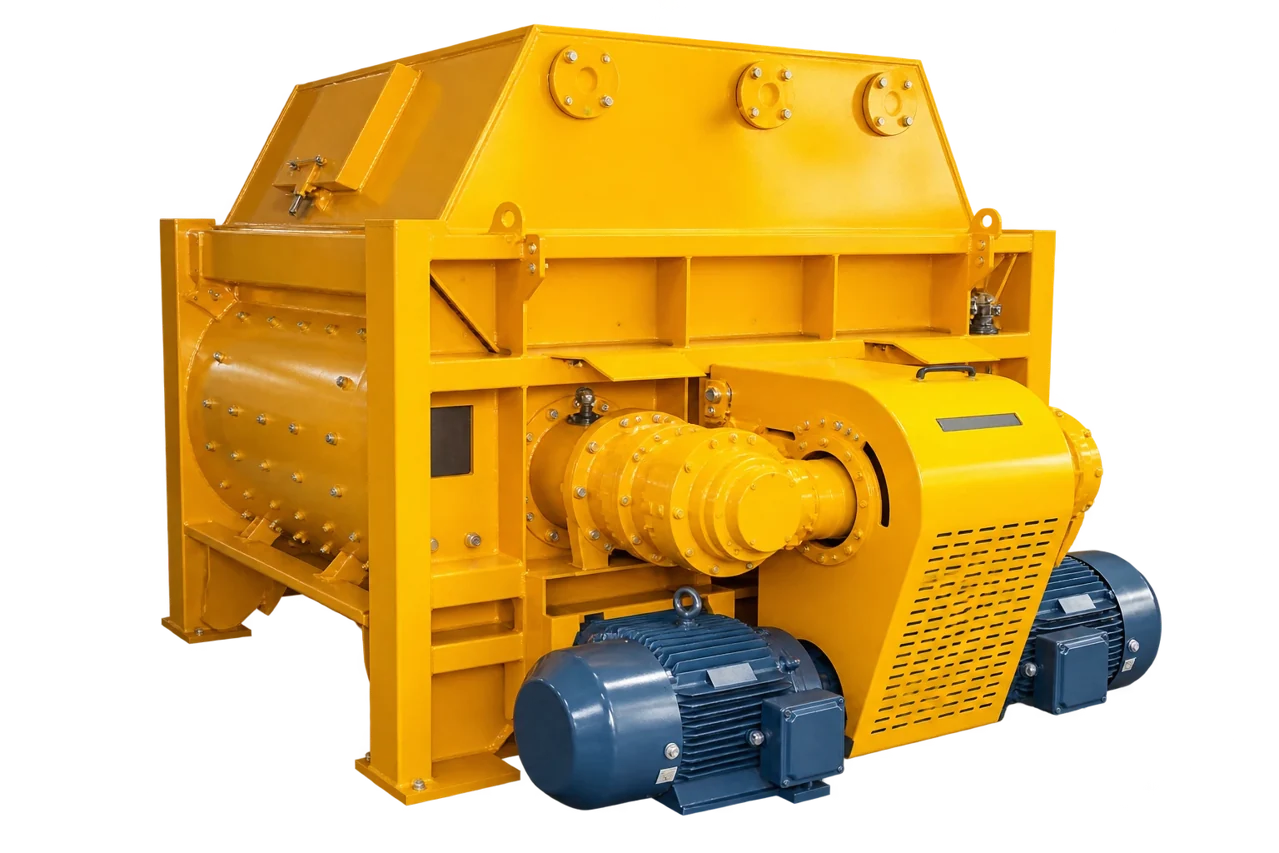
The MFO fly-ash solidification mixer is a cataloged mixer range for stabilization and solidification processes. Selection depends on batch output, additive recipe and duty. The catalog does not establish a universal binder dose, curing period or leaching guarantee. Those belong in a project-specific treatment and verification plan.
Start with ash identity and the acceptance question
Identify the ash source before ordering a test. Coal-combustion fly ash and residues from waste incineration should not be treated as interchangeable feedstocks. Record the generating process, collection point, lot, moisture condition and available characterization. Also state whether the ash is the waste being treated or an ingredient used to treat another waste; the same words can describe different formulations.
Ask who will use the result: a receiving facility, environmental assessor, process developer or procurement team. Obtain that party’s required method, analytes, reporting units and decision criteria in writing. The EPA methods discussed here are examples of defined test purposes, not a declaration that a US method or threshold governs every country or project.
Match the leaching test to the question
The following table is a selection aid for discussion with the laboratory, not a laboratory operating procedure. Sample preparation and execution must follow the applicable method and the approved project plan.
| Question | Test basis to discuss | Interpretation boundary |
|---|---|---|
| Is the waste acceptable under a requirement that explicitly calls for TCLP? | EPA Method 1311, TCLP | Report against that requirement; do not infer every field exposure from it |
| Could constituent availability change as pH changes? | EPA Method 1313 | A partitioning-versus-pH assessment, not a service-life prediction |
| How does an intact or compacted treated material release constituents during water contact? | EPA Method 1315 | Time-dependent release under the method’s conditions, not a universal outdoor lifetime |
| Is percolation through a granular material the relevant scenario? | Discuss EPA Method 1314 within LEAF | Match the granular form and liquid-to-solid basis to the question |
EPA’s TCLP scope addresses analyte mobility and identifies the procedure as a method-defined parameter when used for RCRA testing. It should not be casually modified to make a treated sample easier to test or more likely to pass.
Method 1313 provides a pH-dependent partitioning basis. Method 1315 addresses inorganic release from monolithic or compacted granular material under diffusion-controlled conditions. EPA’s LEAF guidance explains how method choice relates to a use or disposal scenario. These are complementary questions; one result cannot simply be substituted for another.
Preserve the link from mixer batch to specimen
A laboratory report is difficult to use for procurement if nobody can reproduce the sample’s history. Use the following record for each trial batch and send the relevant fields with the specimen. Decide sampling locations and replicate requirements with the test specialist before the trial, rather than selecting only the most convenient hardened piece afterwards.
| Record | What to retain | Why the comparison needs it |
|---|---|---|
| Feed identity | Ash lot, source and moisture measurement | Separates formulation effects from feed changes |
| Dosing | Actual ash, binder, reagent and water masses; wet/dry basis | Makes the recipe reproducible |
| Mixing | Batch identifier, charge order, mixing duration and discharge observations | Connects the specimen to a documented process |
| Curing | Start time, environment, storage and age at testing | Prevents unequal cure histories from masquerading as recipe differences |
| Specimen | Sampling location, preparation, dimensions or granular condition as applicable | Preserves the test’s physical basis |
| Laboratory | Method/version, analytes, units, detection limits and quality-control information | Makes results interpretable against the agreed criteria |
For a hypothetical comparison of formulations A and B, use representative portions of the same characterized ash lot and record every actual addition. Prepare and cure both according to the agreed plan, then test them at the same planned condition. If A is tested as an intact specimen while B is crushed for a different method, the reports may both be valid, but they do not isolate the effect of formulation. Label the difference rather than ranking the binders from those results alone.
Require an interpretable laboratory return
The request should name the decision maker and the decision being supported. Ask the laboratory to confirm whether the proposed material form and analytes fit the method, what sample quantity and containers are required, and how transport and storage will be controlled. Do not prescribe improvised crushing, drying or preservation steps from a purchasing article.
Require the report to distinguish measured concentration, calculated release and any normalization basis used by the method. A nondetect is not a measured zero: retain the reporting limit and check whether it is useful for the acceptance criterion. Record deviations and unavailable measurements explicitly. Have the responsible specialist interpret conflicting results before declaring treatment successful.
Translate the test plan into equipment acceptance
Keep mechanical and environmental acceptance separate. A specimen’s handling strength does not replace leaching evidence, and a favorable leaching result does not demonstrate mixer throughput or wear life. Define which trial records prove dosing and mixing repeatability, and which laboratory records support the treatment outcome.
The MFO mixer specification guide covers the broader equipment inquiry. Attach the agreed test plan to that inquiry, with responsibilities for sampling, curing, laboratory work and result approval. Confirm whether the proposed trials represent the expected feed variability; a single selected batch is not evidence for every future ash lot.
Conclusion
A useful fly-ash leaching specification names the question, method, specimen condition and decision rule together. Preserve the chain from ash lot to mixed batch to cured sample, and compare like with like. Purchase the mixer against documented process duty while qualifying treatment performance through the agreed testing program.