
Calculate ice as a replacement for part of the approved mixing water, using the measured mass and temperature of every major ingredient. The result predicts an initial batch condition; it does not guarantee the temperature at discharge or placement. Plant heat gain, wet aggregate, ice temperature, melting, mixing time and haul time all need field verification.
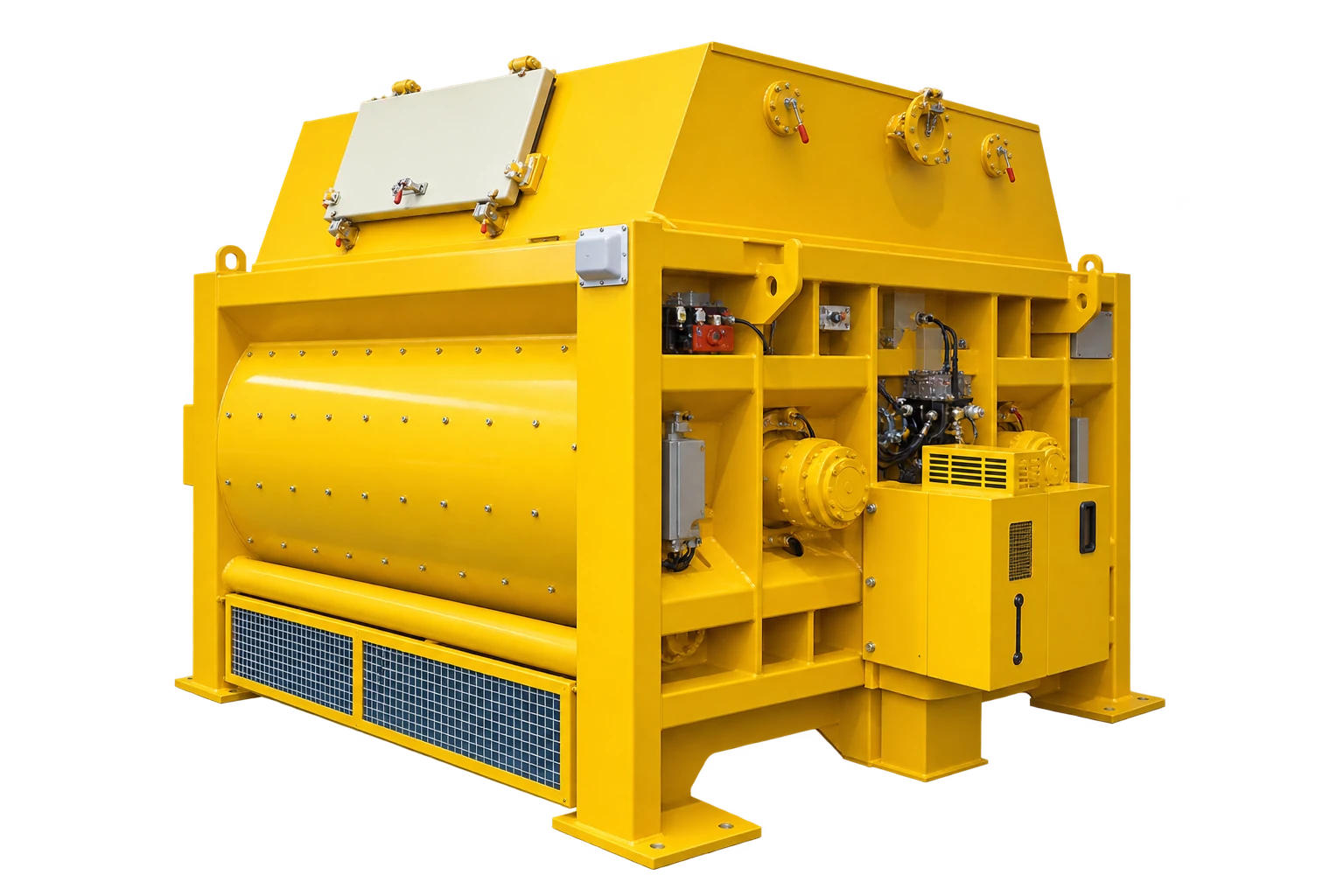
The MRC high-grade concrete mixer is cataloged by batch output and required mixing performance. Its public data do not claim an ice-handling rate or a guaranteed concrete temperature. The project team must confirm charging sequence, allowable ice size, mixer loading and evidence from representative trials.
Define the acceptance point before calculating
Record whether the limit applies at mixer discharge, truck discharge or placement. These are different control points. Use the contract value rather than a generic maximum. The NRMCA specification guide shows that hot-weather limits belong in project requirements and should be coordinated with the cited ACI and ASTM provisions.
Measure the actual temperature of cementitious materials, coarse and fine aggregate, batch water and ice close to production. Include aggregate free moisture in the approved water balance. A dry-mass recipe combined with unmeasured wet stockpiles can produce the right arithmetic and the wrong concrete.
| Required input | Unit | Source of evidence |
|---|---|---|
| SSD aggregate mass and temperature | kg, °C | Approved mix and representative stockpile measurement |
| Cementitious mass and temperature | kg, °C | Batch record and silo/material measurement |
| Total approved mixing water | kg | Approved mix after moisture correction |
| Liquid-water and ice temperatures | °C | Calibrated plant measurement |
| Target control-point temperature | °C | Project specification |
| Heat gain and transport allowance | °C | Trial-batch and production records |
FHWA lists cooling aggregates and replacing mixing water with ice among methods for lowering concrete temperature. NRMCA quality-system examples also show that plants may combine stockpile misting, chilled water and controlled batching. These references support a system approach; they do not prescribe one quantity for every plant.
Use a transparent heat balance
For a first-pass metric calculation, a commonly used simplified balance treats the heat capacity of dry aggregate and cementitious solids as 0.22 times that of water. The heat of fusion of ice is approximately 79.7 kcal/kg. With ice at 0°C replacing liquid water at temperature (T_w), a planning equation is:
[ T_f=\frac{0.22\sum(m_sT_s)+m_wT_w-m_i(T_w+79.7)}{0.22\sum m_s+m_w} ]
Here (m_s) and (T_s) are each dry solid mass and temperature, (m_w) is the total approved water mass after moisture correction, and (m_i) is the portion supplied as ice. This simplified equation assumes all ice melts and does not include plant heat gain. If ice is below 0°C, if aggregate moisture is treated separately, or if admixture and supplementary-material terms matter, use the project’s accepted method with consistent units.
Worked example: a hypothetical batch
Assume, only for illustration, 1800 kg of SSD aggregate at 35°C, 400 kg of cementitious material at 45°C, and 180 kg total mixing water otherwise available at 25°C. The target calculated batch temperature is 28°C.
Without ice, the simplified estimate is:
[ T_0=\frac{0.22(1800\times35+400\times45)+180\times25}{0.22(1800+400)+180}=33.6^\circ C ]
Solving for ice that replaces water at 25°C:
[ m_i=\frac{22320-664\times28}{25+79.7}=35.6\text{ kg} ]
The hypothetical batch would therefore use about 35.6 kg of ice and 144.4 kg of liquid batch water before any separate aggregate-moisture allocation. Do not copy these values into production: they depend entirely on the stated masses, temperatures and assumptions.
Check whether the calculated dose is feasible
The ice mass cannot exceed the portion of mixing water available for substitution. GCP’s hot-weather bulletin explains that ice must be weighed, replaces mixing water and has both latent and sensible cooling effects. It also notes that practical cooling is limited by available mix water. A calculation that asks for more ice than the water budget permits requires another measure, such as colder aggregates or chilled water, or a revised production plan approved by the responsible engineer.
Confirm that ice geometry and charging do not create clumps, damage equipment or leave unmelted pieces. Require all ice to melt before discharge. Keep the water-cementitious ratio unchanged by counting melted ice and free surface water together.
The related aggregate-moisture correction guide explains how wet aggregate changes batch masses and added water. Complete that correction before finalizing the ice split.
Validate with instrumented trial batches
Run trials at representative hot conditions, not only in a cool morning. Record ingredient temperatures and masses, stockpile moisture, ice mass and form, charge order, mixing time, discharge temperature, elapsed time and placement temperature. Use calibrated instruments and repeat enough batches to separate a stable offset from random variation.
If discharge is warmer than predicted, investigate heat gain from hot bins or mixer surfaces, actual aggregate temperature, delayed ice charging, incomplete melting, and the measurement location. If placement is warmer while discharge agrees, investigate truck heat gain, waiting and agitation. Change one controlled factor at a time.
Put the evidence into the purchase specification
Ask the mixer and plant supplier to return the permissible ice form and maximum piece size, charging point, interlock or sequence requirements, mixing-time effects, water-accounting interface and the method used to prove complete melting. Ask the cooling-system supplier for delivered ice temperature, mass accuracy and peak production duty. These answers are configuration-specific.
Conclusion
An ice calculation is an energy-balance starting point. Use measured ingredient data, replace water mass-for-mass, respect the available water budget, and prove the result at the specified control point with representative trials. Cooling equipment and mixer capability must be confirmed for the actual configuration.
References
FHWA — Guide for Curing of Portland Cement Concrete Pavements, alternative text ↗NRMCA — Guide to Improving Specifications for Ready Mixed Concrete ↗NRMCA — Quality Management System for Ready Mixed Concrete Companies ↗GCP Applied Technologies — Hot Weather Concrete, Technical Bulletin TB-0101 ↗