Concrete mixer spare parts identification should start with the installed machine’s serial number, applicable drawing revision and exact assembly position. A familiar model name or a photograph alone is not enough to release an order. Connect those records before comparing prices, and keep uncertain matches out of the installation-ready stock.
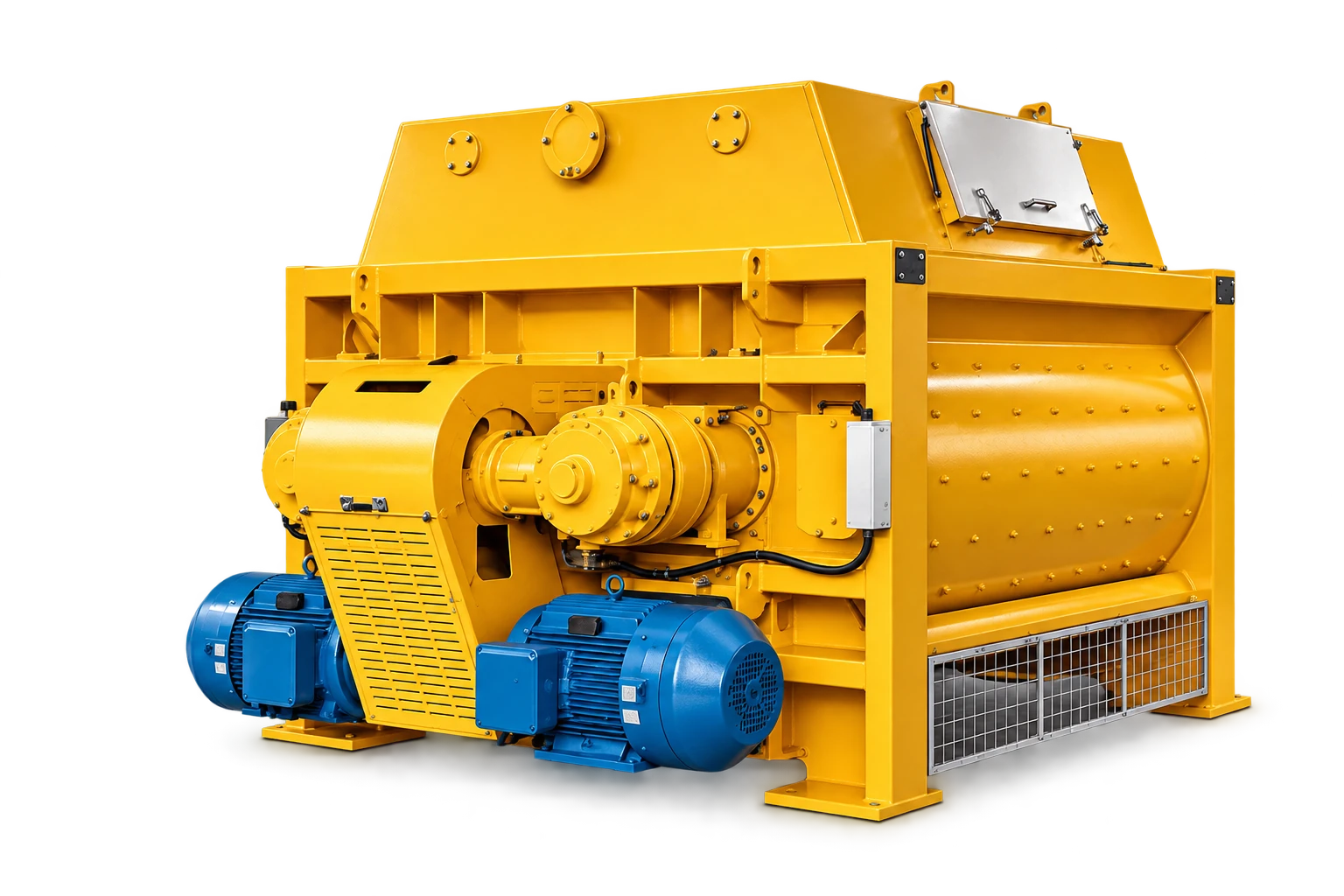
For a plant using the MAO standard twin-shaft concrete mixer, the VOGO catalog identifies the product family. It does not establish which replacement part fits a particular installed machine, whether a later modification was made, or whether a spare is available. Those questions need project-specific confirmation. The method below is a procurement worksheet, not a repair instruction or a promise of parts supply.
Build the concrete mixer spare parts identification chain
Make one machine record with the plant asset tag, manufacturer, complete model designation, serial number, year if available, and an accessible nameplate photograph. Keep the asset tag separate from the manufacturer’s serial number: a plant may have reassigned its own tags after moving equipment.
Next attach the assembly drawing or parts book that actually applies. Record its document number, revision, page and any serial-number applicability note. Liebherr’s original-parts information describes a catalog tied to a machine serial number; that is a useful illustration of why a generic model list is not the same as an installed-machine parts record. It does not establish interchangeability with MAO equipment.
For each requested item, trace machine → applicable drawing → assembly → position → orderable identifier. A drawing position is not necessarily an orderable part number. If the supplier replaces an old identifier with a new one, ask for the supersession statement and any associated changes, rather than silently replacing a spreadsheet cell.
Record position, orientation and kit contents separately
A name such as “mixing blade” leaves several purchasing questions unanswered. Record where the item belongs and how the drawing defines orientation. A location photograph should include surrounding features and a marked viewpoint. “Left” without a viewing direction can describe two different locations.
Use this recommended return schedule for every quotation line. Its field names are a purchasing aid; they are not VOGO part designations.
| RFQ field | Buyer supplies | Supplier returns |
|---|---|---|
| Machine identity | Model, serial, asset tag | Applicability confirmation and exceptions |
| Drawing identity | Document, revision, page | Applicable revision or documented replacement |
| Assembly position | Position and viewing direction | Orderable identifier and orientation |
| Item specification | Existing marking and approved material record | Declared specification and deviations |
| Quantity basis | Installed positions, requested pieces or kits | Pieces per kit and total supplied pieces |
| Associated items | Existing assembly scope | Included and excluded fasteners, seals or supports |
| Release evidence | Required documents | Traceability and confirmation reference |
ROSS’s official spare-parts request form asks for model, serial, needed parts and a photograph. These are sensible information categories, but the form is not evidence that another manufacturer’s component fits this mixer. Measurements and images support the identification chain; they do not replace it.
Resolve a mismatch before accepting the offer
Consider a hypothetical order for a blade at the buyer’s location label “A3.” That label is only a worksheet reference, not a real part number. The stored drawing and the removed item show different hole arrangements. The procurement decision is to hold that line, not to select whichever outline looks closest.
Ask whether the machine was modified, whether the drawing belongs to another serial range, whether the item was previously substituted, or whether the photographed component has been misidentified. Return the discrepancy to the responsible supplier or engineer with both records attached. Accept a proposed substitute only after its applicable drawing, interfaces and required companion changes are confirmed in writing.
A replacement kit needs a declared contents list and quantity basis. If the quote says “one set,” request the piece count and installation coverage. Keep planned replacements, contingency spares and mandatory companion items on separate lines. This prevents a low unit price for one component from being compared with the price of a complete assembly.
Gather evidence without creating a maintenance hazard
Start with records and externally accessible markings. Do not open guards, enter the mixer or move a shaft simply to improve an RFQ photograph. If internal inspection is necessary, it becomes a planned maintenance task. HSE’s equipment-maintenance guidance calls for competent people, suitable instructions and safe isolation. Its UK context should be considered alongside the rules applicable at the site.
Electrical isolation alone may not address pneumatic gates, hydraulic circuits, gravity, suspended equipment or material that can enter from upstream. The US OSHA hazardous-energy overview identifies multiple energy forms and the role of energy-control procedures. Use the site’s authorized procedure and verify the safe state; a control-panel stop is not the procurement team’s permission to approach machinery.
Wear-condition assessment is a different decision from identifying an orderable item. The twin-shaft mixer wear-inspection guide addresses that condition-assessment boundary. This article does not prescribe replacement clearances, tightening values, wear limits or repair methods.
Release purchasing and installation as different decisions
A commercially acceptable offer should identify the confirmed line item, quantity, delivery scope, documentation, exclusions and unresolved deviations. Request written clarification where compatibility is conditional. Availability, lead time and price remain supplier-confirmed commercial facts, not conclusions inferred from a catalog picture.
At goods receipt, compare the supplied identifiers and documents with the approved order. Keep discrepancies segregated from released stock. Record the item’s eventual installation against the asset history, so a future request does not start again from an unidentified photograph. Receiving a matching package does not by itself approve the installation method or machine restart.
Can a photograph confirm that a mixer part fits?
A photograph helps identify a candidate part; compatibility still needs the installed-machine record, applicable drawing and supplier confirmation.
Conclusion
Concrete mixer spare parts identification works best as a traceable chain, from serial number to drawing revision to the exact order line. Resolve conflicts before release, state what each kit contains and preserve the confirmation with the asset record. That gives engineering and purchasing a common basis for evaluating offers without inventing compatibility or replacing the required maintenance controls.