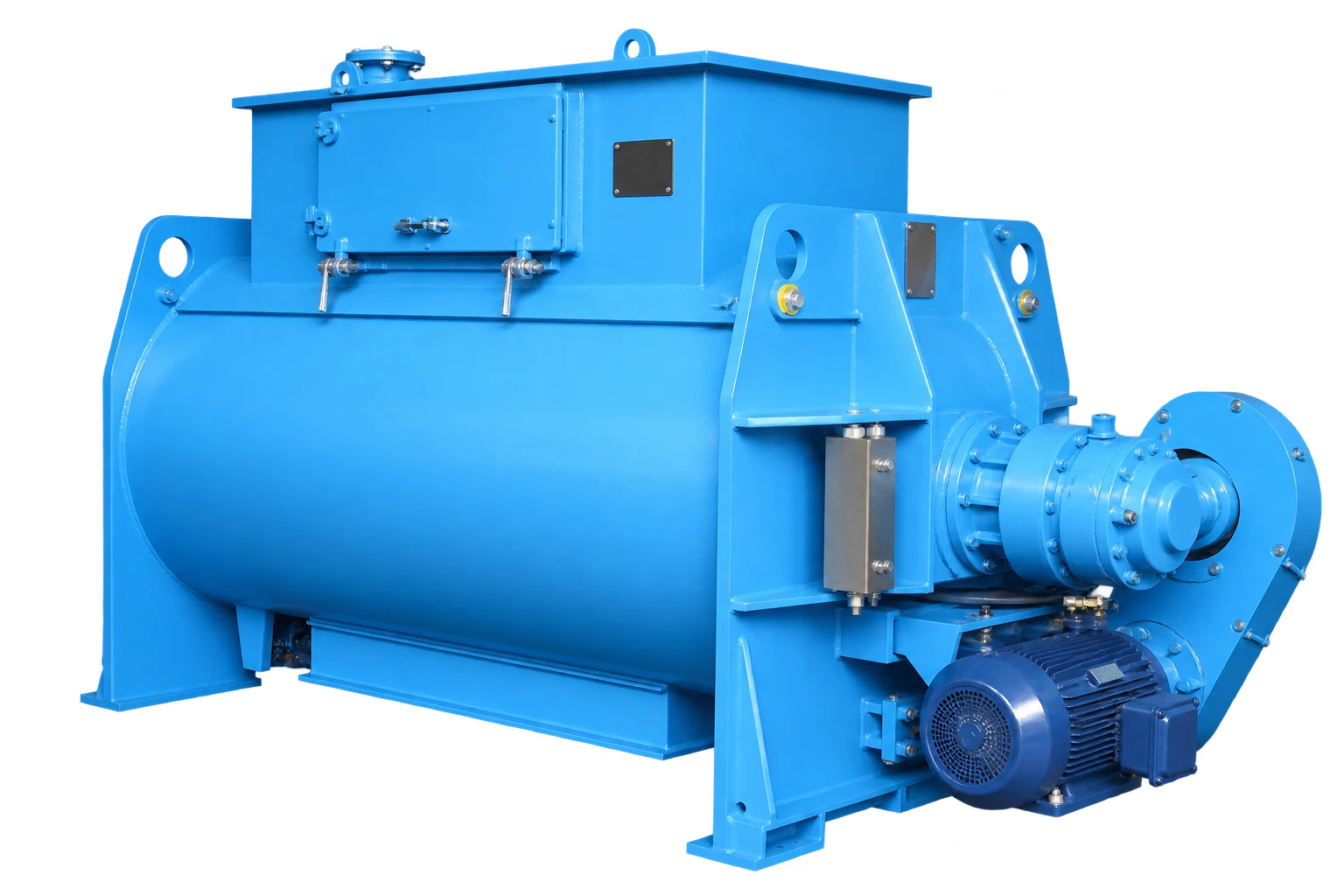
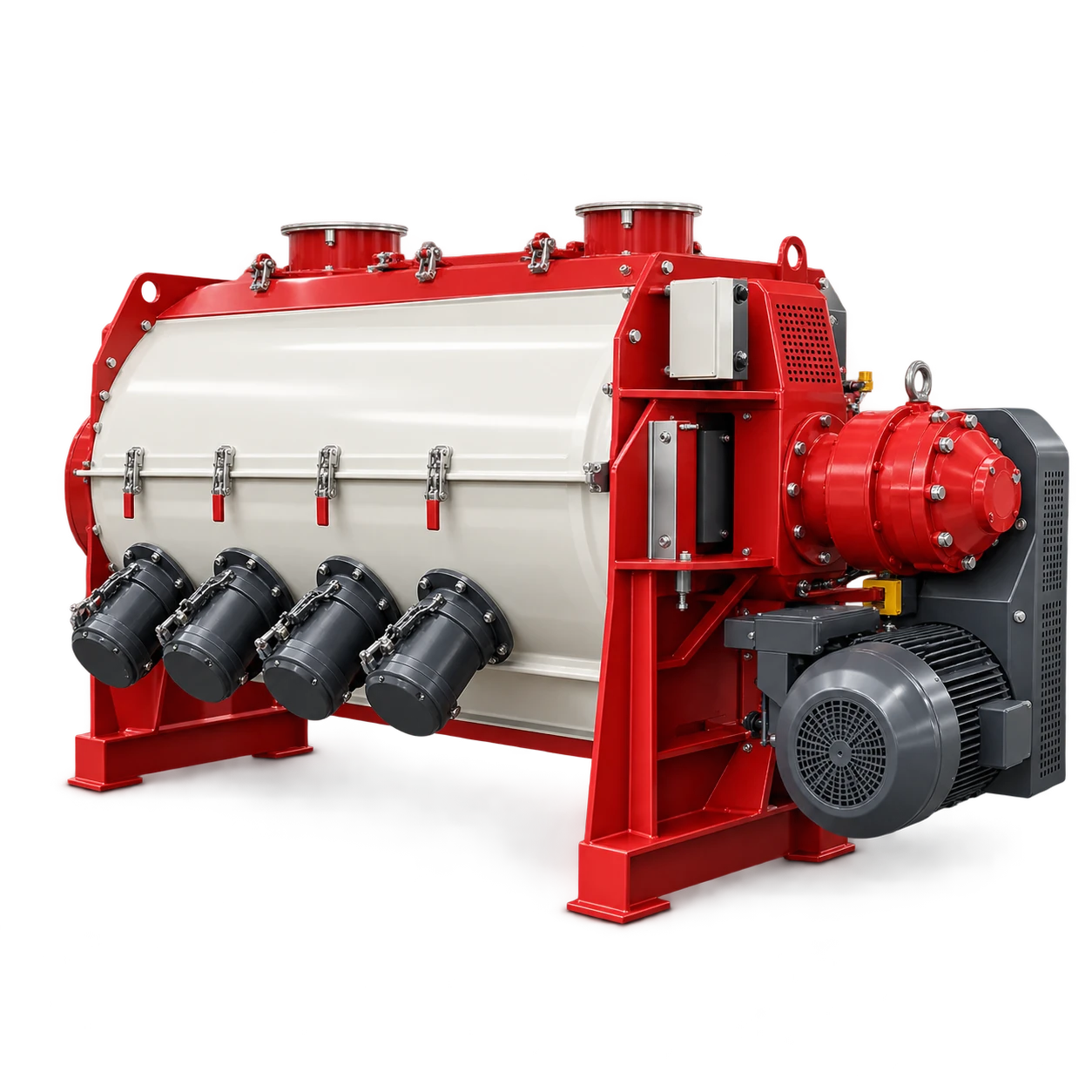
A dry mortar mixer quotation is comparable only when every supplier prices the same formulation, accepted batch mass, complete cycle and scope of supply. Send a duty sheet before requesting a model or a headline price. Separate the dry-blending machine from a wet mortar mixer used at the building site, and define who supplies dosing, dust extraction, discharge handling and controls.
The FKM dry-powder mortar mixer range has catalog total volumes from 600 to 6,000 L. Selection depends on total volume, working volume and formulation. Those labels do not establish one usable batch mass or hourly output for every powder; request a returned specification tied to your actual recipe.
Put the material envelope in the dry mortar mixer quotation
Identify the product families to be blended, the smallest additive dose and the range of intended batches. Supply representative bulk-density measurements, particle-size information, moisture, temperature, abrasive constituents and any fibers or liquid additions. Include safety data sheets and known dust hazards. A description such as “cement powder” leaves too much uncertainty for a meaningful proposal.
State whether quoted quantities are dry masses, as-received masses or volumes. Document how samples were conditioned for density measurement. Settled material and a loosely aerated blend may occupy different volumes; the supplier must approve the operating envelope rather than accept a convenient average.
Avoid making a requested mixing time the only acceptance target. The buyer needs accepted product delivered to the next process, which may be restricted by weighing, charging, gate operation or bagging. Specify which delays belong inside the rated cycle.
Separate total volume, working volume and mass
An independent Lödige batch-mixer engineering sheet lists total and working volume separately and states that optimum fill depends on the application. It illustrates the distinction; Lödige’s FKM designation and fill ranges are not VOGO data and do not establish a relationship between the products.
Use working material volume = batch mass ÷ measured bulk density as an initial material-volume estimate. The selected supplier must still approve filling, tool action and loading sequence.
Hypothetical example: a 1,000 kg batch at an assumed bulk density of 1,200 kg/m³ occupies 1,000 ÷ 1,200 = 0.833 m³, approximately 833 L. This is not a recommendation for an FKM model. Initial charging volume, partial batches and the formulation can change the required operating space.
For a planning output, assume that accepted batch is discharged every 240 seconds and choose an explicit operating fraction of 0.80. Then 1.0 t × 3,600 ÷ 240 × 0.80 = 12 t/h. All inputs are assumptions, not a product guarantee. Do not count the same delay in both cycle duration and operating fraction.
Issue a supplier-return schedule
Ask each bidder to fill the same table and mark exclusions. Blank entries should remain open questions, not be interpreted as included equipment.
| Required return | What it prevents |
|---|---|
| Exact model and total/working volumes | Comparing different capacity definitions |
| Minimum and maximum batch mass by recipe | Applying a single fill factor to every material |
| Complete cycle and time boundary | Comparing mixing time with delivered output |
| Tools, drive and confirmed options | Assuming a chopper or liquid system is standard |
| Inlet/outlet drawings and loads | Discovering incompatible interfaces after purchase |
| Electrical and pneumatic utilities | Pricing an incomplete installation |
| Test method, documentation and acceptance | Replacing evidence with a brochure claim |
Use a column for “included,” “optional” or “by purchaser” next to each item. Assign ownership for commissioning, operator training, spares and local installation work. Clarify whether a quoted performance statement applies to one demonstrated recipe or the entire requested range.
Price interfaces and dust control explicitly
The mixer offer should identify weighing and feeding equipment, inlet seals, vent connections, discharge valve, receiving hopper, supports and controller interfaces. Confirm who provides permissives and feedback when downstream equipment is unavailable. A receiving hopper that cannot accept the whole batch can prevent the quoted cycle from being achieved.
For dusty charging and discharge, define the extraction responsibility and the operating states it must control. HSE’s HSG258 guidance treats commissioning as proof of effective control, with performance checks and a report. A vent connection or an enclosed vessel alone does not establish dust control, airtightness or a pressure rating.
Ask for an interface drawing before civil work is finalized. Specify access for wear parts, seals and cleaning. Maintenance space that is omitted from the layout may force expensive changes after delivery, even if the machine fits within its outline dimensions.
Make acceptance a contractual deliverable
Agree representative recipes, batch sizes, raw-material conditions and the sampling plan before the factory demonstration. Require the supplier to report batch mass, full-cycle timestamps, delivered quantity, retained material and drive observations. Test the lowest intended batch as well as the normal duty. Define how failed results are handled and who approves a revised configuration.
Keep dry-blend uniformity separate from the finished mortar’s performance after adding water. ASTM C387/C387M-23 addresses packaged dry materials for concrete and high-strength mortar; its scope excludes unit-masonry mortars. Specify the applicable product standard for your market rather than claiming that a mixer is certified by a material specification.
The dry mortar homogeneity guide explains marker selection and discharge sampling. Reference that agreed method in the RFQ instead of inventing a supplier-independent uniformity percentage.
Compare the installed scope before comparing prices
Normalize offers to the same installation and acceptance basis. A lower machine price can exclude control panels, air treatment, dust extraction, transport, testing or replacement parts. Separate capital cost from recurring energy, wear and product-loss assumptions; request evidence where a supplier claims a lower operating cost.
Require a list of consumables with part identifiers and lead times. Ask what data is supplied for local conformity assessment and safe integration. OSHA’s energy-control overview identifies service hazards; plant isolation procedures must cover the assembled line. A stopped drive alone is not a completed maintenance arrangement.
Conclusion
A useful dry mortar mixer quotation prices a defined recipe envelope, accepted output, interfaces and evidence. Return schedules expose omissions before ordering. Convert mass and volume with stated measurements, retain full-cycle assumptions and compare the complete installed scope so a low headline price does not conceal a different machine or duty.