
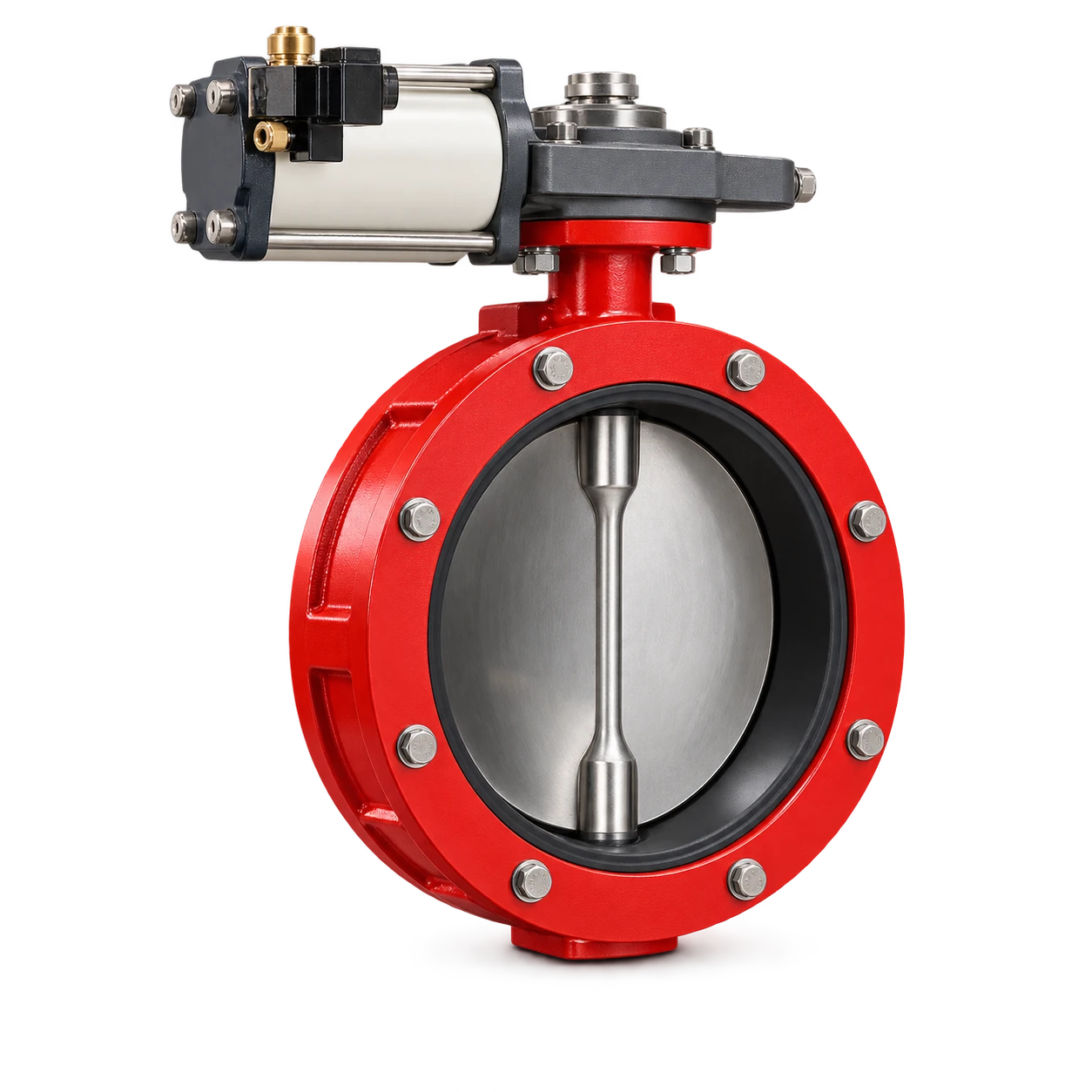
A V1FS vs V2FS replacement quotation starts with the lower process connection. In WAMGROUP’s VFS family, V1FS provides a lower sleeve connection, while V2FS provides a second flange. Choose the arrangement that fits the adjoining equipment and approved installation; neither code means a universally better or cheaper valve.
If you are considering the VOGO cement butterfly valve range as another quotation candidate, compare its own configuration and drawing. The current catalog model table uses SD references. It does not declare an SD-to-WAM VFS interchangeability list, and this article supplies no such approval.
Read a V1FS vs V2FS replacement quotation correctly
The WAMGROUP VFS brochure distinguishes the one-flange sleeve arrangement from the two-flange arrangement. The following summary applies to that documented family, not to every marketplace product carrying similar letters.
| WAMGROUP family | Upper connection | Lower connection | First replacement question |
|---|---|---|---|
| V1FS | Flange | Beaded section for a flexible sleeve | Does the existing sleeve fit the offered connection? |
| V2FS | Flange | Flange | Do both mating flange drawings agree? |
Record manufacturer, complete part number, nameplate or casting identification and document revision. A generic listing headed “V1FS/V2FS” may cover several bodies, discs, seals and actuation packages. Ask the seller to identify the exact supplied assembly before comparing price or treating a photograph as evidence of fit.
Identify whether the inquiry concerns an original spare, a different manufacturer’s candidate or an installation modification. These are proposed purchasing categories, not certifications. A cross-brand candidate needs its own confirmation even when the nominal size and outward appearance are similar.
Survey both sides of the installed valve
Collect the upper and lower mating drawings, installed spacing and available removal space. Check drilling, fastener access, sealing faces, sleeve or spigot geometry and the space needed by the disc through its travel. Use the dimensions defined in each drawing; identical letter labels on two drawings need not denote the same feature.
Consider an existing valve connected to a flexible sleeve below. A two-flange offer changes the connection concept unless the complete transition is separately designed and accepted. Price that transition and its installation responsibility explicitly. Do not assume that a nominal-size adapter preserves the original load path, movement allowance or maintenance access.
Conversely, a sleeve-ended offer is not a documented replacement for a rigid flanged receiver merely because the bore appears similar. Return the proposed assembly drawing to the responsible plant designer. Keep mechanical compatibility on hold until the full arrangement is reviewed.
Physical inspection is a controlled maintenance task. OSHA’s hazardous-energy overview addresses unexpected startup and stored energy during servicing. Follow the site’s authorized isolation and access procedure before measuring or removing equipment; a close command alone is not permission to reach into the valve.
Separate the actuator interface from process fit
An actuator that bolts on can still be unsuitable for the complete valve duty. Obtain its exact identification, drive connection, mounting hardware, utilities and approved demand basis. Reusing an existing actuator must be an explicit scope item rather than an assumption made from a similar housing.
The public scope of ISO 5211:2026 concerns actuator attachment dimensions and reference interface torques. It does not establish the torque demanded by a particular powder, the process flange match or the intermediate support’s attachment to the valve. Ask for each applicable drawing and confirmation rather than claiming that an ISO mounting label proves compatibility.
Keep pressure, leakage, seal and material suitability configuration-specific. A rating stated for a WAM version cannot be transferred to an SD candidate or to a generic VFS-marked listing. The existing cement valve specification guide owns the broader duty and acceptance brief; use it without repeating a torque calculation here.
Return a replacement comparison with every offer
This original decision sheet focuses on replacement identity and installation changes. Use it alongside the current manufacturer’s documents.
| Comparison | Evidence required | Purchasing disposition |
|---|---|---|
| Product identity | Exact maker, full code and revision | Hold unidentified or incomplete listings |
| Upper connection | Mating drawing and offered drawing | Resolve every drilling or face difference |
| Lower connection | Sleeve or flange geometry and installed arrangement | Price any conversion as a separate modification |
| Envelope | Installed spacing, disc movement and removal access | Approve the complete assembly drawing |
| Actuation | Mount, drive, utilities and duty confirmation | State new supply versus verified reuse |
| Handover | Accepted drawing, parts identification and agreed checks | Match delivered items to the accepted offer |
Distinguish a bare body price from a complete valve with actuator, position devices, mounting parts, sleeve hardware or adapters. Record currency, date, validity, delivery place, packing and transport for the actual transaction. No generic price difference between V1FS and V2FS is established by the connection names.
Do not rank offers while a required modification is priced as zero or left unassigned. A lower valve price can be offset by separately required transition work, controls or installation. Obtain those amounts from the responsible parties rather than inventing a percentage premium.
Conclusion
Compare V1FS and V2FS replacement quotations by the actual lower connection, exact manufacturer configuration and complete installed drawing. Treat other brands as separately assessed candidates and keep every modification visible in scope and price. Release the order after compatibility and acceptance responsibilities are documented, not merely after nominal sizes match.