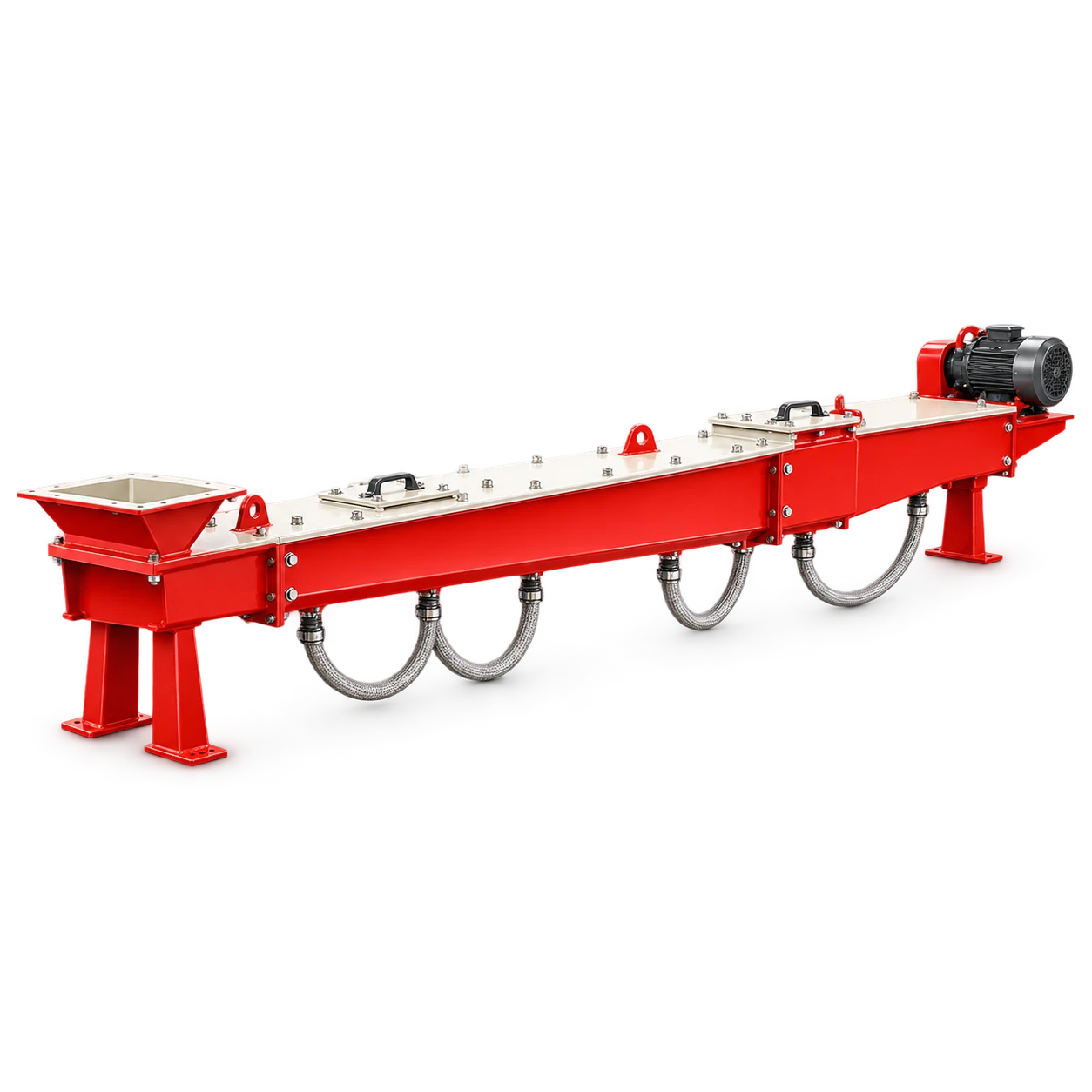
Belt conveyor drive pulley slip occurs when the pulley surface moves faster than the belt it is trying to drive. Confirm the speed mismatch, identify when it occurs, and inspect the traction system before changing motor size or take-up settings. A motor that keeps turning does not prove that the conveyor is transmitting its intended load.
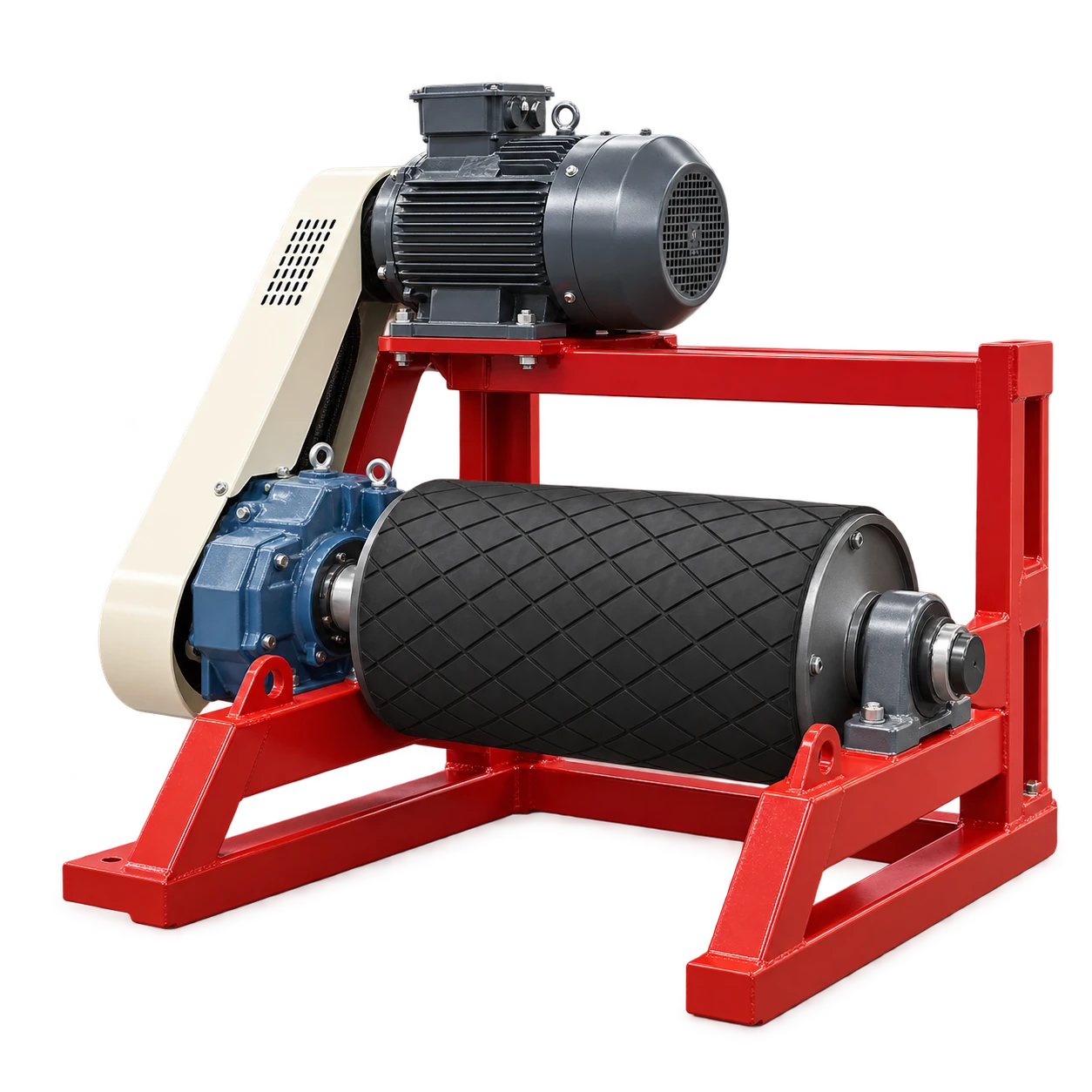
The VOGO belt conveyor drive frame is a motor and shaft-mounted gearbox arrangement. Selection depends on load, speed, power and mounting. The catalog does not certify the traction of an installed belt, pulley, lagging or take-up. A replacement inquiry should carry the observed fault and the approved conveyor duty together.
Establish which component is losing motion
Use existing guarded speed instrumentation or an approved non-contact observation arrangement to compare pulley rotation and belt travel during the same operating event. Record whether the motor, gearbox output, pulley and belt are moving as expected. A stationary belt with a stationary pulley calls for a different investigation from a rotating pulley sliding under the belt.
Do not approach a nip point to mark, touch or measure a moving belt. If access or instrument installation requires entering a hazardous area, stop and use the site’s isolation procedure. Record available control-system speed and trip data first; a protection trip must not be bypassed to obtain a longer observation.
Capture the time, load condition, weather or wash-down exposure and time since shutdown. Distinguish empty running, loaded starting, steady full load and restart after a trip. A symptom appearing only after rain or only during loaded acceleration gives the maintenance team a different evidence set from persistent slip during empty operation.
Inspect the contact and tension system together
Elastotec’s pulley-lagging engineering guidance identifies worn or glazed lagging, wet contamination, insufficient take-up tension, inadequate wrap and trapped carryback among slip causes. Inspect those categories without assuming that one material upgrade cures them all. Photograph the same identifiable face regions during an isolated inspection and link them to the event log.
Check take-up travel against its approved range and identify whether a gravity arrangement is obstructed or a screw arrangement has reached its adjustment limit. Have the conveyor designer determine the required tension; position alone is not a tension measurement. Include belt and splice identity because a changed belt can alter the approved mechanical basis.
| Observed case | Evidence to collect | Decision before ordering |
|---|---|---|
| Slip after rain or washing | Surface contamination, cleaner condition, lagging profile | Review wet-duty interface and drainage |
| Slip during loaded start | Speed and load traces, acceleration, take-up response | Recheck starting traction with the approved load |
| Slip with travel limit reached | Take-up position, belt history and available stroke | Restore an approved tension arrangement |
| Heat or visible face damage | Isolated lagging condition map | Determine repair or replacement scope |
| Pulley does not follow gearbox | Connection and shaft inspection under isolation | Investigate transmission, not belt friction alone |
| Persistent slip after repair | Same-case retest and changed-part record | Reopen root cause before another purchase |
Keep effective pull separate from total belt tension
Rulmeca’s belt-tension tutorial distinguishes effective tension Te from slack-side tension T2. T2 must satisfy both the slip and sag checks, and the larger requirement controls. Tight-side tension is T1 = Te + T2. These relationships explain why motor power and belt tension cannot be treated as the same selection value.
Do not calculate a counterweight from a generic photograph or copy a wrap factor from an unrelated conveyor. The take-up arrangement, wrap, lagging and belt characteristics belong to the actual calculation. Bearing and structural loads also require the correct geometry; the scalar sum of two span tensions is not automatically the shaft’s vector load.
Increasing tension may improve one traction condition while exceeding belt, splice, bearing or pulley limits. Ask for the approved running and starting tension envelopes and the responsible designer’s disposition. Do not make repeated field adjustments until the visible slip disappears and then treat that observation as design approval.
Turn the diagnosis into a defined repair inquiry
If the drive needs replacement, provide motor and reducer nameplates, output speed, pulley-shaft drawing, connection, torque reaction, starts and accepted load cases. The drive quotation checklist covers that commercial and interface package. Use it after identifying the fault category, rather than treating a new drive quote as the diagnosis.
If lagging needs work, separate pulley removal, inspection, structural disposition, relagging, transport and reinstallation responsibilities. Ask whether a quoted item is a drive assembly, a pulley refurbishment or a complete conveyor intervention. The VOGO drive-frame page does not establish that all of these services or components are included.
Compare the proposed repair with its evidence and outage scope. A hypothetical low-price motor-only offer may omit the worn contact surface that caused the event. This is a scope gap, not evidence that a particular motor brand or power rating is inferior. Keep actual prices, delivery and availability as supplier-confirmed inquiry fields.
Verify isolation and release against the original case
OSHA 1910.147 addresses unexpected energization and stored-energy release during servicing. Apply the site’s equipment-specific procedure, including electrical isolation and hazardous movement from gravity or tension. A stop button is not proof that the belt, take-up and rotating parts are secured.
After authorized work, retain the part identities, settings and responsible approvals. Restore guards and verify the approved protection functions before an operating test. Conduct a controlled retest using the original fault condition where safe and approved, with speed evidence from protected positions. Empty running cannot release a repair intended to solve loaded-start slip.
Record whether the symptom disappeared, whether any limits were approached and what still remains unverified. Escalate persistent slip instead of disabling detection or applying an undocumented tension increase. Define the next inspection or monitoring responsibility in the release record without inventing a universal maintenance interval.
Conclusion
Diagnose drive-pulley slip from motion, contact condition, tension-system evidence and the actual load case. Order the repair that addresses the verified cause and its interfaces. Release it only through an approved same-case test with guards and protection restored.