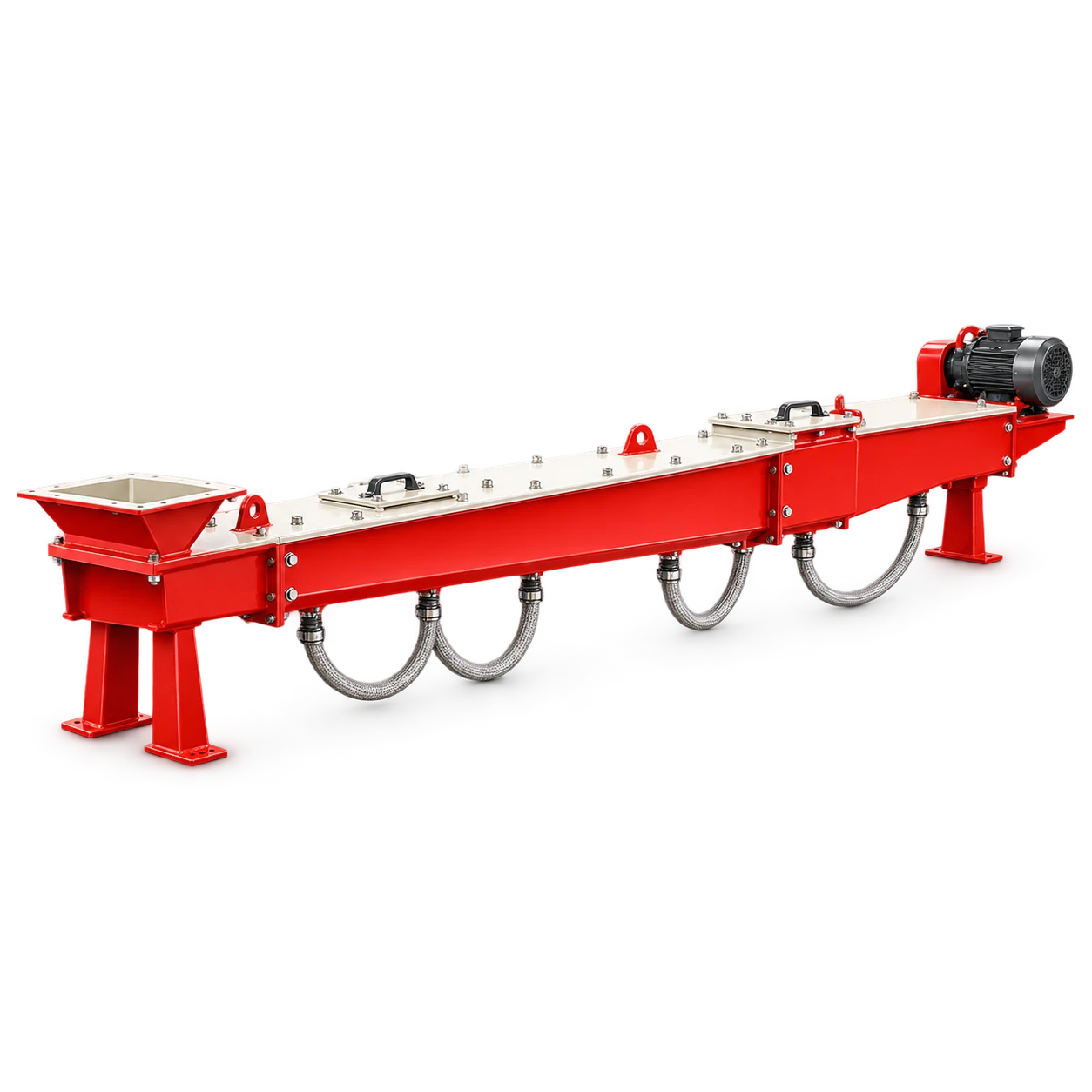
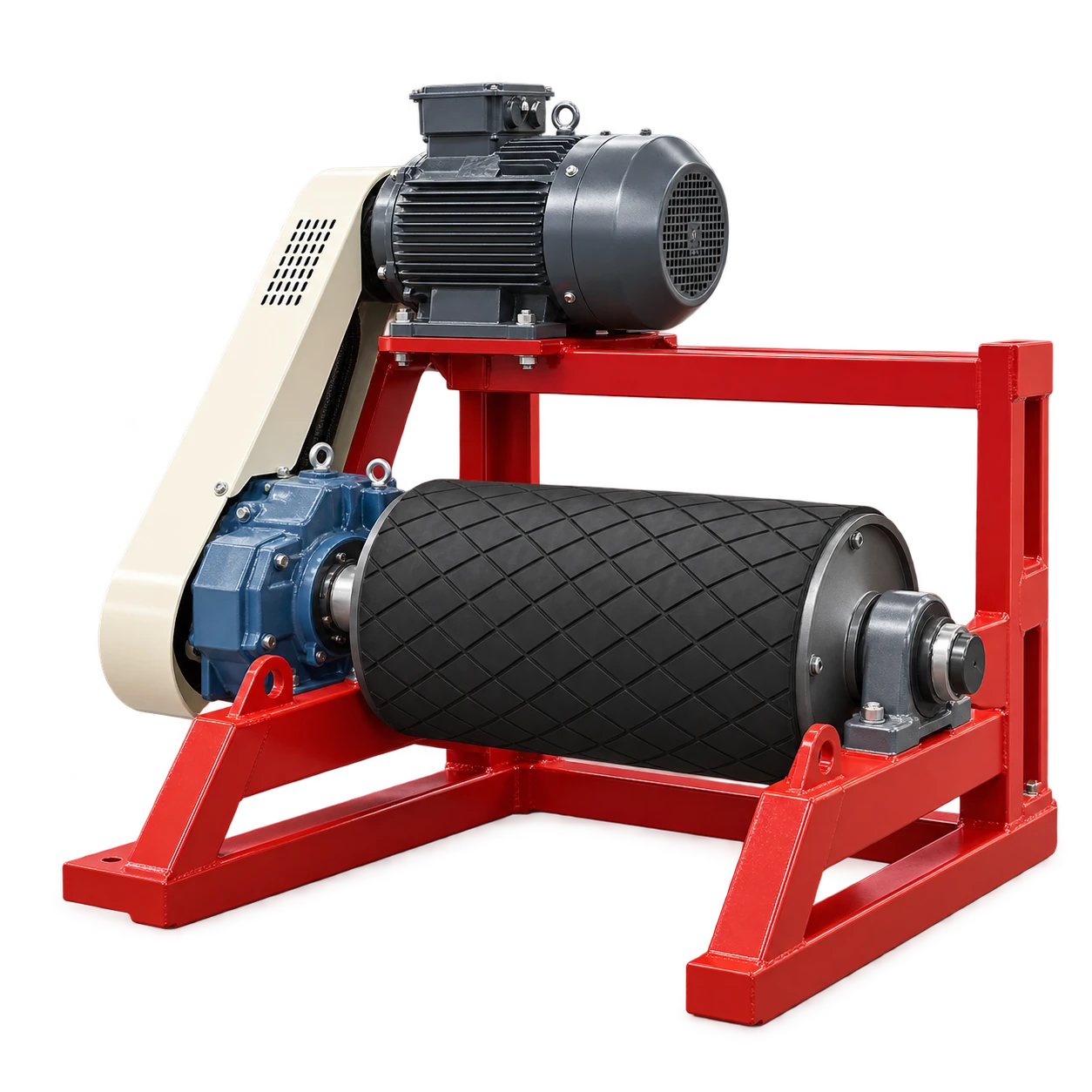
A belt conveyor drive quotation should define the load at the drive pulley, operating speed, starting and stopping cases, shaft interfaces and complete supply boundary. Motor kilowatts alone cannot establish an equivalent package. Ask every bidder to return the same duty calculation and scope schedule before comparing prices.
The belt conveyor drive frame is the catalog destination for a motor and shaft-mounted gearbox arrangement. Its selection inputs include belt load, speed, drive power and mounting arrangement. A listed motor option does not prove that the package can start a particular loaded conveyor or fit an existing pulley shaft.
Define the conveyor before naming a motor
Issue one revision-controlled layout with conveyor length, lift or decline, belt width and speed, material bulk density and normal and maximum feed rates. Identify the loading arrangement, cleaners, skirts, take-up and pulley locations. Describe sticky carryback, outdoor exposure or long shutdowns where these change the duty.
Rulmeca’s belt-tension tutorial distinguishes effective tension from the tensions needed to avoid slip and excessive sag. Effective tension covers the resistance to movement; it is not the total force acting on the drive shaft. An offer that returns only power leaves the belt, pulley and bearing review incomplete.
Record who supplies the load calculation. If the conveyor designer provides it, bidders should state that they have used that revision and identify any exclusions. If the drive supplier must calculate it, supply the necessary route and component data. A guessed resistance hidden in a quotation cannot become the approved design basis.
Check the shaft-power boundary with a worked example
The Forbo calculation handbook, pages 7 and 16, separates drive-drum mechanical power from motor mechanical power. The underlying relationship is P = F × v. Use consistent units and identify which losses are included. Forbo’s belt-specific coefficients are not universal values for every bulk conveyor.
Assume, solely for quotation screening, an approved steady effective pull of 8,000 N, belt speed of 1.5 m/s and mechanical transmission efficiency of 0.90 from motor shaft to pulley:
P_pulley = 8,000 × 1.5 / 1,000 = 12.0 kW
P_motor_shaft = 12.0 / 0.90 = 13.33 kW
All inputs are hypothetical, not VOGO ratings. The 13.33 kW result is a steady mechanical shaft requirement before the separate starting, service-duty and thermal approvals. Motor electrical input would also depend on motor efficiency. Dividing by motor efficiency again to select a shaft-rated motor would mix two different boundaries.
Now suppose bidder A describes a “15 kW drive,” but places that value at the motor shaft, while bidder B uses it as available pulley power. Those statements are not equivalent. Ask each bidder to identify the shaft, speed, losses and operating case behind the number. Do not settle the ambiguity by choosing the larger label.
Use a return schedule that exposes missing scope
| RFQ line | Required supplier return | Evidence needed before approval |
|---|---|---|
| Steady operation | Pulley power, speed and duty basis | Referenced tension calculation and loss boundary |
| Loaded start | Starting method, acceleration and permitted starts | Torque versus speed and conveyor load case |
| Stop or power loss | Proposed brake or holdback arrangement, if needed | Conveyor-specific stopping and reverse-motion review |
| Mechanical connection | Output bore, shaft, retention and reaction support | Approved interface drawing |
| Installed package | Frame, motor, reducer, transmission parts and guards | Included/excluded item schedule |
| Controls | Starter or VFD, sensors, wiring and control responsibilities | Interface and protection schedule |
Separate normal running from difficult operating cases
Ask for a loaded restart case when material may remain on the belt after a trip. State the expected start frequency and acceleration time. A drive that meets steady power can still need a different torque or thermal assessment during repeated starting. Have the supplier identify the applicable motor and reducer limits rather than applying an unexplained percentage allowance.
Inclined and declining conveyors also need a defined loss-of-power behavior. A backstop, service brake and controlled electric deceleration perform different jobs. Their need, position and capacity require the conveyor designer’s review. A reversible conveyor must not receive an incompatible holdback simply because another conveyor uses one.
Traction remains a separate acceptance question. Rulmeca explains that slack-side tension is checked for both slip and sag. A larger motor does not by itself establish adequate traction. Require the pulley, lagging, wrap and take-up basis to accompany the drive review; do not instruct the installer to keep tightening the belt until slipping stops.
Compare the installed interfaces and commercial boundary
Provide a drawing showing shaft diameter, key or locking connection, shoulder positions, available envelope and maintenance removal path. Define who designs the torque-reaction support and who verifies the pulley bearings and structure. The existing shaft-mounted gearbox installation guide covers assembly and reaction-arm checks; this RFQ should secure the drawings and responsibilities needed for that work.
Guards belong in the supply schedule. The U.S. OSHA power-transmission rule addresses exposed shafts, pulleys, couplings and related rotating equipment. Have the project specify the applicable jurisdiction, guarding responsibility and access requirements. A product photograph cannot demonstrate compliance for the installed conveyor.
Normalize freight, delivery point, installation assistance, drawings, commissioning, spares and acceptance documents as explicit commercial lines. Do not compare a factory motor/reducer price with an installed drive package total. Mark every unresolved line as an open item with an owner and due date, rather than silently treating silence as inclusion.
Release an order against evidence
Before order release, retain the accepted duty calculation, supplier selection sheet, interface drawing revision and agreed scope. Record deviations separately from price. For an assumed comparison, offer A may include a frame and guards while offer B excludes them; B’s lower price remains incomplete until those costs and responsibilities are returned. No invented market price is needed to identify that gap.
Set acceptance around the actual package: identity and document checks, interface dimensions, agreed rotation and protection checks, and the site’s approved loaded test. A workshop no-load run cannot prove a loaded conveyor duty. Any work requiring removed guards needs the site’s safe isolation procedure and competent personnel.
Conclusion
Compare belt conveyor drive quotations on the same pulley duty, starting and stopping cases, mechanical interfaces and installed scope. Use the power calculation to expose boundary errors, then obtain the separate traction, load-case and supplier-rating approvals. Release the purchase only when deviations and missing responsibilities have been resolved.