Air pads and vibrators are not interchangeable accessories. An air-fluidization pad introduces distributed air so a suitable powder loses part of its inter-particle and wall resistance. A vibrator applies mechanical motion to the vessel or material. The correct RFQ starts with the observed failure—arching, ratholing, wall buildup, compaction or erratic feeder supply—rather than with the cheapest device.
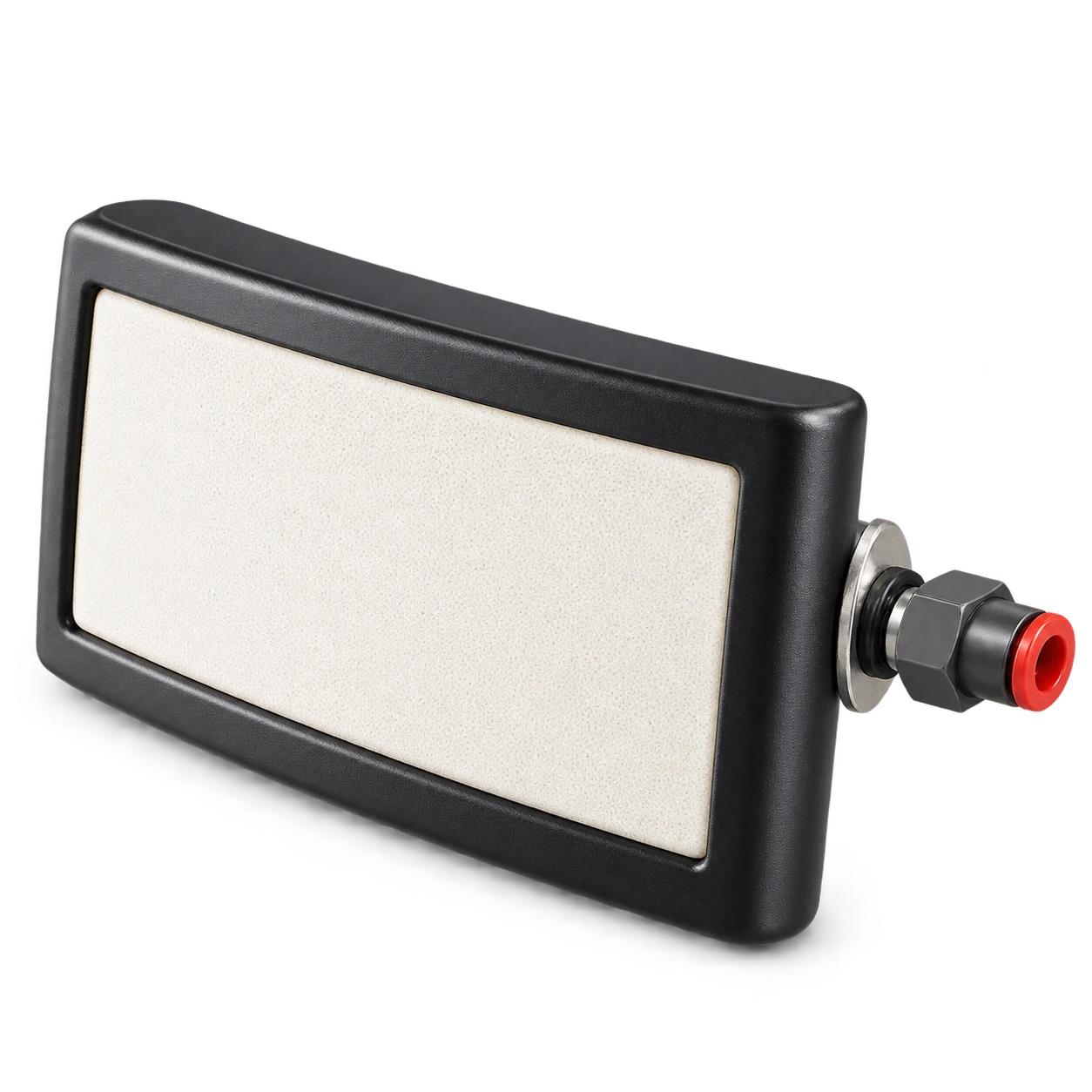
The PL air fluidization pad is catalogued for powder-flow assistance in silos and hoppers, with a stated working-pressure range of 0.2–0.3 MPa. That range is a product fact, not a universal system setting. Required quantity, placement, airflow and control depend on the powder and hopper.
Diagnose the failure before selecting a device
Record where flow stops, whether the outlet is open, how long the material has rested and what happens after the first intervention. A stable arch over the outlet, a central rathole and wall adhesion are different failures. Photograph the material surface if safe and record batch, moisture, temperature and storage time.
SHAPA’s discharge-aids guidance explains that aeration dilates fine bulk material by introducing air between particles. It also warns that excessive fluidization may cause uncontrolled flow, fines carryover or segregation. The same guidance notes that vibration can compact fine powder if used with a closed outlet. These are selection boundaries, not guaranteed results for a particular product.
If the material is wet, sticky, fibrous or rapidly de-aerates, an air pad may not address the controlling mechanism. If the silo wall or support cannot accept cyclic vibration, a vibrator may be unsuitable even when it changes flow.
Compare the physical action and the installation
| Decision item | Air-fluidization pad | External vibrator |
|---|---|---|
| Primary action | Adds distributed air and reduces bulk strength | Applies mechanical force to hopper/material |
| Best evidence | Material responds to aeration without flooding | Controlled vibration breaks the observed obstruction |
| Main interface | Compressed air, pad location, porous media and venting | Mounting plate, structural response, force and frequency |
| Common hold point | Moist/sticky material, air-channeling or uncontrolled flushing | Compaction, fatigue, noise or unsuitable mounting |
| Control question | Pulse/sequence with discharge and feeder | Run timing, force setting and interlock with outlet |
| Maintenance | Air quality, blockage, media and seals | Fasteners, bearings, cable/air line and mounting welds |
Hosokawa Alpine presents vibration, aeration and mechanical agitation as different discharge technologies selected by material and task. A quotation should therefore state why one action is being proposed.
Specify the air-pad system, not only the pad
Give the supplier a sketch with hopper angles, outlet size, wall material/thickness, internal obstructions and proposed pad positions. State powder identity, bulk density range, particle-size information, moisture tendency, storage time and whether aeration can change downstream weighing or feeding.
Define compressed-air pressure at the use point, available flow, dryness, oil content and filtration. The VOGO catalog pressure range does not establish the regulator setting, line size, consumption or number of pads for a project. Ask the supplier to return those values and the basis used.
Ingtec’s description of fluidising discharge systems explains that porous, distributed surfaces introduce air into powder and that point jets may form channels instead of mobilising the full region. Treat this as design context. The actual arrangement still needs validation with the project material.
Include regulator, gauge, solenoid valve, manifold, tubing, isolation, fittings and access in the scope table. If the offer includes pads only, price the missing utility and control package separately.
Compare installed and operating cost
A low purchase price can hide a difficult retrofit. For air pads, count vessel penetrations, internal access, hot work, air treatment and controls. For vibrators, include a suitable mounting plate, structural review, electrical or pneumatic supply, fasteners and inspection access.
Operating cost also differs. Air pads consume compressed air when active; vibrators use electrical or pneumatic energy and impose mechanical cycles. Do not invent a universal energy advantage. Ask bidders to state consumption and duty cycle at the proposed operating point.
The related vibrator-motor frequency guide covers force and speed inputs for a motor-based option. It does not prove that vibration is the correct remedy for the present powder.
Commission against the original symptom
Before modification, record the baseline discharge behavior. During commissioning, use the same material condition and measure whether flow begins, remains controlled and supplies the downstream feeder without surging. Check dust carryover, pressure response, segregation and residual material.
A successful empty test does not validate full storage-time behavior. Agree a trial matrix that includes the longest expected rest period and the material conditions that caused the problem. Define the hold point for uncontrolled flushing or abnormal silo pressure.
Conclusion
Choose between an air pad and a vibrator from the failure mechanism, material response, hopper structure and utilities. For a PL quotation, provide powder and geometry data and request the complete air, control and installation scope. Keep the 0.2–0.3 MPa catalog range conditional; it is not a project airflow, quantity or performance guarantee.