A replacement quotation for a rotary paddle level switch must preserve both the mechanical interface and the control function. A unit can fit the existing opening yet use the wrong voltage, relay state, probe length or paddle for the material. Start with the old nameplate and wiring record, then verify every interface against the process duty.
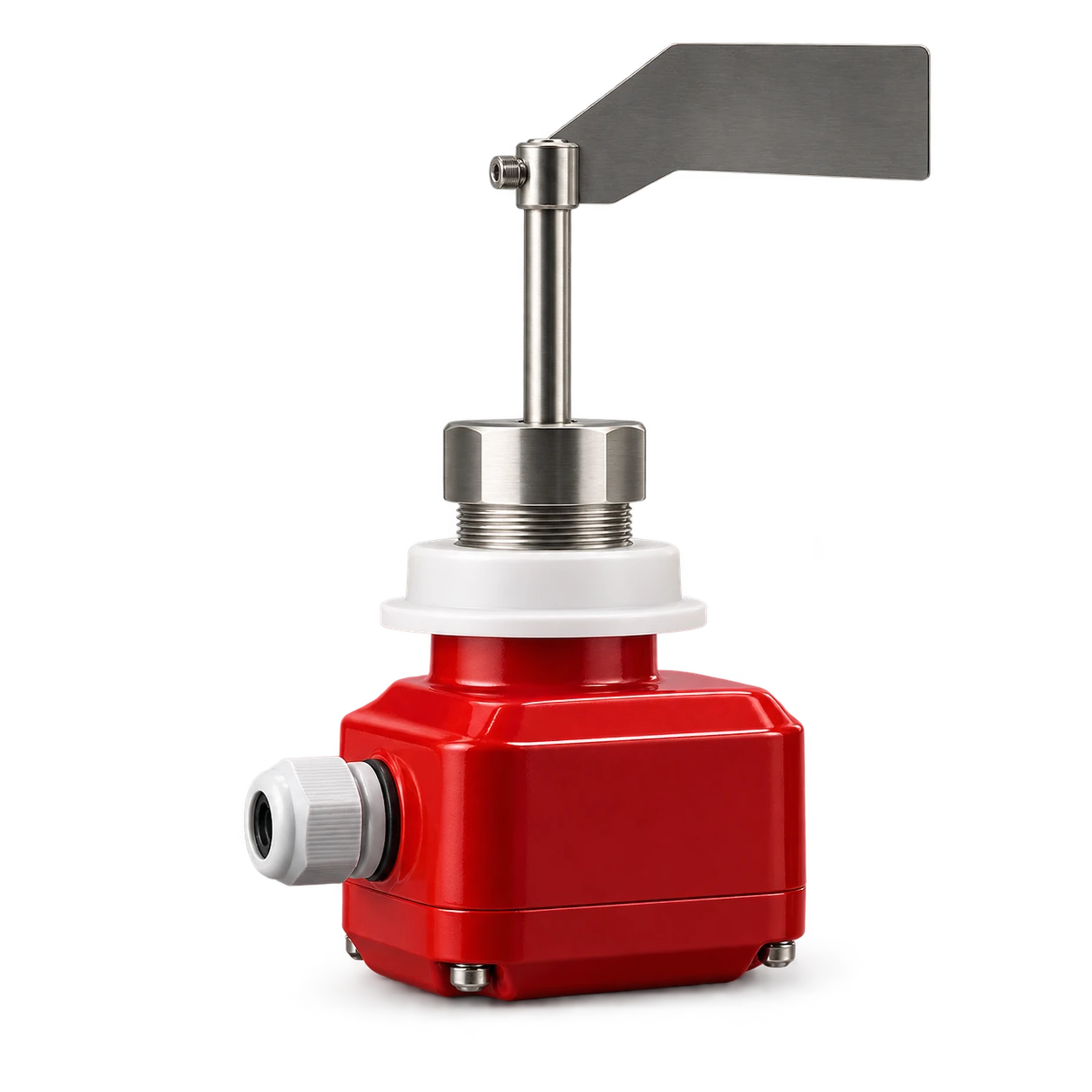
The VOGO rotary paddle level indicator is catalogued with AC 220 V / 50 Hz and a Ø54 installation size. Those two values do not prove drop-in replacement for another brand or model. The current product page also asks the buyer to confirm material, mounting direction, probe length and control voltage.
Record the failed device before removing it
Photograph the complete nameplate, enclosure, cable entries, process connection, shaft, paddle and mounting orientation. Record whether the switch is used for high level, low level, alarm, filling shutdown or feeder permission. Save terminal numbers and the normal/covered contact state from controlled documentation.
The TOREX ILT instructions separate mechanical connection, electrical connection, adjustment, maintenance and replacement. They also instruct that the device be switched off and disconnected before work. Use the manual for the installed device; its model-specific dimensions and settings are not VOGO specifications.
Do not rely on a handwritten model code alone. Check whether extensions, guards, flexible couplings or special paddles are installed. Material flow can load a side-mounted probe differently from a top-mounted one.
Send a complete replacement schedule
| Replacement item | Existing evidence | Supplier return |
|---|---|---|
| Function | High/low point, alarm or interlock | Confirmed operating and fail-state logic |
| Supply | Voltage, frequency and circuit protection | Rated supply and tolerance |
| Relay | Contact arrangement and loads | Contact form, ratings and terminal diagram |
| Process connection | Thread/flange, opening and seal | Dimensioned mating interface |
| Probe | Insertion length, shaft, paddle and support | Offered geometry and accessories |
| Material | Bulk density range, particle size, temperature and buildup | Suitability limits and sensitivity options |
| Environment | Indoor/outdoor, dust, water and corrosion | Enclosure/material declaration |
| Area classification | Site hazardous-area document | Applicable certification for the exact configuration |
| Scope | Cable gland, gasket, mounting parts and commissioning | Included/excluded list and documentation |
A replacement price is comparable only when the same schedule is answered. If area classification is unknown, keep it unresolved; do not infer certification from enclosure appearance or a product-family name.
Check mounting and material loading
The BinMaster BMR-100 instructions distinguish top and side mounting and call for shielding a low-level shaft and paddle when exposed to material flow. That document applies to its own product, but it demonstrates why mounting orientation belongs in any replacement RFQ.
Ask whether the existing coupling, boss or mounting plate will be reused. Confirm accessible removal length and clearance above or beside the silo. If hot work or a larger opening is proposed, return it for structural and site review rather than calling it a direct replacement.
For a low-density powder, a different paddle area or sensitivity may be required; for heavy or fast-moving material, the probe may need protection. Require the supplier’s specific recommendation and evidence instead of copying a competitor accessory.
Verify electrical logic before commissioning
Document the expected contact state for uncovered, covered and power-loss conditions. The control drawing should show what the PLC or relay interprets. Never assume that wire color, terminal position or “normally open” wording has the same process meaning across devices.
OSHA’s hazardous-energy standard addresses servicing where unexpected energization or stored energy can injure personnel. The applicable site procedure and jurisdiction control the work. This article is an RFQ checklist and does not authorize entry into a silo, live testing or bypassing an interlock.
Commissioning should be planned by qualified personnel. Verify grounding, supply, covered/uncovered switching, alarm or trip response and restoration of guards and covers. Use a controlled simulation method approved for the site; do not place a person in the material path.
The related rotary paddle versus capacitance guide owns the technology-selection question. This page assumes a rotary replacement remains the approved principle and focuses on identity and scope.
Compare total replacement cost
Normalize device price, accessories, freight, electrical changes, mechanical adaptation, access, commissioning, spares and documentation. A cheaper sensor may cost more if it requires a new boss, extension or control relay.
Request lead time and a clearly identified spare configuration. Keep the old unit’s photos and the accepted supplier schedule with the new serial number. That record reduces ambiguity at the next replacement.
Conclusion
Select a rotary paddle replacement from the complete mechanical, electrical, process and control interface—not thread size alone. Ask every bidder to return the same schedule and identify deviations. Preserve the approved safety and interlock function, and keep any bypass or hazardous-area decision under the site’s competent procedure.