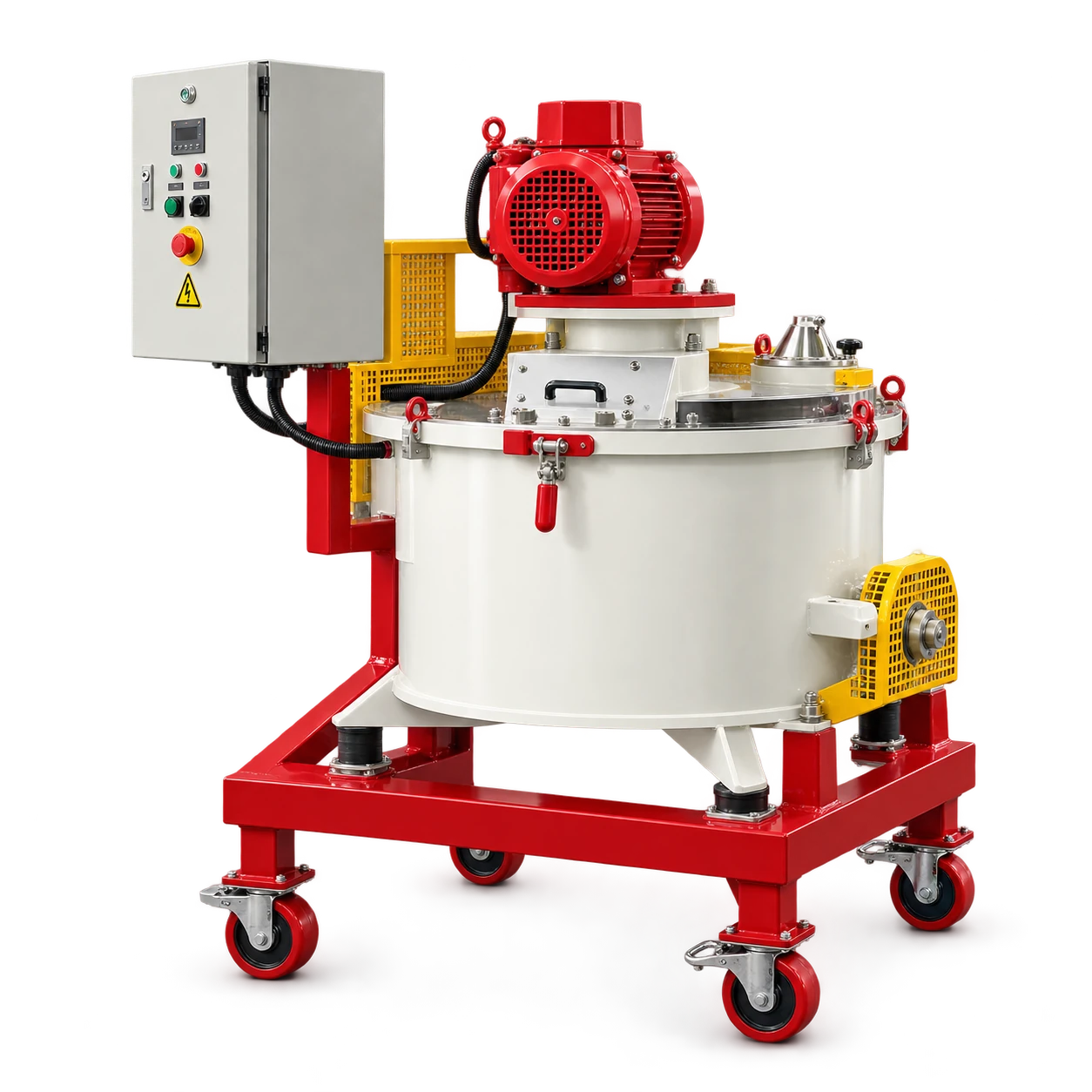
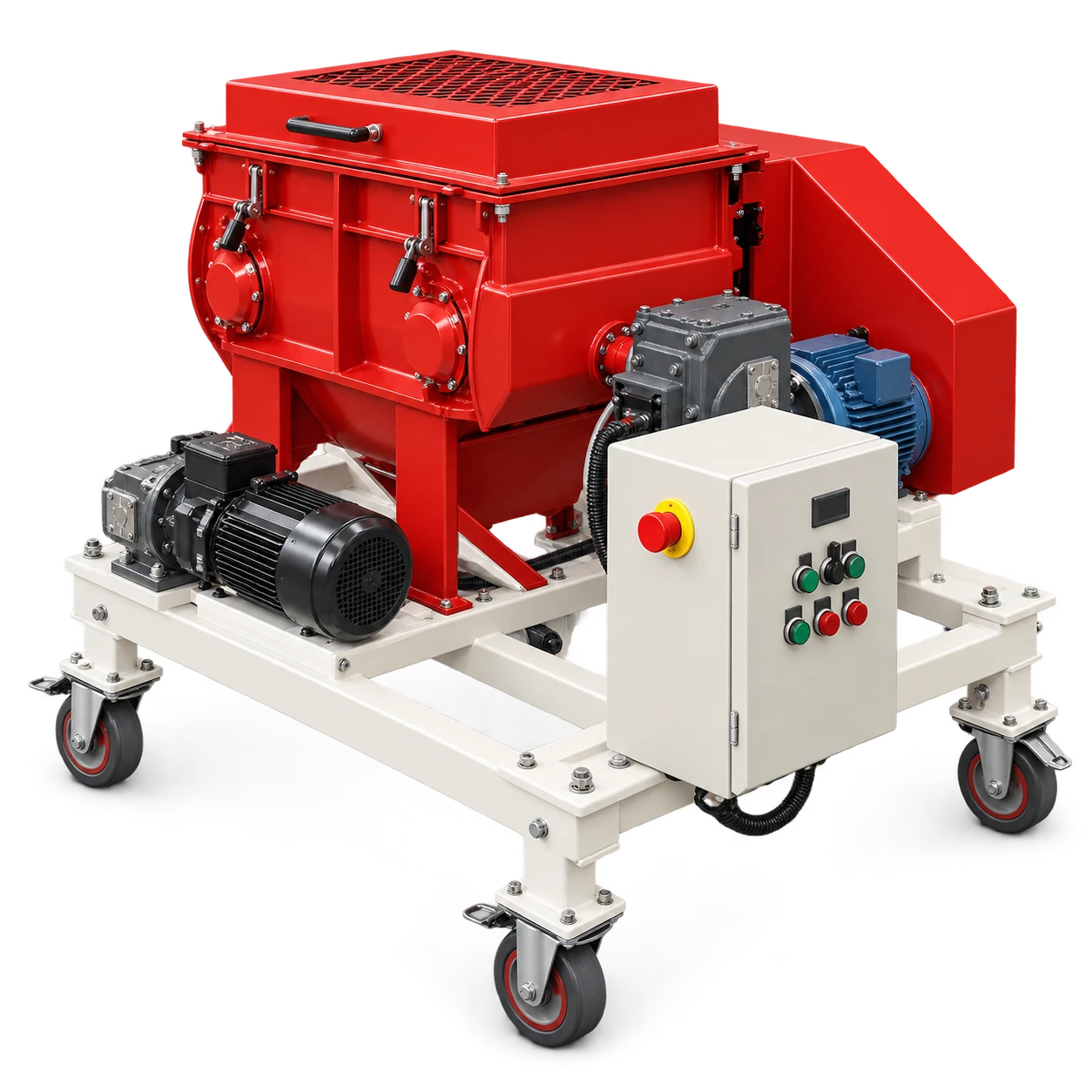
The laboratory concrete mixer minimum batch size must satisfy two conditions: enough usable concrete for the planned tests, and a mixing load approved for the actual mixer and recipe. Calculate the test demand first, then qualify the proposed low-load operating point. A nominal capacity does not establish a minimum working batch.
The MTO twin-shaft laboratory mixer has a published compacted-capacity range of 50–150 L across its catalog models. That range is product information, not permission to operate any model with an arbitrarily small charge. The manufacturer must confirm the working-load envelope for the selected configuration and material.
Why minimum batch size needs its own test
A research team may reduce a batch to save a scarce constituent or screen several formulations. The resulting load can interact differently with the tools and leave a different share of the charge on wetted surfaces or in the discharge path. Treat the reduction as a process change requiring evidence, rather than assuming that every proportionally scaled recipe mixes identically.
NIST’s review of concrete mixing methods identifies loading, mixing and discharge as parts of the process and notes that power consumption depends on mixture, batch size and loading method. Consequently, an unchanged timer setting or a plausible motor-current trace cannot by itself validate a reduced batch. These are observations to record, not substitutes for evaluating the material produced.
This question differs from ordering a larger laboratory machine. Here the decision is whether one proposed low-load procedure may be used for a defined experimental program. The answer should remain tied to that recipe family, equipment condition and operating method; it is not a general minimum-fill percentage for twin-shaft mixers.
Budget the concrete consumed by the experiment
Use one declared volume basis for specimens, fresh-property tests, retained material and handling losses. Do not compare loose dry charging volume directly with a compacted-output reference. The laboratory should select specimen dimensions, aggregate compatibility and test quantities under its applicable methods before calculating the demand.
Hypothetical example: assume six cylindrical specimens, each 100 mm in diameter and 200 mm high. Their ideal filled volume is 6 × π × 0.1² × 0.2 / 4 × 1000 = 9.42 L. Assume a further 8 L for fresh-property tests and 2 L for handling losses. The provisional usable-concrete budget is 9.42 + 8 + 2 = 19.42 L on the agreed basis.
The specimen dimensions, count and allowances are planning assumptions, not prescribed standard quantities. Do not return tested or discarded material to the mixer unless the governing procedure expressly permits it. If extra samples will be taken during qualification, add their consumption to the plan before charging.
The 19.42 L result is a test-material requirement, not an approved MTO operating point. If the supplier’s permitted minimum is higher, the laboratory must use an approved batch and handle the surplus appropriately, revise the experiment with authorization, or consider equipment suited to the smaller volume. Dividing specimens among separate batches may change the experimental design and needs its own approval.
Define the low-load qualification record
| Record field | What to fix or measure | Reason to hold the trial |
|---|---|---|
| Volume basis | Required usable concrete and proposed charge | Incompatible dry, loose or compacted definitions |
| Equipment permission | Selected model, tools and supplier-approved load | Proposed charge outside documented limits |
| Dosing resolution | Constituent quantities and instrument capability | Small addition cannot be measured adequately |
| Process | Charging stages, timer boundary and discharge method | Uncontrolled change from the comparison procedure |
| Material results | Agreed discharge samples and relevant tests | Missing samples or results outside agreed criteria |
| Recovery | Charge, recovered material and retained residue | Unexplained loss or insufficient test material |
Compare a reference batch with the proposed low load
Begin with a documented reference procedure inside the approved working window. Keep the same recipe basis and define which variables remain fixed. Then run the proposed reduced load within the manufacturer’s permitted envelope. Do not improvise inspection by opening a guard or reaching toward moving tools to see whether the material is being swept.
Choose material checks with the responsible laboratory specialist. ACI’s explanation of mixing adequacy discusses comparing samples from different points in the discharge for normal-density concrete under its stated conditions. It does not provide a universal minimum batch. Adapt the sampling plan to the recipe and applicable test method; representative sampling becomes a practical constraint when little material is available.
Record relevant fresh properties, discharge recovery and any visible unmixed material without substituting appearance for measured results. NIST also explains the limitations of using uniform fresh-property results alone as proof of composition uniformity. Where the research requires evidence of constituent distribution, specify an appropriate additional assessment rather than declaring complete homogeneity from one slump result.
Use the existing laboratory concrete mixer repeatability procedure for controls on moisture, timing and repeated runs. This minimum-load qualification adds a separate approval decision; it does not replace those controls or validate production scale-up. Do not choose an acceptance tolerance after seeing which reduced batch happens to pass.
Make a pass, hold or reject decision
Pass only the tested operating point when the load is permitted, dosing is adequate, enough concrete is recovered and the predefined material criteria are met. Record the recipe revision and permitted procedure. Repeat or extend testing when the intended experimental program requires stronger evidence; one demonstration does not establish reliability across every constituent or season.
Hold the procedure if a supplier limit, sampling method or instrument capability is unresolved. Reject the proposed low load when it is outside the approved envelope or fails the agreed criteria. An operator should not compensate by unapproved speed changes, longer running or manual intervention around moving parts.
Plan safe residue inspection and cleaning. OSHA’s hazardous-energy guidance distinguishes servicing hazards from ordinary operation. Isolate the relevant supplies, control stored energy and verify the safe state under the machine’s procedure before access. A stopped mixer or open cover alone does not establish that condition.
Conclusion
Establish laboratory concrete mixer minimum batch size by reconciling test consumption with the approved mixing window and validating the proposed low-load procedure. Keep the material budget separate from the machine limit. Publish the approved recipe-specific operating point and its evidence, while leaving untested smaller loads unapproved.