
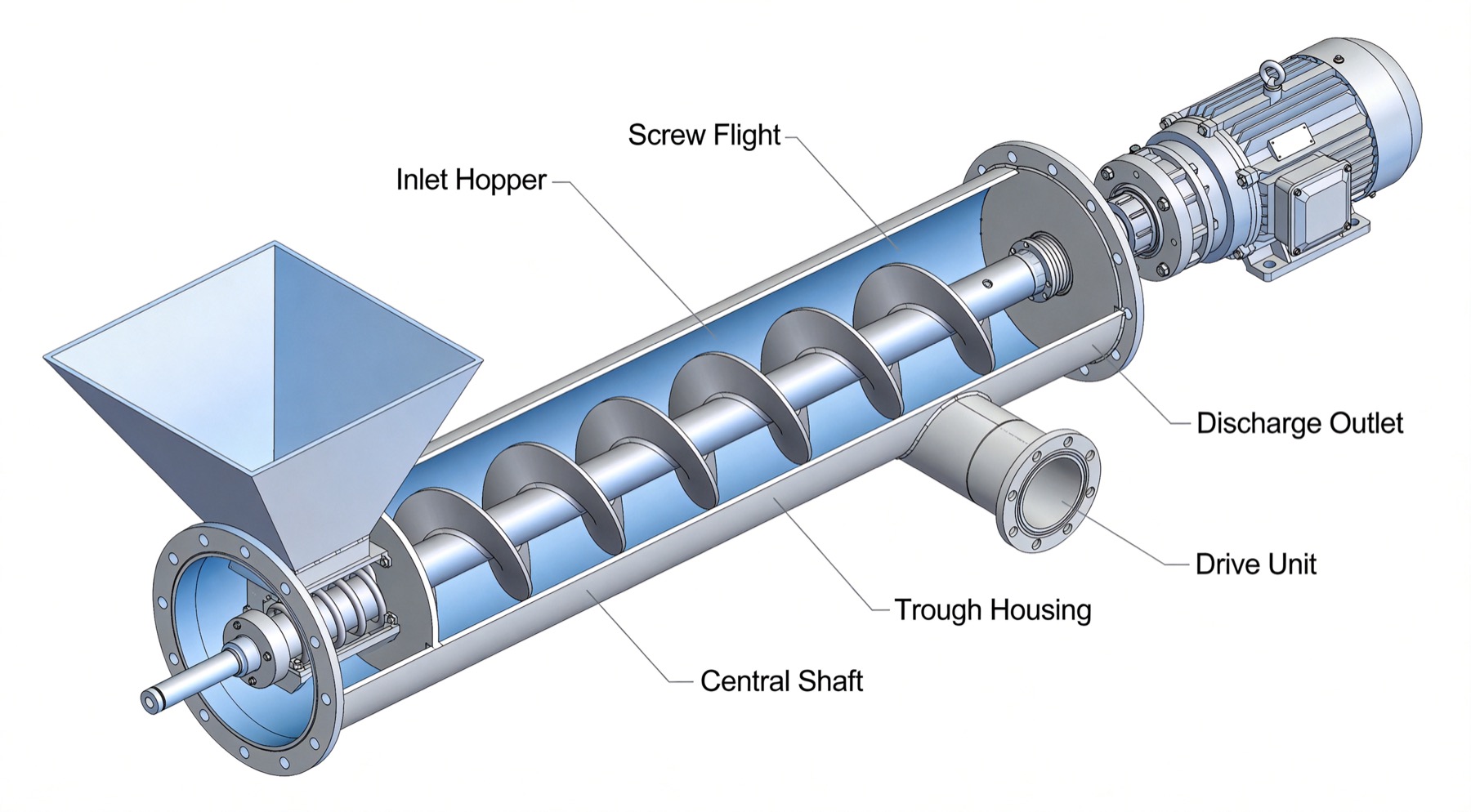
Cement screw conveyor inspection hatch safety depends on keeping people from reaching the rotating flight and preventing unexpected movement during access. A normal stop is not enough for inspection, cleaning or unjamming. First decide whether the task needs a view or physical access; then specify a fixed guard, an interlocked guard, or an isolated-maintenance opening to match the hazard.
The VOGO tubular conveyor range for cement handling uses an enclosed conveying path, but the published product page does not promise an inspection hatch, an interlock performance level or a pressure rating. Those requirements must be stated in the enquiry and confirmed in the supplier’s drawings and control documents.
This article is a design-review checklist, not a substitute for the applicable law, site risk assessment or equipment-specific instructions. The cited US requirements apply within their stated jurisdictions; the UK HSE guidance provides a useful safeguarding hierarchy, but local requirements still govern the project.
Cement screw conveyor inspection hatch safety starts with the task
Write down what the operator is expected to do at each proposed opening. “Inspection” is too vague. A sight check for material movement, a sample collection, a bearing adjustment and entry of a hand tool create different exposures.
OSHA’s machinery safeguarding guide identifies the turning helical flight along an opened screw conveyor as an ingoing nip-point hazard. It recommends enclosing the moving elements except at loading and discharge points, and notes that permanently affixed grids or transparent panels can permit observation. This supports a useful first question: can the required information be obtained without opening the housing?
For occasional visual checks, a fixed viewing panel, external level indication, speed feedback or motor-current trend may remove the need for routine access. This is an engineering recommendation; the selected method still needs a task-specific assessment and an inspection method that can detect the intended condition.
Map every path to the moving flight
Review more than the top cover. Inlets, outlets, cleanout ports, sample points, flexible connections and removed downstream equipment can all create a reach path. The general guarding requirement in 29 CFR 1910.212 calls for protection from rotating parts and ingoing nip points and requires guards to be affixed to the machine where possible.
Create a drawing that marks:
- each removable cover and its fastener type;
- the shortest access path to the screw, coupling or drive;
- whether a person can reach through connected chutes;
- the expected frequency and purpose of access;
- stopping time and any continued movement after a stop command;
- every electrical, mechanical, pneumatic, pressure, thermal and material energy source.
Do not convert a fixed cover into a hand-operated lid merely to save maintenance time. That changes the safeguarding concept and requires review of the opening, control system, stopping behavior and work procedure.
Choose the safeguard from access frequency and reach
The HSE machinery-safety hierarchy places fixed guards first where practical. Where fixed guarding is unsuitable, it describes interlocking so the machine cannot start before the guard is closed and the guard cannot be opened while dangerous movement remains.
Use this decision table as a proposed specification framework:
| Intended task | Preferred design direction | Evidence required |
|---|---|---|
| Observe flow or buildup | Fixed transparent panel or fixed distance guard | Reach is prevented; panel suits impact, abrasion and environment |
| Rare internal inspection | Tool-removable fixed cover plus isolation procedure | Fasteners, access control, isolation points and safe reassembly are documented |
| Frequent access required by the process | Risk-assessed interlocked guard, possibly with guard locking | Safety function, stopping time, reach time, reset behavior and validation are documented |
| Clean or clear a blockage | External method where feasible; otherwise isolated access | Written hazardous-energy and retained-material procedure |
| Whole-body entry possible | Separate entry assessment and positive isolation | Entry controls, rescue provisions and all connected sources are addressed |
HSE’s guidance on inspection hatches says reach should be prevented by design or fixed distance guarding; if a person can reach moving parts after opening a hatch, it calls for interlocking that isolates power and stops the motion before the hazard can be reached. The final arrangement depends on risk assessment. Do not copy a generic switch circuit from another machine.
An interlocked cover should not cause automatic restart when reclosed. A deliberate reset and start sequence, positioned so the hazard area can be checked, is a practical acceptance requirement. If coast-down lasts longer than reach time, guard locking or another validated measure may be needed; the responsible safety designer must define it.
Separate stopping, interlocking and isolation
These functions answer different questions:
| Function | Purpose | What it does not prove |
|---|---|---|
| Normal stop | Ends the operating sequence | Energy sources are isolated |
| Emergency stop | Stops a developing hazardous situation | The machine is safe for servicing |
| Guard interlock | Prevents or stops operation when access is opened | Stored energy and upstream material are controlled |
| Lockable isolator and procedure | Controls hazardous energy for a defined task | The guard design is adequate during production |
The HSE interlocking guidance states that control-circuit switches are not isolators and that multiple isolation means may be required. In the United States, 29 CFR 1910.147 covers servicing activities including inspecting, cleaning and unjamming where unexpected startup or stored-energy release could cause injury. Its sequence includes shutdown, physical isolation, application of locks or tags, control of stored energy and verification of isolation.
The exact procedure belongs to the employer and the installed system. A procurement document should therefore require identifiable isolation points and the information needed for the site to write its procedure. It should not claim that a door switch alone provides lockout/tagout.
Include cement flow and pressure in the boundary
If the inlet is continuously flood-loaded beneath a hopper, bin or silo, the machine is performing screw feeder duty. A control-fed conveyor exists only where a valve or independent feeder controls inflow. An electrical lock on the screw drive does not isolate gravity-fed cement above the hatch.
For feeder service, review the upstream isolation valve, retained head load, full-load restart torque, VFD low-speed torque, reducer service factor and stall protection. The inlet may require increasing or variable pitch, tapered outside diameter or a justified mass-flow design; reduced pitch alone is not a complete withdrawal solution. Do not apply a control-fed conveyor capacity table to the flooded section.
A hatch also crosses the containment boundary. “Enclosed” does not mean airtight or pressure rated. Before opening, the procedure must address any positive or negative pressure, purge air, connected pneumatic equipment, hot material and compacted or unstable retained powder. Silo arching, rat-holing and bridging remain system problems involving material behavior, outlet geometry, moisture, consolidation and flow aids; the screw does not cure them by itself.
For fault diagnosis before anyone opens the machine, use the cement screw conveyor blockage guide. It helps separate restriction, material condition and mechanical causes without turning the hatch into the first troubleshooting step.
Build an access procedure around verified zero energy
A usable procedure names the task, authorized role, isolation boundary and verification method. For internal inspection or blockage clearing, a project team can use this sequence as a review prompt:
- Stop the process in the approved order and notify affected personnel.
- Prevent further material entry; isolate the silo, hopper and connected equipment as the risk assessment requires.
- Isolate and secure all hazardous energy sources, including the conveyor drive and auxiliary devices.
- Dissipate or restrain stored energy and establish a safe pressure and temperature condition.
- Verify isolation using the site’s approved method, then return controls to the neutral or off position.
- Open the guard with the specified tool or access system; keep people clear of unsupported retained material.
- Complete the defined inspection or clearing method without defeating another guard.
- Refit and inspect covers, fasteners and connections; account for tools and personnel.
- Remove locks or tags only under the approved procedure, notify affected workers, and perform a controlled restart.
For US construction work, 29 CFR 1926.555 specifically requires screw conveyors to be guarded against contact with turning flights and addresses lockout or rendering conveyors inoperable during hazardous maintenance. It is not a universal specification for every country or industry, but it reinforces the need to connect guarding with the work procedure.
The maintenance checklist guide can hold inspection intervals and records. The hatch-safety review defines how those tasks are reached without exposure.
Use a witnessed acceptance checklist
Before handover, ask the supplier, integrator and site safety representative to close each item with a drawing, test record or approved procedure:
- all reachable flight, coupling and drive paths are identified;
- fixed covers require the intended removal method and return to their secured condition;
- any viewing panel or grid prevents reach and suits the service environment;
- each interlock has a defined safety function, reset behavior and fault response;
- measured stopping time is compatible with access time and any guard locking;
- opening and reclosing a guard cannot initiate automatic restart;
- isolators are labelled, lockable where required and mapped to controlled energy;
- upstream solids, pressure, purge air, gravity, temperature and residual motion are included;
- safe access, lighting and working position are provided around the hatch;
- warning labels remain visible but are not treated as substitutes for guards;
- the final drawings, electrical documents, validation records and operating instructions agree.
Do not accept “interlocked” as a complete line item. Record the device, control logic, stopping assumptions, test method and pass criteria. Likewise, do not accept a cover simply because it is bolted; verify that no alternate opening leaves the same moving flight reachable.
Conclusion
Cement screw conveyor inspection hatch safety is acceptable only when the physical guard, control function and isolation procedure address the same access task. Prefer observation without opening, use fixed guarding where practical, validate interlocked access where it is justified, and require hazardous-energy control for inspection, cleaning and unjamming. Send the access tasks, layout and site safety requirements with your VOGO enquiry so the proposal can define the required interfaces.
References
OSHA: Safeguarding Equipment and Protecting Employees from Amputations ↗eCFR: 29 CFR 1910.212, General Requirements for All Machines ↗eCFR: 29 CFR 1910.147, Control of Hazardous Energy ↗eCFR: 29 CFR 1926.555, Conveyors ↗HSE: Introduction to Machinery Safety ↗HSE: Drawing-in and Trapping Hazards ↗HSE: Guard Interlocking ↗