
Introduction
The concept of moving bulk materials efficiently is as old as civilisation itself. In the 3rd century BC, Archimedes invented the water screw to lift water from lower to higher elevations. Today, this ancient principle has evolved into one of the most reliable and widely used mechanical handling systems in modern industry. From large-scale cement plants and construction sites to food processing facilities and chemical factories, screw conveyors play a critical role in keeping production lines moving.
Despite their long history, many first-time buyers and plant managers new to bulk material handling still find the technology complex. With various configurations, components, and application-specific designs available, choosing the right system requires a solid understanding of the basics. This beginner’s guide will systematically explore what a screw conveyor is, how it operates, its core components, common types, and the practical advantages and limitations you should consider before specifying one for your facility.
What Is a Screw Conveyor?
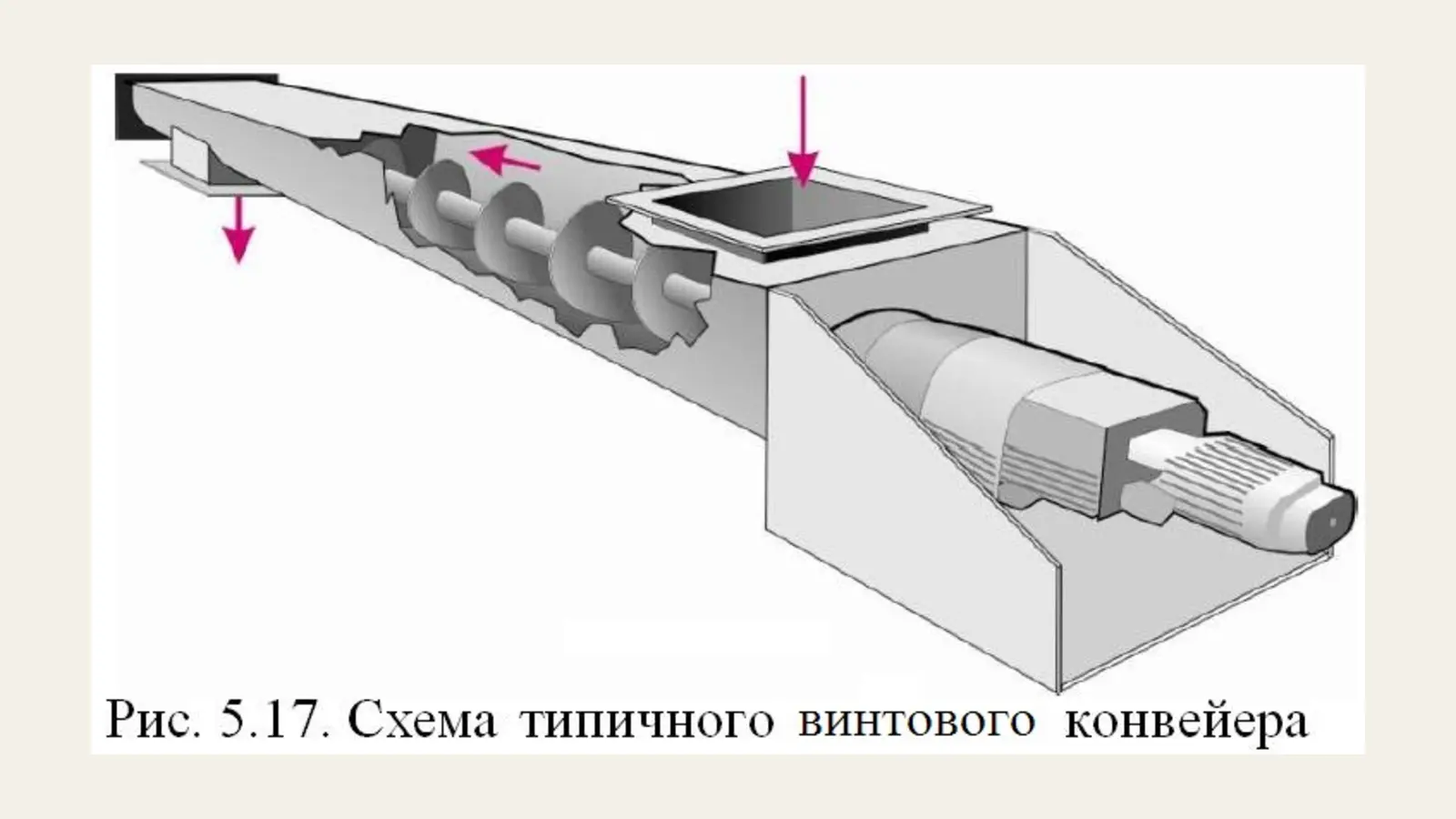
A screw conveyor is a continuous mechanical conveying device that utilises a rotating helical screw flight to push bulk materials through a closed trough or tube. As the screw rotates, the material is moved axially from the inlet to the discharge point.
Depending on the industry and specific application, this equipment is also commonly referred to as an auger conveyor or a screw feeder. While the terms are often used interchangeably, a screw feeder is typically designed for controlled, precise metering of material, whereas a standard conveyor focuses on continuous transport.
These systems are highly versatile and are primarily suited for handling dry to semi-dry bulk materials. This includes fine powders, granules, and small lump materials. They are generally not recommended for highly viscous, sticky, or extremely large lump materials, which can cause operational issues.
How Does a Screw Conveyor Work?
The fundamental working principle of a screw conveyor is surprisingly straightforward. The system is driven by a motor connected to a gearbox, which in turn rotates the central shaft and the attached helical flight.
As the screw blade spins inside the casing, the bulk material does not rotate with it. Instead, due to the force of gravity and the friction between the material and the trough wall, the material is prevented from spinning. Consequently, the rotating blade acts like a continuous wedge, pushing the material forward along the trough. A helpful analogy is to imagine a nut sliding along the threads of a rotating bolt; the nut moves linearly without spinning.
With every single revolution of the screw, the material advances by a distance equal to the pitch of the flight. The overall conveying efficiency and speed depend on several basic factors, including the diameter of the screw, the pitch of the flight, the rotational speed (RPM), and the specific physical characteristics of the material being handled, such as its bulk density and flowability.
Core Components of a Screw Conveyor
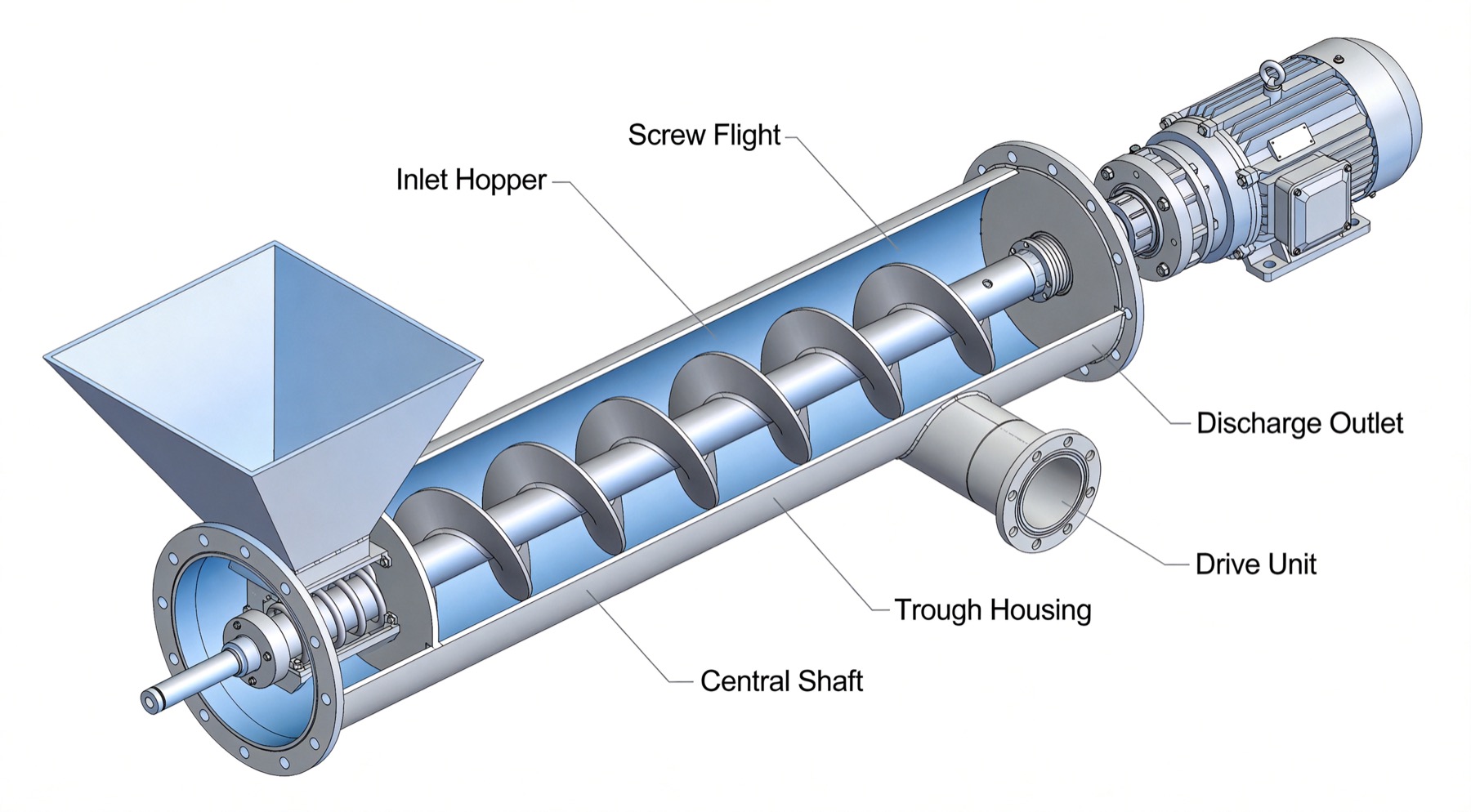
To understand how these systems are specified and maintained, it is essential to know their primary building blocks.
Screw Flight This is the core working component, typically a helical blade wrapped around a central shaft. The flight can be designed with various pitches, thicknesses, and even special configurations like cut-and-folded or ribbon flights to handle specific materials.
Shaft The shaft provides structural support for the screw flight and transmits the rotational torque from the drive unit. It must be robust enough to handle the mechanical stress and the weight of the material load.
Trough or Casing This is the enclosed pathway that guides the material. It is generally available in two main forms: a U-shaped trough with a hinged or bolted cover, or a fully enclosed tubular casing. The casing prevents dust emissions and contains the material safely.
Drive Unit The drive unit consists of an electric motor and a gearbox (reducer). It provides the necessary power and controls the rotational speed of the screw shaft to match the required throughput.
Bearings Bearings support the rotating shaft. End bearings are located at the head and tail of the conveyor to handle radial and thrust loads. For longer conveyors, intermediate hanger bearings are used to support the shaft and prevent sagging.
Inlet and Outlet These are the designated openings where material enters and exits the system. They can be configured as simple flanged openings or equipped with specialised gates and valves for multi-point loading and discharging.
Common Types of Screw Conveyors
Screw conveyors are primarily categorised by their installation orientation, which directly impacts their efficiency and application.
Horizontal Screw Conveyors This is the most common and efficient configuration. Operating on a level plane, horizontal conveyors can achieve maximum throughput with minimal power consumption. They are ideal for transferring materials between different process stages within a single facility.
Inclined Screw Conveyors When space constraints require lifting material to a higher elevation, inclined conveyors are used. As the angle of inclination increases, the efficiency typically decreases because gravity pulls the material backward. They are frequently seen in batching plants where silos are positioned above mixers.
Vertical Screw Conveyors For steep vertical lifts, vertical screw conveyors utilise very high rotational speeds. The centrifugal force generated pushes the material against the outer casing, preventing it from rotating with the screw and allowing it to be lifted straight up.
Beyond orientation, there are also specialised designs such as shaftless screw conveyors (ideal for sticky or stringy materials like sludge), flexible screw conveyors (using a flexible inner auger inside a tube), and tubular screw conveyors, which offer a completely enclosed, compact design for fine powders.
Applications and Industries
Because of their enclosed nature and versatility, screw conveyors are utilised across a vast array of sectors.
In the cement and building materials industry, they are essential for transferring cement, fly ash, and mineral fillers. For instance, a tubular screw conveyor for cement handling is a standard choice in concrete batching plants for moving cement from the silo to the weighing hopper. They are also heavily used in dry-mix mortar and asphalt plants for controlled conveying of powders.
In food and agriculture, food-grade screw conveyors handle grain, flour, sugar, and animal feed safely and hygienically. The chemical and pharmaceutical industries rely on them for blending and transporting various powders and granules. In environmental and wastewater treatment, specialised shaftless designs manage thick sludge. Finally, the mining and metallurgy sectors use heavy-duty versions to transport ores, coal, and mineral concentrates.
Advantages and Limitations
When evaluating bulk handling equipment, it is crucial to weigh the benefits against the constraints.
Advantages
- Enclosed Design: The rigid tubular or covered trough limits external dust exposure, ensuring a cleaner working environment and preventing material contamination.
- Compact and Flexible: They require relatively little space and can be configured for horizontal, inclined, or vertical layouts. They also easily accommodate multiple inlet and outlet points.
- Versatility: Beyond simple transport, they can simultaneously mix, cool, or heat materials during the conveying process.
- Simple Maintenance: With fewer moving parts compared to belt or pneumatic systems, they generally offer lower maintenance costs and easier servicing.
Limitations
- Distance Constraints: They are generally not suitable for long-distance conveying compared to belt conveyors.
- Material Degradation: The tumbling and pushing action can be harsh, making them unsuitable for highly fragile materials that might break or degrade.
- Wear and Tear: Highly abrasive materials can cause rapid wear on the flights and trough, requiring specialised abrasion-resistant materials.
- Efficiency Drop: As mentioned, conveying efficiency drops significantly on steep inclines.
Conclusion
The screw conveyor remains a cornerstone of modern bulk material handling due to its simplicity, reliability, and multifunctional capabilities. Whether you are moving fine cementitious powders in a batching plant or transferring agricultural granules, understanding the fundamental principles and component variations is the first step toward a successful installation.
For facilities requiring enclosed powder conveying, VOGO Machine offers a comprehensive range of tubular screw conveyors designed specifically for cement and building material applications. With selection diameters ranging from Ø89 mm to Ø407 mm and catalogue lengths up to 15 metres, these systems can be project-specifically configured to match your exact centreline length, inclination, and throughput requirements. Please note that published capacity ranges are selection references; actual output must be confirmed based on your specific material and operating conditions.
To explore our standard configurations, you can visit our tubular screw conveyor for cement handling product page. If you are ready to move beyond the basics, we recommend reading our guides on selecting the correct diameter and capacity or calculating exact throughput requirements to ensure your system is perfectly sized. For detailed technical specifications, feel free to download the datasheet or contact our engineering team today.