
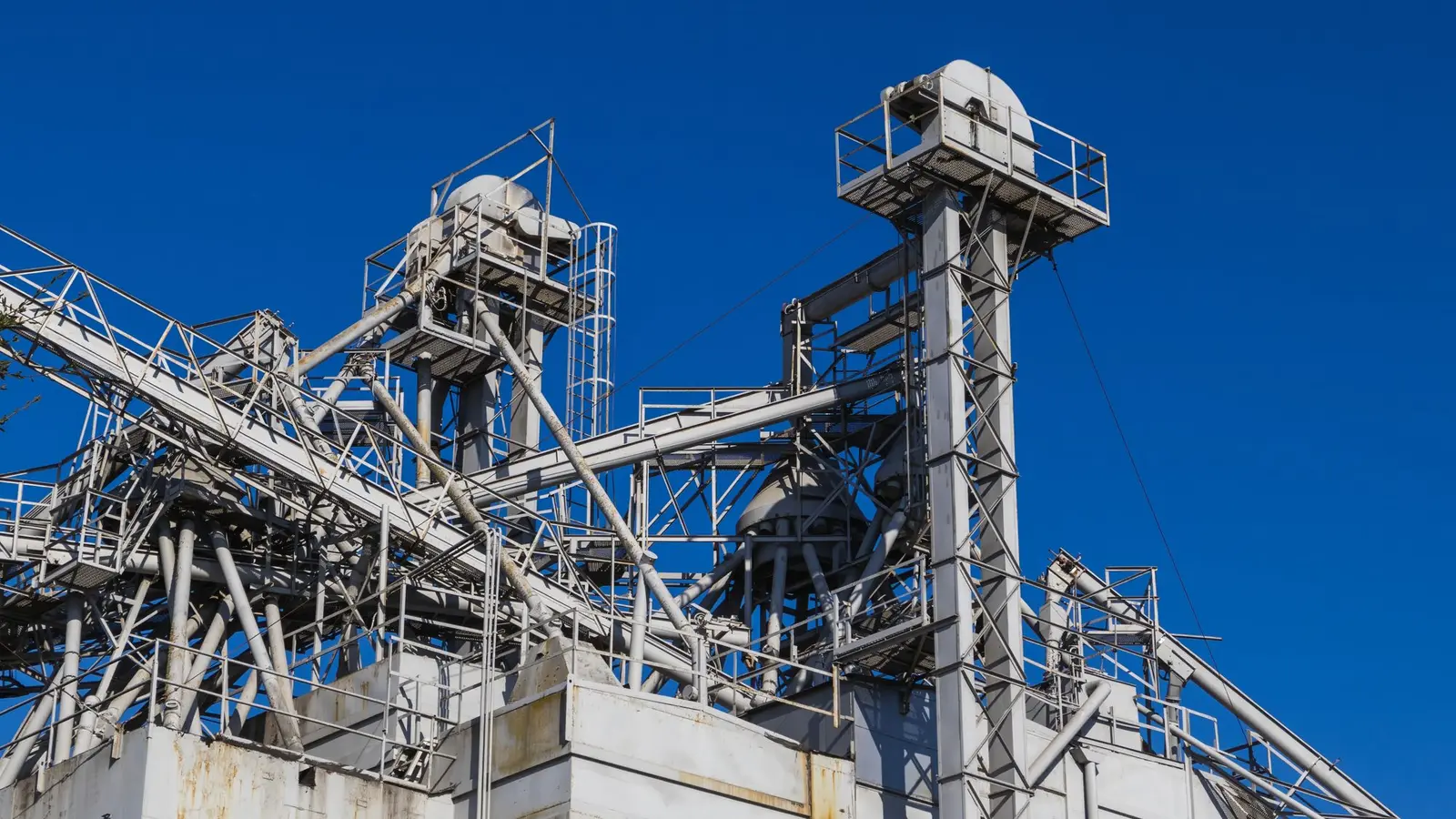
The screw conveyor vs pneumatic conveyor question in cement handling rarely has a one-size answer. Both move dry powder, but they work on very different principles and reward different priorities. A screw conveyor is a mechanical machine with a rotating helix inside a tube. A pneumatic system pushes or pulls cement through a sealed pipeline using air. The right choice depends on distance, layout complexity, dust requirements, energy cost, and how you weigh capital against operating expense.
VOGO supplies enclosed powder conveying systems built around tubular screw technology. That is a specific point of view, not a claim that screw conveyors win every application. Pneumatic systems are the correct choice in many cement plants, especially for long transfers and complex routing. This comparison sets out where each system is strong, where it struggles, and how to decide.
How Each System Moves Cement
A screw conveyor uses a helical flight mounted on a rotating shaft inside a tubular or trough housing. As the screw turns, cement slides forward along the trough wall. It is a positive-displacement machine: each rotation moves a predictable volume, provided the filling rate stays within the design envelope. The CEMA Standard 350 provides the accepted engineering basis for capacity, power, and component selection.
A pneumatic conveyor uses a pressure differential created by a blower or compressor. Cement is introduced into the airstream — through a rotary valve, a blow tank, or a venturi — and carried through a pipeline to a receiver, where the air is separated by a cyclone or bag filter. The two main operating modes are dilute phase (high velocity, particles suspended in air) and dense phase (lower velocity, material moves in slugs or plugs). For cement, dense-phase systems are generally preferred because they cause less pipe abrasion and use less air per tonne.
| Principle | Screw Conveyor | Pneumatic Conveyor |
|---|---|---|
| Transport method | Rotating helix inside a tube or trough | Airflow inside a sealed pipeline |
| Flow pattern | Positive displacement per revolution | Suspended or slug flow driven by pressure differential |
| Cement introduction | Flooded or control-fed inlet | Rotary valve, blow tank, or venturi feeder |
| Discharge separation | Gravity through an outlet | Cyclone, filter receiver, or both |
This difference in principle flows through every other decision: cost, maintenance, energy, layout, and dust control.
Side-by-Side Comparison for Cement Duty
The table below summarizes the key trade-offs for cement specifically, not for bulk materials in general.
| Factor | Screw Conveyor | Pneumatic Conveyor |
|---|---|---|
| Typical distance range | Short to medium (3–30 m is most practical; longer runs need intermediate bearings) | Medium to long (up to hundreds of meters in a single line) |
| Layout flexibility | Straight or slightly inclined; bends require additional machines and transfer points | Pipes can bend, rise, and route around obstacles in a single run |
| Capital cost (short distance) | Lower — a single machine with a drive | Higher — blower/compressor, feeder, filter, controls, and piping |
| Energy per tonne | Lower for short and medium runs; direct mechanical drive | Higher — energy is spent moving air as well as material |
| Maintenance profile | Visible moving parts: flights, bearings, seals, gearbox | Fewer moving parts; pipe and elbow wear, filter media, blower service |
| Dust containment | Enclosed tube reduces exposure, but sealing must be specified and verified | Fully enclosed pipeline with filtered discharge; generally tighter containment |
| Material degradation | Minimal — cement slides rather than impacts | Some attrition in dilute phase; dense phase is gentler |
| Multi-point feed or discharge | Requires separate feeders or splitters | Natural with diverter valves and multiple pickups |
| Wet or sticky cement | Better tolerance — mechanical action can move damp material | Risk of buildup and plugging; material must flow freely |
Use this table as a first filter, not a final answer. The cost columns in particular change with distance and throughput.
Cost: Capital, Operating, and Total Ownership
Capital cost
At short distances — say, silo-to-weigh-hopper in a batching plant — a screw conveyor has a clear capital-cost advantage. It is one machine: tube, screw, drive, inlet, and outlet. A pneumatic system needs the pipeline plus a blower or compressor, a rotary valve or pressure vessel, a filter receiver, and controls. Engineering firms like Gough Econ report mechanical installation costs in the range of $50–100 per foot versus $150–300 per foot for pneumatic systems for comparable duties, though exact figures vary widely with size, materials, and region.
As distance grows, the comparison shifts. A long screw conveyor needs hanger bearings, a stronger structure, and more intermediate supports. A pneumatic line adds mostly pipe and bends. At some point, which depends on the specific duty, pneumatic becomes competitive or even cheaper on capital.
Energy cost
Energy is where the mechanical advantage of a screw conveyor is clearest for short and medium runs. Moving material directly with a screw uses less power than accelerating and transporting it with air. According to TCO analysis published by SpecForge, screw conveyors run at a fraction of the per-meter energy cost of pneumatic systems, which can require the equivalent of 8–15 kW per running meter for the same tonnage.
That gap narrows for dense-phase systems, which use less air per kg of material, and it widens for dilute-phase. RIECO Industries similarly notes that moving air is inherently less efficient than moving material mechanically, and the electricity bill reflects that.
Energy cost is also a function of utilization. A duty that runs 2,000 hours per year makes the per-tonne energy difference matter a lot more than one that runs 200 hours per year.
Maintenance cost
Maintenance costs divide along a familiar line. Screw conveyors have parts that visibly wear — flights, hanger bearings, shaft seals, gear oil, and couplings. The wear is predictable, easy to inspect, and straightforward to replace, but it happens on a regular cycle. On abrasive cement duty, flight wear is the dominant maintenance line.
Pneumatic systems have fewer rotating parts in the conveying path, so the routine list looks shorter — blower service, filter bags, and valve seals. But the internal pipe wear, especially at elbows, is invisible and can surprise a plant if the system is not monitored. Dense-phase operation reduces velocity and abrasion, but it does not eliminate elbow wear, and replacing a section of piping is a different kind of job than replacing a screw flight.
Total cost of ownership
A proper TCO comparison includes at least nine rows: purchase price, freight, installation, energy, preventive-maintenance labor, wear parts, unscheduled downtime, end-of-life disposal, and residual value. The purchase price alone is usually only 20–30% of what a plant pays over 10–15 years.
For a short run in a batching plant, the screw conveyor almost always wins on TCO because the capital cost is low and the energy savings outweigh the mechanical maintenance. For a long, multi-point transfer in a large cement works, pneumatic can win because the alternative is a chain of mechanical machines with many transfer points.
A selection tool for cement screw conveyors can narrow the screw-conveyor side of the comparison by giving a starting diameter and drive for a given capacity and length, which is useful input for a TCO worksheet. The pneumatic side of the comparison, however, needs its own engineering calculation from a pneumatic systems supplier.
Layout, Distance, and Site Constraints
Layout is the single most common reason to choose one system over the other.
A screw conveyor is essentially a straight line between two points, with some inclination possible. If cement has to go around a pillar, up three floors, or to three different silos, a screw-only solution needs additional machines, transfer chutes, and diverter gates. Each transfer point is a potential dust leak, a maintenance item, and a headroom problem.
A pneumatic pipeline can bend, split, rise, and drop within the same run. That flexibility is the core reason pneumatic systems dominate in complex plants. Gough Econ’s comparison notes that pneumatic lines are routinely routed over, under, and around equipment in existing facilities, where installing a mechanical conveyor would require structural modifications.
Distance works the same way. For a 10-meter transfer, the screw is clearly the simpler and cheaper choice. For a 200-meter transfer with two bends and a 15-meter vertical lift, the pneumatic system is usually the only practical option in a single run.
Inclination falls in between. The cement screw conveyor inclination angle guide covers the mechanics of inclined screw conveying in detail. Pneumatic systems handle vertical lifts naturally, but they pay for it in pressure drop and energy.
Dust Control and Containment
Dust control is a major consideration for cement, and this is where pneumatic systems often draw attention.
A pneumatic system operates inside a sealed pipeline. Material enters through a rotary valve or pressure vessel and exits through a filter receiver. The entire transfer path is enclosed, and the discharge air is filtered. This arrangement generally delivers tighter containment than a screw conveyor, especially at multiple transfer points.
A tubular screw conveyor does enclose the conveying path and can substantially reduce dust exposure compared with an open belt or trough. But it is not automatically dust-tight. Leakage can occur at shaft seals, flanges, inspection covers, and inlet/outlet transitions. A plant that needs a specific leakage rate must specify it and verify it with the right seals, gaskets, and flange arrangement.
For explosion-hazard dusts, both systems require proper grounding, venting, and ATEX or equivalent compliance where applicable. Pneumatic systems have pressure-relief and explosion-venting considerations that a screw conveyor does not.
When a Screw Conveyor Is the Better Choice
Choose a screw conveyor for cement when most of these apply:
- Short to medium transfer distance — typically under 30 m in a single run.
- Simple, near-straight layout — no complex routing around equipment.
- Lower first cost is a priority — one machine instead of a full air system.
- Visible, predictable maintenance — you want wear that you can see and plan for.
- Material condition varies — screw conveyors handle damp or slightly sticky cement better than pneumatic lines, which tend to plug.
- Feeder and conveyor in one — under a silo or hopper, a single screw can serve as both the feeder and a short conveyor.
The cement silo discharge article goes deeper into the screw-feeder case specifically.
When a Pneumatic Conveyor Is the Better Choice
Choose pneumatic conveying for cement when:
- Distance is long — beyond where a single screw is practical, or where multiple screws and transfer points would be needed.
- Layout is complex — routing around equipment, multiple floors, or existing structures.
- Multiple pickup or discharge points — diverter valves and multi-point feeding are natural to pneumatic systems.
- Strict dust containment is required — sealed pipeline with filtered discharge.
- Indoor space is at a premium — a pipe uses less floor space than a conveyor with supports.
- The product must stay clean or isolated — fully enclosed transport prevents external contamination.
Within pneumatic conveying, prefer dense-phase over dilute-phase for cement whenever practical. Lower velocity means less elbow and pipe wear, less energy per tonne, and less particle attrition. The trade-off is higher capital cost and a requirement that the material flow well.
Selection Decision Framework
Use this sequence to narrow the choice before asking suppliers for quotes.
- Define the duty. Required capacity (t/h), minimum and maximum rate, conveying distance, vertical lift, number and direction of bends, number of pickup points, and number of discharge points.
- Characterize the material. Bulk density range, moisture, temperature, particle size, abrasiveness, and flowability. For cement, note whether it is fresh and aerated, settled and compacted, or from a storage silo.
- Establish containment requirements. Dust emission limits, operating pressure, explosion zone classification, and any food-grade or special-environment rules.
- Check layout feasibility. Can a screw conveyor fit in the available space, inclines, and headroom? How many transfers would a mechanical chain need?
- Estimate the energy split. Multiply expected operating hours by the estimated power draw of each option, using the plant’s actual electricity cost.
- Build a TCO worksheet. Capital, installation, energy, maintenance labor, wear parts, and downtime — over the expected service life, not just the first year.
- Request comparative quotes. Give each supplier the same duty definition and ask for a response that includes power, estimated maintenance, and expected spare-part consumption, not just equipment price.
A common mistake is comparing a catalog screw conveyor price against a full pneumatic system price and stopping there. The comparison is only fair when both sides include everything needed to perform the same duty.
Worked Scenario: Batching Plant Silo to Weigh Hopper
Assume a concrete batching plant needs to move 40 t/h of cement from a ground-level silo to a weigh hopper 6 m away horizontally and 4 m vertically. Plant space is tight but a straight inclined run is possible. The plant runs roughly 10 hours per day, 250 days per year.
On the screw side, the duty fits within the range of a single inclined tubular screw. The capital cost is the machine plus a support structure and one feed point. Energy is moderate. Maintenance centers on bearing lubrication, seal wear, and eventual flight replacement. The containment is a sealed tube, with dust performance depending on the specified seal arrangement.
On the pneumatic side, the same duty needs a blower, a rotary valve under the silo, a pipeline with one bend and a vertical rise, and a filter receiver at the weigh hopper. Capital cost is higher. Energy consumption per tonne is higher. Maintenance is focused on the blower, rotary valve seals, and filter bags. Containment is excellent because the entire path is a closed pipe with filtered exhaust.
For this specific case — short distance, simple layout, lower utilization — the screw conveyor usually comes out ahead on both capital and total cost, and it handles the silo interface more simply. If the same plant later adds a second silo 80 m away across a driveway, the pneumatic option becomes more interesting because it can serve both silos with one pipeline and a diverter.
Hybrid and Combined Systems
The choice is not always either/or. Many plants use a screw conveyor at the silo discharge — acting as a controlled feeder — and hand off to a pneumatic line for the longer transfer. This arrangement combines the reliable silo-interface of a screw with the routing flexibility of pneumatic conveying. In that setup, the screw’s job is to meter cement into the pneumatic system’s rotary valve or blow tank at a controlled rate.
Similarly, a cement silo discharge screw feeder can feed an air slide for short, dust-tight horizontal distribution within a silo house, or serve as the controlled inlet to a bucket elevator for a vertical lift.
The point is to evaluate the full transfer path, not just individual machines. The best solution is often a combination.
Common Misconceptions
A few ideas come up often and deserve a clear response.
“Pneumatic conveying is always more expensive.” Not always. At long distances, with multiple pickup points, or where mechanical conveyors would need multiple transfers and structures, pneumatic can be competitive or even cheaper on total cost. The initial purchase price is only one line in the TCO worksheet.
“A screw conveyor is dust-free because it is enclosed.” Enclosed is not the same as dust-tight. A tubular housing reduces dust exposure, but a dust-tight performance guarantee requires specified seals, flanges, gaskets, and test criteria. Do not assume a standard tubular screw meets the same containment level as a pneumatic pipeline.
“Screw conveyors cannot handle long distances.” They can, but only with intermediate hanger bearings and structural supports, and the maintenance burden rises. Whether it makes economic sense depends on the duty and the alternatives.
“Pneumatic systems are maintenance-free.” They have fewer moving parts in the conveying line, but blowers, filters, valves, and pipe elbows all require attention. Abrasive cement accelerates elbow wear in dilute-phase systems.
Conclusion
For cement handling, screw conveyors excel at short, simple transfers with lower first cost and straightforward mechanical maintenance, while pneumatic conveyors win on long distances, complex layouts, multiple points, and dust containment. The right choice is not a general preference for one technology but a match between the system’s strengths and the specific duty.
Before committing, define the full transfer path, build a TCO worksheet that covers more than just the purchase price, and ask suppliers to quote on the same basis. If the duty is in the screw conveyor’s range, start with a quick size estimate using the cement screw conveyor selection tool, then compare against a pneumatic supplier’s proposal on energy, maintenance, and total cost over the expected service life.