
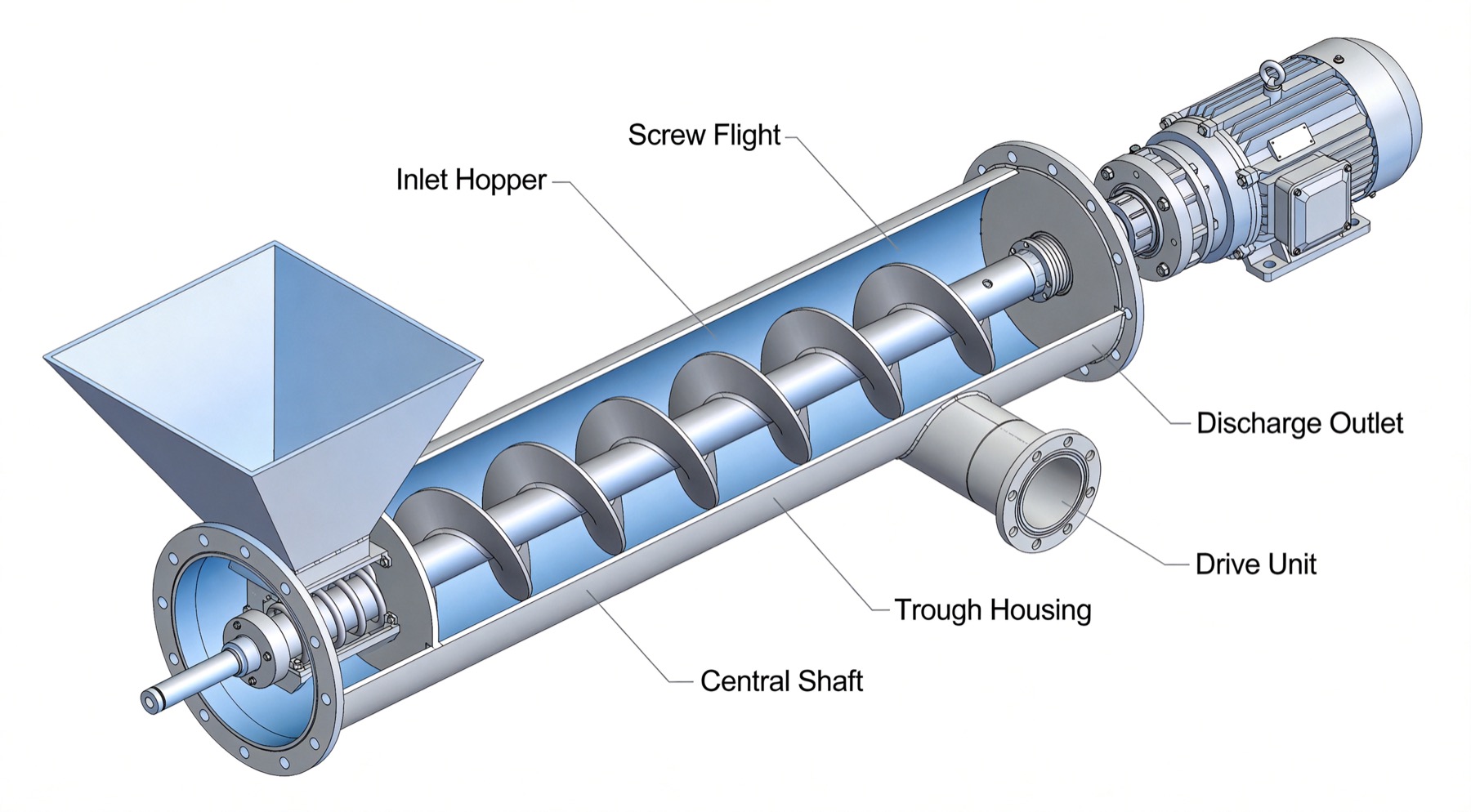
A cement screw conveyor rarely fails without warning. A change in motor current, a new sound from the tube, dust leaking past a shaft seal, or a gradual drop in discharge rate each point to a developing fault that is still inexpensive to correct. The difficulty is that different symptoms can share the same cause, and the same symptom can come from different components. A motor that trips on overload, for example, might be responding to compacted cement, a seized hanger bearing, a restricted outlet valve, or an incorrectly matched gearbox. Replacing the motor without finding the actual resistance simply moves the failure to the next weakest link in the drive chain.
This guide presents a structured troubleshooting approach for cement and powder screw conveyors. It moves from what the operator can observe, through systematic isolation of the fault, to corrective action and a clear statement of when the problem requires a specialist engineer.
Safe shutdown requirements before any diagnosis
Before opening inspection hatches, touching rotating parts, or clearing material from the conveyor, the drive must be isolated and locked out. The minimum safe procedure is:
- Stop the conveyor from the local control station.
- Switch off and lock out the main motor disconnect.
- Verify zero energy state by attempting a local start.
- Allow the shaft to stop completely before opening any hatch or removing any guard.
This applies whether the conveyor is horizontal or inclined. Powder that has settled around the flights can release suddenly once an obstruction is cleared, and an inclined conveyor may roll backward if the brake is not engaged. Never attempt to clear a jammed screw by hand while the drive is connected, and never force a restart against a blockage. Forced restarts can burn out the motor, shear coupling bolts, bend the screw shaft, or crack flight welds.
A diagnostic approach: from symptom to component group
The most efficient way to find a fault is to classify what you observe before opening anything. Three questions narrow the problem:
Where? Noise from the middle of the tube points to hanger bearings or shaft alignment. Noise from the drive end points to the reducer, motor, or coupling. Noise from the tail end points to the end bearing or shaft seal.
When? A symptom present during empty running is almost always mechanical. A symptom that appears only after material enters relates to material condition or loading. A symptom that appears only after a loaded shutdown points to settled material and breakaway torque.
What changed? A trip that started after maintenance suggests assembly error. A trip after a production increase suggests the load exceeds the original drive selection. A gradual increase over weeks suggests progressive wear or buildup.
These three questions separate the majority of screw conveyor faults into manageable categories.
Motor overload and repeated tripping
Motor overload is the most common fault that stops a screw conveyor, and the most frequently misdiagnosed. The overload relay responds to motor current but cannot identify why the current increased. Installing a larger motor may keep the screw turning but sends more torque into the reducer, coupling, bearings, and shaft without removing the original resistance.
Check first whether the conveyor struggles with no material inside. If motor current is high when empty, the fault is mechanical: check hanger bearing drag, screw shaft alignment, flight-to-tube contact, and gearbox resistance. If empty running is normal but current rises after cement enters, check feed rate against design capacity, whether the discharge path is restricted, and whether the material has absorbed moisture and become compacted. Catalog conveying capacity is a selection reference; actual capacity depends on the material, filling degree, inclination, and operating conditions.
A feed rate that exceeds design capacity requires controlled feeding, typically through a variable frequency drive. Material accumulation calls for clearing the conveyor and reviewing the shutdown sequence: always stop the feed first and allow the screw to empty before switching off. For a detailed treatment of motor overload patterns, see the article on screw conveyor motor power calculation and startup torque.
Abnormal noise and vibration
Every cement screw conveyor has a normal operating sound. When that sound changes, its location usually indicates the affected component.
Mid-tube noise that becomes louder under load points to hanger bearing wear. The shaft loses stable support, may rotate off-centre, and can cause the screw blade to rub against the tube wall. Check the bearing housing for heat and listen for uneven rotation. Drive-end noise may come from the gear reducer (gear meshing that has become irregular, possibly with oil leakage), the motor (misalignment or bearing damage), or the shaft coupling (knocking during startup or load changes). Tail-end noise relates to the end bearing or shaft seal; cement dust entering through a worn seal causes progressive bearing damage.
Vibration that appears only when material is being conveyed can come from internal buildup, loose support bolts, or an uneven feed. For inclined conveyors, support and alignment carry additional importance.
Metal-on-metal scraping, strong vibration, hot bearing housings, or noise that becomes progressively louder within minutes are all reasons to stop immediately. A worn bearing or loose coupling may be a small spare part problem at first. Left unchecked, it leads to screw blade rubbing, shaft damage, reducer overload, or tube wear.
Reduced throughput without complete blockage
A conveyor that still runs but delivers less material is reporting a problem. Measure the flight outside diameter at several points; replacement or hardfacing is typically needed when the edge has lost roughly 10 to 15 percent of its radial height. Check for internal buildup from moist or sticky cement, especially after long shutdowns or humid weather. Worn hanger bearings allow the shaft to sag, reducing effective pitch at that section. If the conveyor has been repositioned at a steeper angle, gravity causes more material fallback.
Flight wear is managed through regular measurement and scheduled replacement. Internal buildup requires cleaning and a review of moisture control. For the relationship between flight geometry and volumetric capacity, see the capacity calculation guide.
Seal leakage and dust emission
Shaft seals sit where the shaft passes through the trough end plates. When they leak, product escapes and contaminant enters the end bearing, a frequent cause of end-bearing failure. Look for dust tracks around the seal area, check whether powder has entered the end bearing (hot or noisy housing), and verify cover gaskets and flange bolts between screw sections. Seal replacement restores the containment boundary; if the end bearing has been affected, it should be inspected and replaced if damaged. For seal type selection, see the shaft seal selection guide.
Material fallback and poor discharge
Material that flows backward against the conveying direction usually indicates a problem with inclination or discharge conditions. An excessive angle allows gravity to pull material back faster than the screw can push it forward. If rotational speed is too low for the inclination and material, the conveying force is insufficient. A partially closed valve or blocked duct forces material to accumulate inside the tube.
Fallback due to inclination requires a layout review. If the angle cannot be reduced, drive power and speed must be checked against the increased demand. For inclined layout design, see the inclination angle guide.
When to contact the engineer
Some situations require the equipment manufacturer or a specialist engineer: repeated coupling bolt shearing (indicates a fundamental torque problem at the joint), screw shaft bending or cracking (requires straightening or replacement), drive mismatch after a process change (the entire drive package should be re-evaluated together), or a conveyor that cannot restart after a loaded shutdown (breakaway torque may exceed the installed drive). If the same symptom returns within a short period after corrective action, the original diagnosis may have addressed the symptom rather than the root cause.
For project-specific drive selection, the information required for a screw conveyor quotation includes material properties, throughput, layout geometry, power supply, and operating conditions.
Conclusion
Effective screw conveyor troubleshooting follows a disciplined path: observe the symptom, isolate it to a component group using location and timing, verify the diagnosis by comparing empty and loaded behaviour, then apply targeted corrective action. A larger motor is rarely the first correct answer. Most motor overload trips point to a mechanical or material resistance that is better addressed directly.
VOGO Machine supplies cement screw conveyors configured for each project, with selectable diameters from Ø89 to Ø407 mm, project-specific drive arrangements, and serviceable components including hanger bearings, end bearings, shaft seals, and shaft couplings. For selection parameters and engineering data, visit the VOGO Cement Screw Conveyor product page or download the datasheet for detailed guidance.
Cement Screw Conveyor Content Map
Cement Screw Conveyor 系列 Insights 内容地图。每篇文章使用唯一主关键词和独立搜索意图,避免关键词内耗。
Published Articles
| # | Title | Slug | Primary Keyword | Search Intent | Funnel Stage | Date |
|---|---|---|---|---|---|---|
| 1 | Screw Conveyor Blockage Causes in Cement Handling | screw-conveyor-blockage-causes-prevention | screw conveyor blockage causes | Diagnose cement-handling blockages and identify prevention checks | Problem / Troubleshooting | 2026-08-28 |
| 2 | Cement Screw Conveyor Sizing Guide: Capacity & Diameter | cement-screw-conveyor-sizing-guide | cement screw conveyor sizing | Select diameter and layout for a control-fed conveying duty | Consideration / Selection | 2026-08-28 |
| 3 | Screw Conveyor Capacity Calculation Guide | screw-conveyor-capacity-calculation | screw conveyor capacity calculation | Understand control-fed capacity variables and calculations | Engineering / Calculation | 2026-08-29 |
| 4 | What Is a Screw Conveyor? A Beginner’s Guide | what-is-a-screw-conveyor | what is a screw conveyor | Learn the operating principle, components, types, and limits | Awareness / Introduction | 2026-08-29 |
| 5 | Screw Conveyor Quotation: Required Information Checklist | information-required-for-screw-conveyor-quotation | screw conveyor quotation | Prepare material, duty, layout, and operating data for a quotation | Decision / Procurement | 2026-08-30 |
| 6 | Cement Silo Discharge Screw Conveyor: Design Guide | cement-silo-discharge-screw-conveyor | cement silo discharge screw conveyor | Distinguish flood-loaded feeder duty and define the silo, inlet, drive, controls, and sealing design process | Engineering / Design | 2026-08-31 |
| 7 | Cement Screw Conveyor Inclination Angle Design Guide | cement-screw-conveyor-inclination-angle | cement screw conveyor inclination angle | Select the lowest practical angle and verify fallback, capacity, drive, and restart requirements | Engineering / Layout Design | 2026-09-01 |
| 8 | Screw Conveyor vs Pneumatic Conveyor: Choosing the Right System for Cement | screw-conveyor-vs-pneumatic-conveyor | screw conveyor vs pneumatic conveyor | Compare mechanical and pneumatic conveying for cement on cost, energy, maintenance, layout, dust control, and TCO, and choose the right system | Consideration / Technology Comparison | 2026-09-01 |
| 9 | Cement Screw Conveyor Startup Torque and Loaded Restart | cement-screw-conveyor-startup-torque | cement screw conveyor startup torque | Define breakaway, acceleration, running and upset torque for a credible loaded restart | Engineering / Drive Design | 2026-09-01 |
| 10 | Screw Conveyor Motor Power Calculation for Cement | screw-conveyor-motor-power | screw conveyor motor power calculation | Calculate continuous drive power from friction, material work, incline and losses, then separate restart torque | Engineering / Calculation | 2026-09-01 |
| 11 | Cement Screw Conveyor Speed Selection: RPM Guide | cement-screw-conveyor-speed-selection | cement screw conveyor speed selection | Select and commission screw RPM from volumetric demand, loading, material behavior and component limits | Engineering / Selection | 2026-09-01 |
| 12 | Cement Screw Conveyor Gearbox Service Factor Guide | cement-screw-conveyor-gearbox-service-factor | cement screw conveyor gearbox service factor | Select and compare reducers using continuous, peak, service-factor and thermal limits | Engineering / Drive Selection | 2026-09-01 |
| 13 | Cement Screw Conveyor VFD Control and Protection Guide | cement-screw-conveyor-vfd-control | cement screw conveyor VFD control | Define speed range, sequencing, permissives, feedback, trips and restart logic | Engineering / Controls | 2026-09-01 |
| 14 | Cement Screw Conveyor Hanger Bearing Selection | cement-screw-conveyor-hanger-bearing | cement screw conveyor hanger bearing | Select intermediate bearing material, journal, lubrication, alignment and inspection strategy | Engineering / Component Selection | 2026-09-01 |
| 15 | Cement Screw Conveyor Shaft Seal Selection Guide | cement-screw-conveyor-shaft-seal | cement screw conveyor shaft seal | Translate a leakage target into a seal, pressure, purge, runout and acceptance specification | Engineering / Containment | 2026-09-01 |
| 16 | Cement Screw Conveyor Wear Inspection and Repair | cement-screw-conveyor-wear-inspection | cement screw conveyor wear inspection | Measure and trend abrasion versus rubbing, then plan an approved repair and acceptance check | Maintenance / Reliability | 2026-09-01 |
| 17 | Cement Screw Conveyor Installation and Alignment Guide | cement-screw-conveyor-installation | cement screw conveyor installation | Align supports, casing, screws, bearings and drive, then commission under controlled load | Project / Installation | 2026-09-01 |
| 18 | Cement Screw Conveyor Maintenance Checklist Guide | cement-screw-conveyor-maintenance | cement screw conveyor maintenance checklist | Build a safe, condition-based inspection, lubrication, testing and records program | Maintenance / Planning | 2026-09-01 |
| 19 | How to Select the Right Screw Conveyor Diameter for Cement and Powder Applications | how-to-select-screw-conveyor-diameter | how to select screw conveyor diameter | Select the right screw conveyor diameter from required throughput and material conditions using the capacity formula and standard sizing steps | Consideration / Selection | 2026-09-02 |
| 20 | Cement Screw Conveyor Batch Overshoot: Diagnose and Fix | cement-screw-conveyor-batch-overshoot | cement screw conveyor batch overshoot | Diagnose overweight receiving-hopper batches by separating cutoff response, afterflow, and installed-scale errors; validate preact with controlled trials | Troubleshooting / Commissioning | 2026-09-03 |
| 21 | Comprehensive Screw Conveyor Troubleshooting Guide for Cement and Powder Systems | screw-conveyor-troubleshooting-guide | screw conveyor troubleshooting | Follow a structured diagnostic flow from observable symptoms (overload, noise, vibration, reduced throughput, seal leakage, fallback) to component-level corrective action | Troubleshooting / Diagnostic | 2026-09-03 |
Scope Boundaries
-
Blockage article: fault causes and maintenance checks for one specific failure mode (blockage); it does not provide a multi-symptom diagnostic process or feeder inlet design.
-
Sizing article: control-fed conveyor diameter and layout selection; its tables do not size a flood-loaded feeder.
-
Capacity article: control-fed capacity method and variables; it does not calculate silo head-load starting torque.
-
Beginner article: terminology and operating overview; it does not make project selections.
-
Quotation article: procurement input package; it does not design silo withdrawal geometry.
-
Silo discharge article: flood-loaded feeder versus conveyor distinction, silo/feeder interface, increasing inlet capacity, loaded restart, VFD/reducer/protection, and containment boundary.
-
Inclination-angle article: control-fed inclined layout decisions, fallback, capacity verification, housing/pitch/speed trade-offs, and upset-load checks; it does not repeat general sizing calculations or flooded feeder inlet design.
-
Comparison (screw vs pneumatic) article: side-by-side evaluation of mechanical and pneumatic conveying for cement, covering CAPEX, energy, maintenance, layout, dust, TCO, and selection framework; it does not duplicate screw-only design guides or sizing procedures.
-
Startup-torque article: breakaway, acceleration, loaded-restart cases and protective torque; it does not calculate continuous conveying power.
-
Motor-power article: continuous empty, material, incline and drive-loss calculation; it points to startup torque instead of hiding restart behind motor kW.
-
Speed-selection article: RPM from verified displacement and operating range; it does not repeat general diameter sizing or incline design.
-
Gearbox article: reducer continuous, peak, service-factor and thermal selection; it does not substitute for the conveyor load calculation.
-
VFD-control article: permissives, sequencing, speed proof, trips and change control; it does not claim a VFD corrects mechanical blockage.
-
Hanger-bearing article: intermediate support material, journal, lubrication, alignment and access; it does not repeat the full maintenance program.
-
Shaft-seal article: measurable leakage target, pressure direction, purge, runout and bearing separation; it distinguishes enclosed from airtight or pressure rated.
-
Wear article: measurement stations, trend, abrasion-versus-rubbing diagnosis and repair acceptance; it does not set generic replacement limits.
-
Installation article: supports, centerline, assembly alignment, hold points and commissioning; it does not redesign the conveyor.
-
Maintenance article: condition-based task and record system; it links to component articles rather than repeating their selection methods.
-
Batch-overshoot article: receiving load-cell hopper cutoff, settled-weight diagnosis, preact trial arithmetic, and batch acceptance records; not loss-in-weight settings, RPM selection, VFD programming, or general silo design.
-
Troubleshooting guide: structured symptom-to-component diagnostic process covering overload, noise, vibration, reduced throughput, seal leakage, and fallback; it does not replace the dedicated blockage causes article (one fault mode) or the component-specific selection articles (bearing, seal, wear, installation).
Internal Linking Relationships
what-is-a-screw-conveyor→ sizing and capacity articles for deeper engineering detail.cement-screw-conveyor-sizing-guide↔screw-conveyor-capacity-calculationfor control-fed selection and calculation.screw-conveyor-blockage-causes-prevention→ sizing guide where incorrect selection contributes to restriction.information-required-for-screw-conveyor-quotation→ product page and sizing guidance for procurement preparation.cement-silo-discharge-screw-conveyor→ sizing and capacity articles only after explaining their control-fed boundary; → blockage article for fault isolation; → quotation article for the wider project-input package.cement-screw-conveyor-inclination-angle→ capacity article for the control-fed baseline; → silo discharge article for the feeder boundary; → quotation article for the complete supplier input package.screw-conveyor-vs-pneumatic-conveyor→ silo discharge article for the screw-feeder interface; → inclination angle article for screw layout constraints; → selection tool for screw-side sizing input.cement-screw-conveyor-startup-torque→ silo discharge and inclination articles for feeder head and fallback load cases.screw-conveyor-motor-power→ capacity article for volume; → startup-torque article for breakaway and upset cases.cement-screw-conveyor-speed-selection→ silo discharge article for the feeder boundary; → inclination article for fallback.cement-screw-conveyor-gearbox-service-factor→ startup-torque article for governing torque; → silo discharge article for feeder duty.cement-screw-conveyor-vfd-control→ silo discharge and startup-torque articles for control boundary and protection limits.cement-screw-conveyor-hanger-bearing→ blockage and installation articles for diagnosis and alignment.cement-screw-conveyor-shaft-seal→ blockage and maintenance articles for pressure and condition trends.cement-screw-conveyor-wear-inspection→ blockage and maintenance articles for root cause and records.cement-screw-conveyor-installation→ startup-torque and hanger-bearing articles for commissioning and intermediate support checks.cement-screw-conveyor-maintenance→ shaft-seal, hanger-bearing and wear-inspection articles for component-level procedures.cement-screw-conveyor-batch-overshoot→ silo discharge article for flooded-feeder design; → VFD-control article for drive permissives and protection; → product page for equipment scope, not evidence of dosing accuracy.screw-conveyor-troubleshooting-guide→ blockage article for the one-fault deep dive; → motor-power article for drive calculation; → startup-torque article for loaded restart; → hanger-bearing article for mid-tube noise; → shaft-seal article for leakage; → wear-inspection article for throughput loss; → inclination-angle article for fallback; → VFD-control article for feed-rate and protection.- All articles may link to the VOGO Cement Screw Conveyor product page as an internal commercial link, never as an external reference.
Product Page Anchor Text Diversity
- tubular screw conveyor for cement handling
- enclosed powder conveying systems
- VOGO cement screw conveyor
- cement screw conveyor configurations
- project-specific tubular conveying equipment
- project-configured tubular cement screw conveyors
Status
Last updated: 2026-09-03 Total published: 21 Series: Cement Screw Conveyors